Scientists find mercury threatens next generation of loons
March 4, 2008
Scientists find mercury threatens next generation of loons

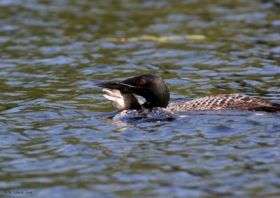
According to a long term study by the Wildlife Conservation Society, the BioDiversity Research Institute, and others, common loons with elevated levels of environmental mercury become sluggish parents, raising fewer chicks to adulthood. Credit: Nina Schoch

A long-term study by the Wildlife Conservation Society, the BioDiversity Research Institute, and other organizations has found and confirmed that environmental mercury—much of which comes from human-generated emissions—is impacting both the health and reproductive success of common loons in the Northeast.

The results of the 18-year study on loons—a species symbolic of northern lakes and wilderness—appear in the most recent edition of Ecotoxicology.

“This study demonstrates how top predators such as common loons can be used as the proverbial ‘canaries-in-the-coalmine’ for pollutants that concern humans as well,” said David C. Evers of the BioDiversity Research Institute and lead author of the study. “Our findings can be used to facilitate national and global decisions for regulating mercury emissions from coal-burning plants and other sources.”

The study uses data from nearly 5,500 samples of blood, feathers, and eggs collected from captured and released loons from some 80 lakes in Maine, New York, New Hampshire, and other states and provinces. The researchers made correlations between the behaviors of individual birds and their levels of methylmercury, the most toxic form of mercury that accumulates up the food chain.

Loons with high levels of mercury—about 16 percent of the adult population in the study area—were found to spend some 14 percent less time at the nest than normally behaving birds. Unattended nests have a higher rate of failure due to either chilling of the eggs or predation by minks, otters, raccoons and other egg robbers.

With behavioral observations from 1,529 loon territories between 1996 and 2005, researchers found that loon pairs with elevated mercury levels also produced 41 percent fewer fledged young than loons in lakes relatively free of mercury. Other behavioral impacts due to elevated mercury were sluggishness, resulting in decreased foraging for fish by the adults for both themselves and for chicks.

In addition to behavior, the concentration of mercury in loons has physiological impacts as well.

“This study confirms what we’ve long suspected—mercury from human activities such as coal-burning power plants—is having a significant negative impact on the environment and the health of its most charismatic denizens, and potentially, to humans, too,” said Nina Schoch of the Wildlife Conservation Society’s Adirondack Program. “Thus, it becomes even more urgent for the EPA to propose effective national regulations for mercury emissions from power plants that are based on sound science.”

Although many northeastern states have implemented stringent mercury emission rules, a nationwide regulation has yet to be passed. The U.S. District Court of Appeals recently struck down the EPA’s proposed Cap-and-Trade Rule for mercury emissions from coal-fired power plants, which would have led to localized “hotspots” of mercury, a highly toxic pollutant. “The ecological impacts of mercury identified in this study illustrate the need for comprehensive, national regulations to limit mercury emissions,” added Schoch.

Source: Wildlife Conservation Society

4.5 /5 (2 votes)  

Rank 4.5 /5 (2 votes)
Tags

Relevant PhysicsForums posts

More news stories

The power of estrogen -- male snakes attract other males

A new study has shown that boosting the estrogen levels of male garter snakes causes them to secrete the same pheromones that females use to attract suitors, and turned the males into just about the sexiest ...

Biology / Plants & Animals

created 19 hours ago | popularity 4.8 / 5 (6) | comments 2 | with audio podcast

Miami battling invasion of giant African snails

No one knows how they got there. But an invasion of African giant snails has southern Florida in a panic over potential crop damage, disease and general yuckiness surrounding the slimy gastropods.

Biology / Ecology

created 23 hours ago | popularity 4 / 5 (1) | comments 4

Grass to gas: Researchers' genome map speeds biofuel development

Researchers at the University of Georgia have taken a major step in the ongoing effort to find sources of cleaner, renewable energy by mapping the genomes of two originator cells of Miscanthus x giganteus, a large perenn ...

Biology / Biotechnology

created 16 hours ago | popularity 3.8 / 5 (5) | comments 0 | with audio podcast

Experts reveal how plants don't get sunburn

(PhysOrg.com) -- Experts at the University of Glasgow have discovered how plants survive the harmful rays of the sun.

Biology / Cell & Microbiology

created 19 hours ago | popularity 4.8 / 5 (5) | comments 0 | with audio podcast

Protein libraries in a snap

(PhysOrg.com) -- A Rice University undergraduate will depart with not only a degree but also a possible patent for his invention of an efficient way to create protein libraries, an important component of biomolecular ...

Biology / Cell & Microbiology

created 23 hours ago | popularity 4.8 / 5 (4) | comments 1 | with audio podcast


Anonymous knocks CIA website offline (Update)

The website of the Central Intelligence Agency was inaccessible on Friday after the hacker group Anonymous claimed to have knocked it offline.

Humans may have helped the decline of African rainforests 3000 years ago

(PhysOrg.com) -- Large areas of rainforests in Central Africa mysteriously disappeared over three thousand years ago, to be replaced by savannas. The prevailing theory has been that the cause was a change ...

New error-correcting codes guarantee the fastest possible rate of data transmission

Error-correcting codes are one of the triumphs of the digital age. They’re a way of encoding information so that it can be transmitted across a communication channel — such as an optical fiber o ...

Small modular reactor design could be a 'SUPERSTAR'

(PhysOrg.com) -- Though most of today's nuclear reactors are cooled by water, we've long known that there are alternatives; in fact, the world's first nuclear-powered electricity in 1951 came from a reactor ...

New power source discovered

(PhysOrg.com) -- Researchers at the Massachusetts Institute of Technology (MIT) and RMIT University have made a breakthrough in energy storage and power generation.

Google users warned of threat to smartphone wallets

Users of Google smartphone wallets were being warned on Friday that there is a way to crack pass codes intended to thwart thieves from going on illicit shopping sprees.