PANTHER sensor quickly detects pathogens
March 4, 2008
PANTHER sensor quickly detects pathogens

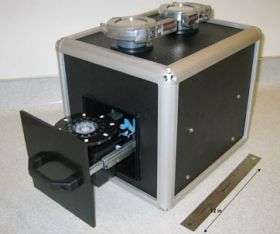
This prototype of the PANTHER device is about one cubic foot and weighs 37 pounds. Photo courtesy / MIT Lincoln Laboratory

Researchers at MIT Lincoln Laboratory have developed a powerful sensor that can detect airborne pathogens such as anthrax and smallpox in less than three minutes.

The new device, called PANTHER (for PAthogen Notification for THreatening Environmental Releases), represents a "significant advance" over any other sensor, said James Harper of Lincoln Lab's Biosensor and Molecular Technologies Group. Current sensors take at least 20 minutes to detect harmful bacteria or viruses in the air, but the PANTHER sensors can do detection and identification in less than 3 minutes.

The technology has been licensed to Innovative Biosensors, Inc. (IBI) of Rockville, Md. In January, IBI began selling a product, BioFlash, that uses the PANTHER technology.

"There is a real need to detect a pathogen in less than three minutes, so you have time to take action before it is too late," said Harper, the lead scientist developing the sensor.

The PANTHER sensor uses a cell-based sensor technology known as CANARY (after the birds sent into mines to detect dangerous gases), and can pick up a positive reading with only a few dozen particles per liter of air.

The device could be used in buildings, subways and other public areas, and can currently detect 24 pathogens, including anthrax, plague, smallpox, tularemia and E. coli.

"There's really nothing out there that compares with this," said Todd Rider of Lincoln Lab's Biosensor and Molecular Technologies Group, who invented the CANARY sensor technology.

Rider started developing CANARY in 1997 when he realized that there were no sensors available that could rapidly detect pathogens. His idea was to take advantage of nature's own defense system--specifically the B cells that target pathogens in the human body. "B cells in the body are very fast and very sensitive," Rider said.

The CANARY concept uses an array of B cells, each specific to a particular bacterium or virus. The cells are engineered to emit photons of light when they detect their target pathogen. The device then displays a list of any pathogens found.

CANARY is the only sensor that makes use of immune cells. Other available sensors are based on immunoassays or PCR (polymerase chain reaction), which take much longer and/or are not as sensitive as CANARY.

Rider and colleagues first reported the success of CANARY (which stands for Cellular Analysis and Notification of Antigen Risks and Yields) in the journal Science in 2003. Since then, they have been working to incorporate the technology into a portable device that could be used in a variety of settings where environmental threats might exist.

The new device, PANTHER, takes the CANARY technology and combines it with an air sampler that brings pathogens into contact with the detector cells. The prototype sensor is about a cubic foot and weighs 37 pounds and is well suited to building-protection applications. With minor modifications it could also enhance biological detection capabilities for emergency responders.

CANARY has been tested in rural and coastal environments as well as urban ones. It could eventually be used on farms or in food-processing plants to test for contamination by E. coli, salmonella, or other food-borne pathogens.

Another potential application is in medical diagnostics, where the technology could be used to test patient samples, giving rapid results without having to send samples to a laboratory.

"Instead of going to the doctor's office and waiting a few days for your test results, with CANARY you could get the results in just a minute or so," said Rider.

Source: MIT

Filter


Move the slider to adjust rank threshold, so that you can hide some of the comments.


Display comments: newest first

superhuman
Mar 05, 2008

Rank: not rated yet
It is based on alive B cells? How are they kept alive then? Do you have to provide them with fresh medium etc on a daily basis as with normal cell culture?
Rank 5 /5 (1 vote)
Tags

Relevant PhysicsForums posts
  • How to tilt a object
    created12 hours ago
  • How to calculate total compressibility in liquid porous solid system
    created17 hours ago
  • Need help reading 3-D
    createdFeb 11, 2012
  • A way to send and receive wireless data
    createdFeb 11, 2012
  • Calling function with no input argument
    createdFeb 10, 2012
  • Force free body diagram problem on gym equipment
    createdFeb 10, 2012
  • More from Physics Forums - General Engineering

More news stories

Building a 'blind-friendly' Internet

Rakesh Babu demonstrates how a blind person uses the Internet.

Technology / Internet

created 35 minutes ago | popularity not rated yet | comments 0

Ethanol mandate not the best option

Many people are willing to pay a premium for ethanol, but not enough to justify the government mandate for the corn-based fuel, a Michigan State University economist argues.

Technology / Energy & Green Tech

created 21 minutes ago | popularity not rated yet | comments 0

Darpa to develop mobile millimeter-wave backhaul networks

Providing high-bandwidth communications for troops in remote forward operating locations is not only critical but also challenging because a reliable infrastructure optimized for remote geographic areas does ...

Technology / Telecom

created 13 minutes ago | popularity not rated yet | comments 0

Thomas Edison inspires the oscar awards you don't see

Thomas Edison's invention of the first motion picture camera in 1891 inspired scientific and technological advances that he never could have imagined.

Technology / Hi Tech & Innovation

created 1 hour ago | popularity 5 / 5 (1) | comments 0

Microsoft India retail site down after 'cyber attack'

Microsoft said Monday it was investigating an attack by hackers on its Indian retail website, reportedly carried out by a Chinese group called the "Evil Shadow Team."

Technology / Internet

created 2 hours ago | popularity not rated yet | comments 0


Manipulating genes with hidden TALENs

(PhysOrg.com) -- A better understanding of gene function in model plant and animal systems could be used to develop useful traits in livestock and crop plants, and might someday lead to developments in stem ...

Alien matter in the solar system: A galactic mismatch

This just in: The Solar System is different from the space just outside it.

Transforming galaxies

(PhysOrg.com) -- Many of the Universe's galaxies are like our own, displaying beautiful spiral arms wrapping around a bright nucleus. Examples in this stunning image, taken with the Wide Field Camera 3 on ...

'Smart' microcapsules in a single step

(PhysOrg.com) -- A new, single-step method of fabricating microcapsules, which have potential commercial applications in industries including medicine, agriculture and diagnostics, has been developed by researchers ...

Tenofovir, leading HIV medication, linked with risk of kidney damage

(Medical Xpress) -- Tenofovir, one of the most effective and commonly prescribed antiretroviral medications for HIV/AIDS, is associated with a significant risk of kidney damage and chronic kidney disease that increases over ...

A continent ablaze in auroral and manmade light

The North American continent is literally set ablaze in a confluence of Auroral and Manmade light captured in spectacular new videos snapped by the astronauts serving aboard the International Space Station ...