Archeologists Find Ancient Cemetery in Egypt
The El Hibeh tell — a mound of ancient human architecture, artifacts and debris — is so rich with the remnants of human life in central Egypt that shards of pottery literally crunch under a visitor’s feet. Beads, jug handles, and even bits of fabric are visible to the naked eye, making collection and cataloging both an exciting and daunting task.
Carol Redmount, a professor of Egyptian archeology and chair of Near Eastern Studies at UC Berkeley, has led a research team to El Hibeh every year since 2001. The team varies from year to year but generally includes Hearst Museum Registrar Joan Knudsen, archeologists, Egyptologists, osteologists (bone specialists), ceramologists, Egyptian inspectors, and other experts. They head over there in the summer — when school is out, but also when the weather is punishingly hot.
Last year they made a special fall expedition. Funding for the expensive trip was covered by GRB Entertainment for the Discovery Channel. In February the excavation on the banks of the Nile was featured in an episode of The Bone Detectives, a series that runs until April, visiting archeological digs from Central America to the outer edge of the Arctic Circle.
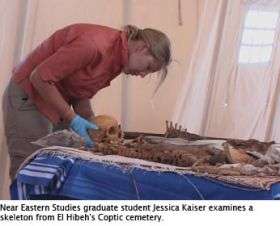
The episode “Violence Along the Nile” focused on a mummy Redmount and her team found in an ancient cemetery at El Hibeh. While the site as a whole appears to have been inhabited from eleventh century BCE up to about the 6th century CE, the mummy that stars in the program is relatively young — probably from the Coptic period of the 5th to 6th centuries CE. True to the Christian tradition of that era, this mummy was not encased in cartonnage (like paper mache) or placed within a coffin, nor was it buried with the “grave goods” we associate with Egyptian graves — beads, jewelry, gold. But it did come out of a cemetery the team had just discovered.
“We knew there were bodies there, but we hadn’t actually done any systematic excavation in that specific area before,” recalls Redmount on a sunny day outside the Free Speech Movement Café. “The camera crew showed up after we’d been working only two days. They had a tight timetable and wanted to limit filming to three days. People bent over backwards.”
The mummy, it turned out, had died from a blow to the head. He was dressed in embroidered tunic. These details helped fuel a minor tug of war between the program’s producers and the scholars. Where researchers tend to be very cautious, the Discovery Channel crew is intent on entertaining its audience — with education as a happy by-product. At one point the program’s host was filmed smashing a clay pot (not an ancient relic) with a mallet, in an effort to dramatically re-enact the fatal blow to the mummy’s head.
“They want details that are attention-grabbing, but they also want to be reasonably accurate. They do stress that,” Redmount says. “We had some interesting discussions and some of their suggestions just wouldn’t go.”
One had to do with naming the mummy. As part of developing a loose storyline for the episode, the producers had named the mummy Hasani, an Arabic name.
“It was a complete anachronism, and the local Coptic community would probably not have taken kindly to it,” Redmount recalls, laughing. The crew had already shot some film with Hasani as the name, but the Egyptian government inspector, the official Egyptian Antiquities Organization representative and a member of the dig team, had a creative solution. She suggested they use the Coptic name Arsani for the remainder of the program. With a bit of sound editing they could salvage the footage they’d shot while producing a historically accurate product.
Redmount is enthusiastic about the TV coverage. “The project gets wonderful publicity,” she says. “It’s good and has broad benefit for the project and for the field as a whole.”
The El Hibeh project is still in the early stages, she adds. The area was never wealthy, and even to this day it’s an economic backwater. But the abundance of material showing how middle-class people lived — and died — makes the site a place where Redmount expects to spend many more warm summer months.
“We’re still just finding out quite a lot about the site,” she says. “It was at its heyday during an underexplored time period scholars call the ‘Third Intermediate Period’ — immediately after the glory days of the New Kingdom when Egypt controlled the largest empire in the eastern Mediterranean. And it continued to be occupied for the rest of the first millennium BCE and beyond. Egypt is regarded as in decline at this point, but there was a lot of cultural mixing going on and it’s a fascinating time.”
There are graduate student researchers on every annual team. They get basic field training, supervisory experience, and overall experience helping with all aspect of the dig — from registration to actually moving dirt. Students can explore specialties too, including osteology, lithics, and others.
“This site will provide years of training for future generations of archeologists,” says Redmount. “I fully expect to spend the rest of my academic career working on it.”
Source: By Kate Rix, University of California Berkeley


