Sky's the limit for bee brain power
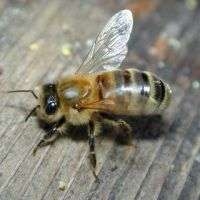
Families flocked to see the latest animated hit Bee Movie, but scientists from UQ's Queensland Brain Institute (QBI) have long embraced the bee for very different reasons.
Bees have a brain the size of a sesame seed but they are proving to be a model species to study for their smart ‘minds', their amazing capacity to learn and remember things and for their astute sense of smell and vision.
“Bees are the Rolls Royce of the insect world due to their amazing brain,” Dr Charles Claudianos from QBI's Visual and Sensory Neuroscience Group said.
The group is studying how the bee's brain works and how bees behave, fly, navigate, see and smell.
They have discovered that bees use only a handful of key compounds to discern between floral scents, which, like a perfume, can contain more than 100 different odorants.
QBI Senior Research Fellow Dr Judith Reinhard said bees' ‘noses' were their antennae which carried countless odour receptors to detect even the smallest scent molecule in the air.
Dr Reinhard said a bees' sense of smell was so precise that it could distinguish between hundreds of different aromas and also tell whether a flower carried pollen or nectar, by sniffing its scent from metres away.
The UQ team is working with the CSIRO to uncover how insects, such as the honeybee, learn and process scents to develop more sensitive electronic noses.
Electronic noses have been used for many years in industries such as wine, fragrances, food and beverages, pest control and animal production.
Scientists from the 17-strong UQ group led by Professor Mandyam Srinivasan, have proved that bees and humans share up to 30 percent of the same genes, including many genes involved in brain function.
QBI Senior Research Fellow Dr Claudianos has found the same molecules that cause autism in humans are also involved with memory formation in bees.
Dr Claudianos said the bee brain was quite sophisticated for its size, but that it needed constant sensory input and stimulation to develop properly – similar to the human brain.
The research group is continuing to test and apply bee technology to unmanned aerial vehicles (UAVs), which, like bees, can navigate and control their speed based on the how quickly the vehicle passes objects on the fly.
There are many species of bees in the world, but the UQ group is studying the common honey bee from Europe.
They keep several bee hives at UQ St Lucia for their research, with between 10,000 and 20,000 bees in each.
Did you know?
• Bees have lived on our planet for about 25 million years
• Bee brains are oval, about 20 times bigger than the brain of a fruit fly
• Most bees live for six weeks, but the queen can live for years
• Worker bees are females and do all the work for the hive
• Male bees are called drones and are merely “flying sperm”. They attract the queen to their bachelor
hangouts where she mates and then returns to the hive to lay her eggs
• Bees have their own language which uses a vocabulary of different dances
• Bees usually die after stinging a mammal, but not after stinging other insects
• Bees' legs have knees, ankles and feet
• Bees try and fly at a constant speed of about 7-8 kmh, even against headwinds
• Bees can fly in light rain, but have problems in heavy rain
• Bees must visit thousands of flowers to produce just a kilogram of honey
Source: University of Queensland


