Mars and Venus are surprisingly similar
March 5th, 2008 Mars and Venus are surprisingly similar

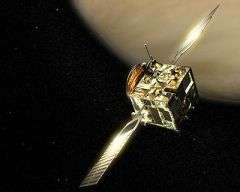
Venus Express is studying largely unknown phenomena in the Venusian atmosphere like never before. Its suite of instruments is also digging into the interaction between the solar wind and the planetary environment. In addition, the mission is gathering glimpses of the planet's surface, which is strictly coupled with its dense atmosphere. Credits: ESA (Image by AOES Medialab)

Using two ESA spacecraft, planetary scientists are watching the atmospheres of Mars and Venus being stripped away into space. The simultaneous observations by Mars Express and Venus Express give scientists the data they need to investigate the evolution of the two planets’ atmospheres.

Scientists call this work comparative planetology. Mars Express and Venus Express are so good at it because they carry very similar science instruments. In the case of the Analyser of Space Plasmas and Energetic Atoms (ASPERA), they are virtually identical. This allows scientists to make direct comparisons between the two planets.

The new results probe directly into the magnetic regions behind the planets, which are the predominant channels through which electrically-charged particles escape. They also present the first detection of whole atoms escaping from the atmosphere of Venus, and show that the rate of escape rose by ten times on Mars when a solar storm struck in December 2006.

By observing the current rates of loss of the two atmospheres, planetary scientists hope that they will be able to turn back the clock and understand what they were like in the past. “These results give us the potential to measure the evolution of planetary climates,” says David Brain, Supporting Investigator for plasma physics for Venus Express and Co-Investigator for ASPERA on Mars and Venus Express at the University of California, Berkeley.

The new observations show that, despite the differences in size and distance from the Sun, Mars and Venus are surprisingly similar. Both planets have beams of electrically charged particles flowing out of their atmospheres. The particles are being accelerated away by interactions with the solar wind, a constant stream of electrically charged particles released by the Sun.

At Earth, the solar wind does not directly interact with the atmosphere. It is diverted by Earth’s natural cloak of magnetism. Neither Mars nor Venus have appreciable magnetic fields generated inside the planet, so each planet’s atmosphere suffers the full impact of the solar wind.

Interestingly, this full-on interaction does create a weak magnetic field that drapes itself around each planet and stretches out behind the night-side in a long tail. Venus’s atmosphere is thick and dense, whereas that of Mars is light and tenuous. Despite the differences, the magnetometer instruments have discovered that the structure of the magnetic fields of both planets are alike.

“This is because the density of the ionosphere at 250 km altitude is surprisingly similar,” says Tielong Zhang, Principal Investigator for the Venus Express magnetometer instrument at Institut für Weltraumforschung (IWF), Österreiche Akademie der Wissenschaften, Austria. The ionosphere is the surrounding shell of electrically-charged particles created by the impact of sunlight on the planet’s upper atmosphere.

The proximity of Venus to the Sun does create an important difference, however. The solar wind thins out as it moves through space so the closer to the Sun it is encountered, the more concentrated is its force. This creates a stronger magnetic field, making the escaping atmospheric particles move collectively like a fluid.

At Mars, the weaker field means that the escaping particles act as individuals. “This is a fundamental difference between the two planets,” says Stas Barabash, ASPERA Principal Investigator on both Mars Express and Venus Express, Swedish Institute of Space Physics.

Another illuminating difference between Mars and Venus is that Mars displays strong small-scale magnetic fields locked into the crust of the planet. In some regions, these pockets protect the atmosphere, in others they actually help funnel the atmosphere into space.

The complexity of the different processes revealed at Venus and Mars means that planetary scientists do not yet have the full picture. “There will be many more results to come,” says Barabash.

There is a lot to do because there are many different mechanisms that may cause the atmospheric particles to escape. Untangling it all will take time. “The longer the spacecraft work together, the longer we can watch and see what really happens,” says Brain.

Source: European Space Agency


print this article email this article download pdf blog this article bookmark this article     Digg this Stumble it share on Facebook share on Reddit add to delicious save to Yahoo! bookmarks
4.2/5 after 26 votes


March 5th, 2008 all stories
Space & Earth / Space Exploration

Comments: 0
Rank: 4.2/5 after 26 votes

  • Stumble this up

  • Digg this

  • Share it:
  • share on Facebook
  • share on MySpace
  • share on Slashdot
  • rss-newsfeed
  • share on Google
  • share on Reddit
  • add to delicious
  • save to Yahoo! bookmarks
  • share on Windows Live
  • Add to Mixx!
Rating: 4.2/5 after 26 votes

  • Related Stories

  • Watching Venus glow in the dark
    created Feb 24, 2009 | popularity not rated yet | comments 0
  • ESA extends key missions studying Mars, Venus and Earth’s magnetosphere
    created Feb 10, 2009 | popularity not rated yet | comments 0
  • When texting, eligible women express themselves better
    created Feb 10, 2009 | popularity not rated yet | comments 0
  • Europe all set for lunar mission Chandrayaan-1
    created Sep 25, 2008 | popularity not rated yet | comments 0
  • Key molecule discovered in Venus's atmosphere
    created May 15, 2008 | popularity not rated yet | comments 0

Tags


  • Physicists Demonstrate Quantum Memory with Matter Qubits
    Physicists Demonstrate Quantum Memory with Matter Qubits
    Physics / General Physics
    created Jul 03, 2009 | popularity 4.4 / 5 (17) | comments 1
  • 'Holey' Nanosheets for Wastewater Dye Removal
    Nanotechnology / Nanomaterials
    created Jul 01, 2009 | popularity 5 / 5 (5) | comments 1
  • Jellyfish Robot Swims Like its Biological Counterpart
    Jellyfish Robot Swims Like its Biological Counterpart
    Electronics / Robotics
    created Jun 26, 2009 | popularity 4.4 / 5 (8) | comments 1
  • Could Maxwell's Demon Exist in Nanoscale Systems?
    Could Maxwell's Demon Exist in Nanoscale Systems?
    Physics / General Physics
    created Jun 24, 2009 | popularity 4.4 / 5 (18) | comments 29
  • Living Safely with Robots, Beyond Asimov's Laws
    Living Safely with Robots, Beyond Asimov's Laws
    Electronics / Robotics
    created Jun 22, 2009 | popularity 4.6 / 5 (53) | comments 40
  • Other News

    China environmental phenomena monitored from space

    Space & Earth / Earth Sciences

    created 52 minutes ago | popularity not rated yet | comments 0

    China is in a very seismically active area and has had many catastrophic earthquakes during its history. A joint European-Chinese team is using satellite radar data to monitor ground deformation across major continental faults ...


    California to require sun-blocking car windows

    Space & Earth / Environment

    created 2 hours ago | popularity 2.3 / 5 (3) | comments 4

    New cars sold in California must include windshields that block or absorb the sun's rays beginning in 2012, the state's Air Resources Board recently ruled.


    Scientists: Silent tremors may foretell next Big One

    Space & Earth / Earth Sciences

    created 2 hours ago | popularity not rated yet | comments 0

    The seismometer is snugged in its hole and tamped over with dirt. Now it's time for the stomp test.


    Steam billows from the cooling towers at a nuclear power generating station in Byron

    Tropical zone expanding due to climate change: study

    Space & Earth / Earth Sciences

    created 4 hours ago | popularity 3 / 5 (4) | comments 1

    Climate change is rapidly expanding the size of the world's tropical zone, threatening to bring disease and drought to heavily populated areas, an Australian study has found.


    The least sea ice in 800 years

    The least sea ice in 800 years

    Space & Earth / Earth Sciences

    created Jul 01, 2009 | popularity 4.1 / 5 (65) | comments 60

    New research, which reconstructs the extent of ice in the sea between Greenland and Svalbard from the 13th century to the present indicates that there has never been so little sea ice as there is now. The ...