Good Vibrations Probe Innards of Molecular Electronic Junctions
March 5th, 2008 Good Vibrations Probe Innards of Molecular Electronic Junctions

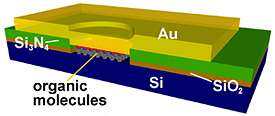
NIST researchers determined that the organic molecules in the middle of this simple silicon-based molecular “sandwich” pass electric current through these junctions by carefully measuring the minute changes in molecular vibrations. Credit: NIST

Using an unusual spectroscopic technique, researchers at the National Institute of Standards and Technology have provided the most convincing evidence yet that current is flowing through a simple silicon-based molecular “sandwich,” which is the most basic structure of molecular electronics. The work is an important step toward realizing the dream of organic molecule-based electronics that could enable much denser, cheaper computer memories and other replacements of traditional electronic devices.

“The ultimate in miniaturization is the molecule,” explains NIST’s Curt Richter. “The hope is that a single molecule will one day be able to act as an electrical component such as a diode or a resistor with the ultimate goal being shrinking computer chips.”

For the past few years, scientists have been building and testing structures made of a hybrid of traditional silicon-based components and more futuristic molecule-based components. The typical junction is a sandwich of a metallic contact layer, a layer of organic compound just a single molecule thick arranged like bristles on a brush, and a substrate of silicon. Richter says that while the electric current seems to pass through the molecules, the current could be finding a way around it or the molecules could have been damaged in fabrication. Scientists want to know what is really happening inside this “black box.”

NIST researchers tried a little-used technique called inelastic electron tunneling spectroscopy (IETS) that measures the vibrations of the molecules inside the junction. “Each molecule has its own vibrational fingerprint,” says Wenyong Wang, adding “IETS acts as our eyes to see what is inside the black box.” An earlier paper by Wang and his colleagues at Yale University set IETS as a standard technique to prove that molecules remain intact in metal-based molecular electronic devices.

Colleagues at Purdue University provided three types of silicon-molecule-metal junctions that are a few micrometers large. The small molecules researchers used were octadecane, nitrobenzene and diethylaminobenzene.

Each silicon-molecule-metal device was cooled to cryogenic temperatures. Wang carefully measured the minute changes in the current passing through the junctions, and these current changes were then related to specific molecular vibrations. Thus, the researchers verified the existence of the molecules and that the electric current passed through them.

NIST physicists plan to continue research into silicon-molecule-metal junctions. “Once we understand the physics of the devices, we can begin to assess how viable the technology is and also determine which molecules may supply the best chance for a technological breakthrough,” says Richter.

Citation: W. Wang, A. Scott, N. Gergel-Hackett, C.A. Hacker, D.B. Janes and C.A. Richter. Probing molecules in integrated silicon-molecule-metal junctions by inelastic tunneling spectroscopy. ACS Nano Letters, 8, 478 (2008).

Source: NIST


print this article email this article download pdf blog this article bookmark this article     Digg this Stumble it share on Facebook share on Reddit add to delicious save to Yahoo! bookmarks
4.5/5 after 18 votes


March 5th, 2008 all stories
Nanotechnology / Nanophysics

Comments: 0
Rank: 4.5/5 after 18 votes

  • Stumble this up

  • Digg this

  • Share it:
  • share on Facebook
  • share on MySpace
  • share on Slashdot
  • rss-newsfeed
  • share on Google
  • share on Reddit
  • add to delicious
  • save to Yahoo! bookmarks
  • share on Windows Live
  • Add to Mixx!
Rating: 4.5/5 after 18 votes

  • Related Stories

  • MicroRNAs hold promise for treating diseases in blood vessels
    created 20 hours ago | popularity not rated yet | comments 0
  • A scientist probes the origins of 'ouch!'
    created Jul 02, 2009 | popularity not rated yet | comments 0
  • Nanotubes weigh the atom
    created Jun 29, 2009 | popularity not rated yet | comments 0
  • Site for alcohol's action in the brain discovered
    created Jun 28, 2009 | popularity not rated yet | comments 0
  • New trigger for chronic inflammation in rheumatoid arthritis discovered
    created Jun 28, 2009 | popularity not rated yet | comments 0

Tags


  • Physicists Demonstrate Quantum Memory with Matter Qubits
    Physicists Demonstrate Quantum Memory with Matter Qubits
    Physics / General Physics
    created Jul 03, 2009 | popularity 4.4 / 5 (17) | comments 1
  • 'Holey' Nanosheets for Wastewater Dye Removal
    Nanotechnology / Nanomaterials
    created Jul 01, 2009 | popularity 5 / 5 (5) | comments 1
  • Jellyfish Robot Swims Like its Biological Counterpart
    Jellyfish Robot Swims Like its Biological Counterpart
    Electronics / Robotics
    created Jun 26, 2009 | popularity 4.4 / 5 (8) | comments 1
  • Could Maxwell's Demon Exist in Nanoscale Systems?
    Could Maxwell's Demon Exist in Nanoscale Systems?
    Physics / General Physics
    created Jun 24, 2009 | popularity 4.4 / 5 (18) | comments 29
  • Living Safely with Robots, Beyond Asimov's Laws
    Living Safely with Robots, Beyond Asimov's Laws
    Electronics / Robotics
    created Jun 22, 2009 | popularity 4.6 / 5 (53) | comments 40
  • Other News

    A 'quantum of sol' -- how nanotechnology could hold the key to a solar-powered future

    A 'quantum of sol' -- how nanotechnology could hold the key to a solar-powered future

    Nanotechnology / Nanomaterials

    created Jun 30, 2009 | popularity 3.9 / 5 (16) | comments 17

    (PhysOrg.com) -- A new generation of 'nano-structured' millimetre-sized solar cells that could convert the sun's energy to electricity more than twice as efficiently as current technology, is the subject of ...


    Australian researchers are set to begin human trials of a tiny nano-cell that acts as a "Trojan horse" against cancer

    Hi-tech 'Trojan horse' can kill cancer cells: researchers

    Nanotechnology / Bio & Medicine

    created Jun 29, 2009 | popularity 4.7 / 5 (12) | comments 7

    Australian researchers are set to begin human trials of a tiny nano-cell that acts as a "Trojan horse" against cancer cells, a breakthrough they say may curb the need for debilitating chemotherapy.


    'Holey' Nanosheets for Wastewater Dye Removal

    Nanotechnology / Nanomaterials

    created Jul 01, 2009 | popularity 5 / 5 (5) | comments 1

    (PhysOrg.com) -- Researchers have discovered that extremely thin sheets of nickel oxide with hexagonally shaped holes can absorb hazardous dyes from wastewater nearly as well as the best traditional methods, but are recyclable. ...


    Harnessing Nanoparticles To Track Cancer Cell Changes

    Nanotechnology / Bio & Medicine

    created Jul 03, 2009 | popularity not rated yet | comments 1

    The more dots there are, the more accurate a picture you get when you connect them. Cancer researchers adopting that philosophy have developed a new imaging technology that could give scientists the ability to simultaneously ...


    Computer-Guided Nanoparticle Therapy Destroys Tumors

    Nanotechnology / Bio & Medicine

    created Jun 29, 2009 | popularity 4.9 / 5 (12) | comments 0

    Gold nanoshells are among the most promising new nanoscale therapeutics being developed to kill tumors, acting as antennas that turn light energy into heat that cooks cancer to death. Now, a multi-institutional research team ...