Camera Spots Wolverine in Sierra Nevada
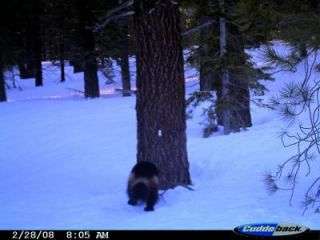
U.S. Forest Service scientists believe an Oregon State University graduate student working on a cooperative project with the agency’s Pacific Southwest Research station on the Tahoe National Forest has photographed a wolverine, an animal whose presence has not been confirmed in California since the 1920s.
Katie Moriarty, a wildlife biology student, was conducting research on another carnivore called the American marten when a remote-controlled camera she set photographed the animal on February 28, 2008. Forest Service scientists who are experts at detecting rare carnivores believe the photographed animal is a wolverine.
The North American wolverine is the largest member of the weasel family. Adult males weigh 26 to 40 pounds, while females are 17 to 26 pounds. It resembles a small bear, with a bushy tail and broad head. Its diet includes carrion, small animals, birds, insects and berries.
U.S. populations are found largely in the Northern Cascades in Washington, and Northern Rockies in Montana and Idaho. The nearest known resident population is about 900 miles north of the Tahoe National Forest in Northern Washington.
Attempts have been made for decades to photograph wolverines in California, according to Bill Zielinski, a Forest Service scientist with the Pacific Southwest Research Station and an expert at detecting wolverines, marten and fisher. He said periodic sightings have occurred, but never scientifically confirmed using detection methods that produce verifiable evidence.
Scientists will now conduct further detection analysis on the Tahoe National Forest using remote-controlled cameras and barbed wire snares that snag hair. They may also use dogs trained to find wolverine scat. Scientists have found dogs to be three and a half times more successful at detecting rare carnivores than remote-controlled cameras in forested areas like the Sierra Nevada Mountains.
Zielinski said hair and scat samples would contain DNA that can be analyzed to determine where the animal originated.
“We have good genetic templates from populations that have been studied elsewhere that can be used to understand the origin of this animal,” he said. “But, first we need a DNA sample.”
Wolverines have large home ranges that vary greatly depending upon gender, age and food availability. In order to avoid interference with ongoing studies, Forest Service officials are not releasing the exact location where the wolverine was photographed.
The agency’s regional forester for California has listed the wolverine as a sensitive species, and the 2004 Sierra Nevada Forest Plan Amendment directs the Forest Service to conduct an analysis to determine if activities within 5 miles of where a wolverine was detected will affect the species.
“This is an exciting research discovery, both for its scientific value, and as a demonstration of our success in forest management.” said Tahoe National Forest Supervisor Tom Quinn. “For now, we on the Tahoe National Forest have more questions than answers. We have initiated discussions with researchers about where this sighting occurred and how this could affect management of the National Forest. We are also consulting with wolverine experts and forest managers where wolverine populations occur, and gathering current literature and studies. As we learn more, we will assess which projects and activities, if any, might be affected.”
Source: US Forest Service


