NIST 'Quantum Logic Clock' Rivals Mercury Ion as World's Most Accurate Clock
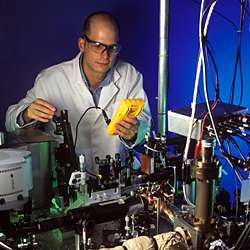
An atomic clock that uses an aluminum atom to apply the logic of computers to the peculiarities of the quantum world now rivals the world's most accurate clock, based on a single mercury atom. Both clocks are at least 10 times more accurate than the current U.S. time standard.
The measurements were made in a yearlong comparison of the two next-generation clocks, both designed and built at the Commerce Department's National Institute of Standards and Technology (NIST). The clocks were compared with record precision, allowing scientists to measure the relative frequencies of the two clocks to 17 digits—the most accurate measurement of this type ever made. The comparison produced the most precise results yet in the worldwide quest to determine whether some of the fundamental constants that describe the universe are changing slightly over time, a hot research question that may alter basic models of the cosmos.
The research is described in the March 6 issue of Science Express. The aluminum and mercury clocks are both based on natural vibrations in ions (electrically charged atoms) and would neither gain nor lose one second in over 1 billion years—if they could run for such a long time—compared to about 80 million years for NIST-F1, the U.S. time standard based on neutral cesium atoms.
The mercury clock was first demonstrated in 2000 and is now four times better than its last published evaluation in 2006, thanks to ongoing improvements in the clock design and operation. The mercury clock continues its reign as the world’s most accurate for now, by a margin of 20 percent over the aluminum clock, but the designers say both experimental clocks could be improved further.
“The aluminum clock is very accurate because it is insensitive to background magnetic and electric fields, and also to temperature,” says Till Rosenband, the NIST physicist who built the clock and is the first author of the new paper. “It has the lowest known sensitivity of any atomic clock to temperature, which is one of the most difficult uncertainties to calibrate.”
Both the aluminum clock and the mercury clock are based on ions vibrating at optical frequencies, which are 100,000 times higher than microwave frequencies used in NIST-F1 and other similar time standards around the world. Because optical clocks divide time into smaller units, they can be far more precise than microwave standards. NIST scientists have several other optical atomic clocks in development, including one based on thousands of neutral strontium atoms. The strontium clock recently achieved twice the accuracy of NIST-F1, but still trails the mercury and aluminum clocks.
Highly accurate clocks are used to synchronize telecommunications networks and deep-space communications, and for satellite navigation and positioning. Next-generation clocks may also lead to new types of gravity sensors, which have potential applications in exploration for underground natural resources and fundamental studies of the Earth.
Laboratories around the world are developing optical clocks based on a variety of different designs and atoms; it is not yet clear which design will emerge as the best candidate for the next international standard.
The new paper provides the first published evaluation of the operational quantum logic clock, so-named because it is based on the logical reasoning process used in quantum computers (see sidebar below for details). The clock is a spin-off of NIST research on quantum computers, which grew out of earlier atomic clock research. Quantum computers, if they can be built, will be capable of solving certain types of complex problems that are impossible or prohibitively costly or time consuming to solve with today’s technologies.
The NIST quantum logic clock uses two different kinds of ions, aluminum and beryllium, confined closely together in an electromagnetic trap and slowed by lasers to nearly “absolute zero” temperatures. Aluminum is a stable source of clock ticks, but its properties cannot be detected easily with lasers. The NIST scientists applied quantum computing methods to share information from the aluminum ion with the beryllium ion, a workhorse of their quantum computing research. The scientists can detect the aluminum clock’s ticks by observing light signals from the beryllium ion.
NIST’s tandem ion approach is unique among the world’s atomic clocks and has a key advantage: “You can pick from a bigger selection of atoms,” explains NIST physicist Jim Bergquist, who built the mercury clock. “And aluminum has a lot of good qualities—better than mercury’s.”
An optical clock can be evaluated precisely only by comparison to another clock of similar accuracy serving as a “ruler.” NIST scientists used the quantum logic clock to measure the mercury clock, and vice versa. In addition, based on fluctuations in the frequencies of the two clocks relative to each other over time, NIST scientists were able to search for a possible change over time in a fundamental quantity called the fine-structure constant. This quantity measures the strength of electromagnetic interactions in many areas of physics, from studies of atoms and molecules to astronomy. Some evidence from astronomy has suggested the fine-structure constant may be changing very slowly over billions of years. If such changes are real, scientists would have to dramatically change their theories of the fundamental nature of the universe.
The NIST measurements indicate that the value of the fine-structure constant is not changing by more than 1.6 quadrillionths of 1 percent per year, with an uncertainty of 2.3 quadrillionths of 1 percent per year (a quadrillionth is a millionth of a billionth). The result is small enough to be “consistent with no change,” according to the paper. However, it is still possible that the fine-structure constant is changing at a rate smaller than anyone can yet detect. The new NIST limit is approximately 10 times smaller than the best previous measurement of the possible present-day rate of change in the fine-structure constant. The mercury clock is an especially useful tool for such tests because its frequency fluctuations are magnified by any changes in this constant.
Where the ‘Quantum Logic Clock’ Gets Its Name
The NIST quantum logic clock is so named because it borrows techniques that are key to quantum computers, which would solve problems using quantum mechanics, nature’s instruction book for the smallest particles of matter and light. Logic is reasoning that determines an action or result based on which one of different possible options is received as input. In the NIST clock, the input options are two different quantum states, or internal energy levels, of an aluminum ion. Information about this state is transferred to a beryllium ion, which, depending on the input, produces different signals that are easily detected.
NIST scientists use lasers to cool the two ions which are held 4 thousandths of a millimeter apart in an electromagnetic trap. Aluminum is the larger of the two ions, while the beryllium emits light under the conditions of this experiment. Scientists hit the ions with pulses from a “clock laser” within a narrow frequency range. If the laser frequency is at the center of the frequency range, the precise “resonance frequency” of aluminum, this ion jumps to a higher energy level, or 1 in the binary language of computers. Otherwise, the ion remains in the lower energy state, or 0.
If there is no change in the aluminum ion, then another laser pulse causes both ions to begin rocking side to side in unison because of their physical proximity and the interaction of their electrical charges. An additional laser pulse converts this motion into a change in the internal energy level of the beryllium ion. This pulse reverses the direction of the ion’s magnetic “spin,” and the beryllium goes dark, a signal that the aluminum remained in the 0 state.
On the other hand, if the aluminum ion jumps to the higher energy level, then the additional laser pulses fail to stimulate a shared rocking motion and have no effect on the beryllium ion, which keeps emitting light. Scientists detect this light as a signal that the aluminum ion jumped from 0 to 1.
The goal is to tune the clock laser to the exact frequency that prompts the aluminum to jump from 0 to 1. The actual measurement of the ticking of the clock is provided not by the ions but rather by the clock laser’s precisely tuned center frequency, which is measured with a “frequency comb,” a tool for measuring very high optical frequencies, or colors of light.
Citation: T. Rosenband, D.B. Hume, P.O. Schmidt, C.W. Chou, A. Brusch, L. Lorini, W.H. Oskay, R.E. Drullinger, T.M. Fortier, J.E. Stalnaker, S.A. Diddams, W.C. Swann, N.R. Newbury, W.M. Itano, D.J. Wineland, and J.C. Bergquist. 2008. Frequency ratio of Al+ and Hg+ single-ion optical clocks; metrology at the 17th decimal place. Science Express. Published online March 6.
Source: NIST


