Researchers control growth rate of replacement blood vessels, tissues
Researchers have discovered a way to control the growth rate of replacement tissue and the formation of new blood vessels, which solves one of the vexing problems of growing replacement tissue to treat injuries and trauma in humans.
The procedure could be used in bone grafts, tissue replacement, dental procedures or for diabetics or elderly patients who experience wound healing problems, said William Giannobile, professor at the University of Michigan School of Dentistry and College of Engineering, and corresponding author of the paper. Peter Ma, U-M professor with appointments in engineering and dentistry, is co-author and principal investigator on the National Institutes of Health project.
"If you have such a large defect that your body can't completely heal, this is a way to augment and dose a natural wound healing protein," Giannobile said.
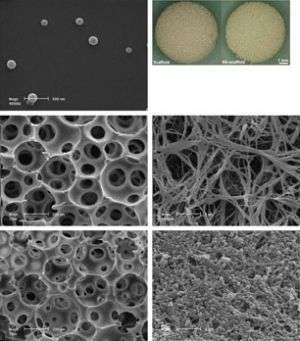
Researchers put platelet-derived growth factor into nanoparticles and then attached them to a lattice-like, biodegradable scaffold. In experiments, the growth factor recruited cells that stimulate the body's own machinery responsible for healing, said Ma, whose lab developed the scaffold and the nanoparticles.
As the tissue grows, it crawls into the scaffold, which eventually dissolves.
"Growth factor is typically dumped in and releases over a period of hours," said Giannobile, who also directs the Michigan Center for Oral Health Research. "With certain wounds you might want a lot (of growth factor) in the beginning, and with others you might want a little released over a longer period of time. We've basically found a way to dial up or dial down the release rate of these growth factors."
Platelet derived growth factor is FDA-approved for treatment of diabetic ulcers and to promote bone repair in tooth-associated defects, but time-release delivery has been a big problem. Ma said the one of the keys was finding a way to preserve the biological properties of the growth factor in the nanoparticle for controlled release.
The next step is to evaluate a broader range of wounds, followed by early stage human studies, Giannobile said.
The research is funded by the National Institutes of Health.
The paper, Nanofibrous Scaffolds Incorporating PDGF-BB Microspheres Induce Chemokine Expression and Tissue Neogenesis In Vivo is available online at the Public Library of Science.
Source: University of Michigan


