All-round safety in car
March 6, 2008 All-round safety in car

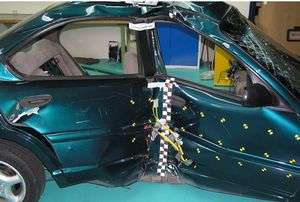
Things can get tight after a lateral collision – intelligent side-impact protection prevents the worst. © Faurecia

A car body that thinks intelligently and protects its occupants at the crucial moment has been every driver’s dream for a long time. Research scientists in an EU project have developed an intelligent side-impact protection system that dramatically reduces the risk of injury.

One more second until collision. The cameras integrated in the doors have long identified the car that will cause the accident. Radar sensors in the car wings measure how far away the other car still is. 200 milliseconds before the crash, the new side-impact protection system is activated. The occupants are reliably protected at the crucial moment.

The intelligent side-impact protection system is a product of the EU project APROSYS – short for Advanced Protection Systems. The technology was developed by Fraunhofer researchers in cooperation with various universities, car manufacturers and suppliers.

“Our goal was to improve the active crash safety of motor vehicles – that is, to adapt the technical properties of the car body in such a way that it absorbs energy at the crucial moment and thus protects the occupants,” says project manager Björn Seipel of the Fraunhofer Institute for Structural Durability and System Reliability LBF.

But how do you get the car body to change its properties? And how does the car know when its occupants need protection? The researchers have devised a kind of sixth sense for cars that anticipates accidents and emits the necessary impulse to activate the side-impact protection system.

Stereo cameras and radar sensors continually scan the environment, and a central computer analyzes the data. “During the journey, the system has to distinguish moving objects – meaning other cars that could potentially cause an accident – from stationary objects such as houses or trees,” explains Dr. Dieter Willersinn of the Fraunhofer Institute for Information and Data Processing IITB.

His team has developed a software program capable of predicting a lateral collision just in time – about 200 milliseconds before the crash. The impulse from the central computer releases a surge of electricity that heats a wire made of a shape memory alloy. This wire is the actual trigger.

“We opted for this solution because it is faster than any conventional solenoid switch,” says Seipel. The heat bends the wire, which then releases a spring. The spring slackens and pushes a steel bolt, which is integrated in the seat, towards the door. At the same time a stable metal body in the door is brought into position to support the steel bolt.

“The system of the bolt and the metal box stabilizes the car door and absorbs energy on collision,” explains Seipel. To prove that the new side-impact protection system actually works in a real crash situation, he will carry out a crash test in Spain on March 7. The passenger cell will be on display at the Hannover trade fair on April 21 through 25.

Source: Fraunhofer-Gesellschaft


print this article email this article download pdf blog this article bookmark this article     Stumble it Digg this share on Facebook retweet share on Reddit add to delicious
Rate this story - 3.4 /5 (5 votes)

Rank Filter

Move the slider to adjust rank threshold, so that you can hide some of the comments.


Display comments: newest first

  • superhuman - Mar 06, 2008
    • Rank: not rated yet
    >A car body that thinks intelligently
    And self-conscious of course.

    Intelligence can only be meaningfully attributed to certain animals. Everyone who thinks otherwise is as intelligent as that car body.

March 6, 2008 all stories

Comments: 1

3.4 /5 (5 votes)
  • Stumble this up

  • Digg this

  • share this

  • hide
  • Related Stories

  • Swiss privacy watchdog to sue Google Street View
    created Nov 13, 2009 | popularity not rated yet | comments 0
  • Hong Kong air pollution equals record high
    created Oct 24, 2009 | popularity not rated yet | comments 0
  • NASA Researchers Explore Lightning's NOx-ious Impact on Pollution, Climate
    created Oct 23, 2009 | popularity not rated yet | comments 0
  • Doctors Use Patient's Own Stem Cells to Grow Facial Bone
    created Oct 12, 2009 | popularity not rated yet | comments 0
  • Premium car research & cow dung point to new high tech disease diagnosis
    created Oct 12, 2009 | popularity not rated yet | comments 0


  • hide
  • Relevant PhysicsForums posts

  • why are you an engineer?
    created 2 hours ago
  • Variable Pitch Propeller mechanism?
    created 6 hours ago
  • Bread Board
    created Nov 14, 2009
  • Student team - building a satellite - want to join - problem:i'm a biotech student.
    created Nov 13, 2009
  • More from Physics Forums - General Engineering

Other News

All eyes on Murdoch as newspapers ponder digital future

Technology / Internet

created 8 hours ago | popularity not rated yet | comments 0

Is Rupert Murdoch bluffing? Making a bold high-stakes gamble that will save the troubled newspaper industry? Or pursuing a pipe dream that can only end in failure?


Road trains may be coming soon to Europe

Road trains may be coming soon to Europe (w/ Video)

Technology / Engineering

created Nov 13, 2009 | popularity 4.8 / 5 (12) | comments 20

(PhysOrg.com) -- Road trains linking vehicles together in a traveling convoy are planned for Europe. With only the lead vehicle being actively driven, the road trains would allow commuters to sleep, read a ...


A system of space solar power system (SSPS)

Japan eyes solar station in space as new energy source

Technology / Energy

created Nov 08, 2009 | popularity 4.8 / 5 (22) | comments 31

It may sound like a sci-fi vision, but Japan's space agency is dead serious: by 2030 it wants to collect solar power in space and zap it down to Earth, using laser beams or microwaves.


Cars sit in traffic on a highway

Netherlands to levy 'green' road tax by the kilometre

Technology / Hi Tech

created Nov 13, 2009 | popularity 3 / 5 (4) | comments 8

The Dutch government said Friday it wants to introduce a "green" road tax by the kilometre from 2012 aimed at cutting carbon dioxide emissions by 10 percent and halving congestion.


Google Go

Google Go gets going (w/ Video)

Technology / Software

created Nov 11, 2009 | popularity 4.3 / 5 (11) | comments 6

(PhysOrg.com) -- Google has introduced its new experimental programming language Go, which aims to combine speedy application development through simplified coding with high-speed program execution.