Black Holes Made of Light
March 6, 2008 Black holes made of light

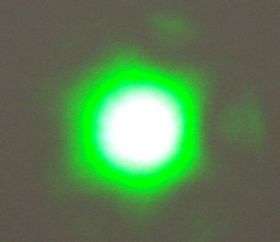
The researchers used ultrashort light pulses in microstructured optical fibres to demonstrate the formation of an artificial event horizon. This image captures the light at the end of the optical fibres (Photo: Chris Kuklewicz)

Scientists at the University of St Andrews have used lasers to simulate a black hole in their laboratory.

Professor Ulf Leonhardt and Dr Friedrich König used intense light pulses to create an artificial `event horizon' - the defining feature of a black hole known as `the point of no return'. The development may allow researchers to test Professor Stephen Hawking's theory that black holes are not black at all but in fact radiate light. The research will be published tomorrow in Science.

It is the first time that scientists have successfully simulated an event horizon using light. There is no danger however of the scientists being sucked into deep space by an intense pull of gravity, since the tabletop device only acts on light in optical fibres and is perfectly harmless.

The St Andrews demonstration of the physics behind the event horizon, in which they measured the shifting of light, has been described as a `milestone'.

The researchers accomplished the feat by firing laser light down an optical fibre - with different wavelengths of light moving at different speeds, creating a distortion which causes a wave of light to be trapped - effectively a black hole event horizon which cannot be escaped.

The `fibre-optical black hole', created by the St Andrews team on a shoestring budget, could allow physicists to investigate what happens to light at both sides of an event horizon - something they describe as a `feat that is utterly impossible in astrophysics'.

Describing the study as a `scientific adventure and formidable challenge', Professor Leonhardt, of the University's School of Physics & Astronomy, said, "Creating optical analogues (simulations) of the event horizon has been an exciting adventure with many ups and downs, high hopes and deep disappointments, an adventure that seems destined to continue. So far, most of it is still theory, but we succeeded in the first small step of demonstrating in the laboratory the physics of horizons for light.

"We used ultrashort light pulses in microstructured optical fibres to demonstrate the formation of an artificial event horizon in optics. We have created analogues of the horizon - not real black holes - that only act on light in the fibre, and we observed a classical optical effect, the blue-shifting of light at a white-hole horizon," he said.

Previous researchers have compared a black hole event to a river flowing towards a waterfall. A horizon (point of no return) is formed at the point where the river moves faster than the speed of the waves. Instead of water, the St Andrews researchers decided to use light because it offers unrivalled advantages; light is the purest and simplest quantum object imaginable, creating fibre-optical horizons of pure glass, light and air.

The researchers say that event horizons are not hard to create and that making a long-distance telephone call can create them without callers even noticing.

"You can simulate an event horizon in the kitchen. Just let water from the tap flow onto a flat surface until a ring of water waves appears - the water inside the ring is smooth and moves faster than the waves around it, making it impossible for the waves to enter the ring. Instead, the water flows outwards and gets slower. Rings of waves form at the circle where the water slows down to the speed of the waves. This circle represents a white-hole horizon," explained Professor Leonhardt.

"It happens all the time in optical telecommunications where information is carried by light pulses which change the speed of light - whenever people communicate via fibre optics, using the internet or making long-distance phone calls, they create numerous artificial event horizons as a side effect without noticing it. The front end of each pulse generates a black-hole horizon, an area that light cannot leave, while the trailing end acts like a white-hole horizon, an area that light cannot enter," he said.

The researchers hope that by using sophisticated laser systems and advanced optical fibres, their horizon will eventually be strong enough to observe Hawking's radiation theory.

Source: University of St Andrews


print this article email this article download pdf blog this article bookmark this article     Stumble it Digg this share on Facebook retweet share on Reddit add to delicious
Rate this story - 4.1 /5 (99 votes)

Rank Filter

Move the slider to adjust rank threshold, so that you can hide some of the comments.


Display comments: newest first

  • googleplex - Mar 06, 2008
    • Rank: 3.5 / 5 (2)
    Very interesting. Curious minds want to know more. I understand the water in the kitchen analogue.
    I didn't understand the light analogue. Are they saying that light slows a little through glass. Hence the front and end of the light pulse are affected.
  • freemind - Mar 06, 2008
    • Rank: 3.5 / 5 (2)
    one of the best things I've read for the last couple of month...
  • superhuman - Mar 06, 2008
    • Rank: 2.7 / 5 (3)
    Jeez, it has almost nothing in common with a real event horizon let alone black holes!
    Just some optical effect which as the author says happens in telecom fibers on regular basis.

    >The development may allow researchers to test Professor Stephen Hawking's theory that black holes are not black at all but in fact radiate light

    AFAIK they radiate particles due to spontaneous particle-antiparticle pairs being created on event horizon, one of them is then pulled into the hole and another one escapes. Is this what the author is referring to? If so its not light and it has nothing to do with this "horizon" the article is about.
  • earls - Mar 06, 2008
    • Rank: 4 / 5 (3)
    superhuman, agreed.

    "Let's not confuse interesting optical effects with singularities."

    http://science.sl.../1633250

    Far less interesting than it appears on the surface.
  • Ragtime - Mar 06, 2008
    • Rank: 1 / 5 (3)
    On the contrary, by Aether Wave Theory the singularities are examples of so called total reflection phenomena. The expansion of universe can be interpreted as a result of cooling or compressing of vacuum, which is being formed by interior of black hole. The event horizon is sort of singularity as well.
  • Ragtime - Mar 06, 2008
    • Rank: 1 / 5 (2)
    One application of the optical model for explanation of event horizon behavior can be the model of Einstein-Rosen bridge between closely entangled black holes.

    http://tiny.cc/XcOSn
    http://www.physor...720.html

    You can consider the article here, too

    http://arstechnic...ormholes
  • brant - Mar 06, 2008
    • Rank: 1 / 5 (2)
    Sounds like a optical standing wave.

    Do you think I could model an event horizon with some cardboard, markers and scissors???
  • Ragtime - Mar 07, 2008
    • Rank: 1 / 5 (5)
    You can model the above experiment by the foam model of vacuum. By Aether Wave Theory (AWT) the foam character of vacuum is of the same nature, like the foamy fluctuations inside of other multiparticle systems, like the condensing supercritical wapor, and it's behavior is basically the same. Well, the soap foam gets more dense, when shaked - right? So if you create some wave in such foam, it will propagate at the distance, but it will make the foam more dense at the place, where such wave is actually spreading (actually, it will form a blob, a wave packet - so called "photon").

    Now we will send the second wave of the slightly higher waveleneght immediatelly after the first one. In the environment with normal dispersion (like the foam), such wave should move by slightly higher speed and to approach the first wave packet. But because the first wave packet is making the foam more dense temporarily, it will trap the second wave in it - so that the second wave will never anticipate the first one.

    Now you can imagine the black hole as single giant blob of vacuum foam, which is condensing by its density. This will result in the fast expansion of the internal space, because the energy will move more and more slowly. From inner observer perspective, the surface of black hole is leaping by the same speed, like the photon wave in the above experiment. And as such it makes an uncrossable barier for the other waves, because it's making the vacuum more dense from our private perspective as well.

    I admit, th balck hole analogy is somewhat artificial, because it renders the black hole surface as a very dynamic thing, approaching to us by the same way, like the leaping photon wave. The simple foam model by AWT is sufficient enough for the understanding of the whole process. But in connection with the universe expansion such analogy is working too, and I've no problem with it. You can choose whatever model, if you like it.

    In fact, the more less or more classical analogies you're able to apply for the black hole event horizon explanation, the better for you. By AWT the theories are behaving like foam for our consciousness, too - so you can achieve better understanding, when you use more independent ways for explanation.
  • jburchel - Mar 07, 2008
    • Rank: 1 / 5 (2)
    Yes, stupid. Totally NOT a black hole AT ALL. Sometimes I wonder if it might be beneficial if a few scientists WERE to disappear inside their own event horizons... At least if their budgets did, that would be satisfactory though. Probably coming from state funds too. The science welfare state... THERE is a TRUE black hole analogue. hahaha
  • Adriab - Mar 08, 2008
    • Rank: not rated yet
    It seems that the fundamental method being used to create this event horizon is different than that of what black holes actually do. I don't think that is enough to properly model a black hole, or test Hawking's radiation theory.
    But that is not to say this research is without merit, it could be quite useful in the realm of fiber optics communication systems. Understanding why the leading and trailing barriers are created may help further systems like optical computers.

March 6, 2008 all stories

Comments: 10

4.1 /5 (99 votes)
  • Stumble this up

  • Digg this

  • share this

  • hide
  • Related Stories

  • Sea level stargazing: Astronomers make key sighting with Florida telescope
    created Sep 28, 2009 | popularity not rated yet | comments 0
  • The Edge of a Black Hole
    created Aug 18, 2009 | popularity not rated yet | comments 0
  • What Hit Jupiter?
    created Aug 03, 2009 | popularity not rated yet | comments 0
  • VLBA locates superenergetic bursts near giant black hole
    created Jul 02, 2009 | popularity not rated yet | comments 0
  • No more geeky glasses to watch 3D (w/Video)
    created Jun 10, 2009 | popularity not rated yet | comments 0


  • hide
  • Relevant PhysicsForums posts

  • Blobs in shadows
    created 56 minutes ago
  • Resistance of a moving coil galvanometer value
    created 1hour ago
  • Entropy vs. video game controllers
    created 4 hours ago
  • Electron oscillating in vacuum
    created 5 hours ago
  • Swings
    created 5 hours ago
  • Bicycling on the Moon
    created 6 hours ago
  • More from Physics Forums - General Physics

Other News

Stars Fueled by Dark Matter Could Hold Secrets to the Universe

Stars Fueled by Dark Matter Could Hold Secrets to the Universe

Physics / General Physics

created Nov 03, 2009 | popularity 4.5 / 5 (50) | comments 40

(PhysOrg.com) -- The first stars in the universe may have been very different from the stars we see today, yet they may hold clues to understanding some of the mysterious features of the universe. These "dark ...


Second Law of Thermodynamics May Explain Economic Evolution

Second Law of Thermodynamics May Explain Economic Evolution

Physics / General Physics

created Nov 02, 2009 | popularity 4.3 / 5 (29) | comments 28

(PhysOrg.com) -- Terms such as the "invisible hand," laissez-faire policy, and free-market principles suggest that economic growth and decline in capitalist societies seem to be somehow self-regulated. Now, ...


High-performance plasmas may make reliable, efficient fusion power a reality

High-performance plasmas may make reliable, efficient fusion power a reality

Physics / Plasma Physics

created Nov 02, 2009 | popularity 4.7 / 5 (37) | comments 31

In the quest to produce nuclear fusion energy, researchers from the DIII-D National Fusion Facility have recently confirmed long-standing theoretical predictions that performance, efficiency and reliability ...


'Teapot effect' solved

Solving Teapot Effect

Physics / General Physics

created Nov 02, 2009 | popularity 4.9 / 5 (11) | comments 10

(PhysOrg.com) -- A team of scientists from France have worked out why teapots dribble at low flow rates, and how to stop them. The effect is called the "teapot effect", and solving it could finally put an ...


Laser accelerated protons to the highest energies so far

Researchers use trident laser to accelerate protons to record energies

Physics / General Physics

created Nov 02, 2009 | popularity 4.6 / 5 (5) | comments 10

An international team of physicists at Los Alamos National Laboratory has succeeded in using intense laser light to accelerate protons to energies never before achieved. Using this technique, scientists can ...