Changes in Ocean Conditions in Sargasso Sea Potential Cause for Decline in Eel Fishery
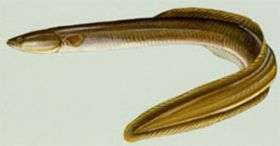
American eels are fast disappearing from restaurant menus as stocks have declined sharply across the North Atlantic. While the reasons for the eel decline remain as mysterious as its long migrations, a recent study by a NOAA scientist and colleagues in Japan and the United Kingdom says shifts in ocean-atmosphere conditions may be a primary factor in declining reproduction and survival rates.
“Although many aspects of spawning and early life history of this species are poorly understood, they are clearly adapted to grow in the low productivity waters of the Sargasso Sea south of Bermuda,” NOAA biologist Kevin Friedland said. “They spend up to a year or more as larvae and tend to live in the upper 100 meters (about 330 feet) of the water column, so any changes in the surface waters will have a big impact during critical stages in their development.”
Friedland and colleagues have found a significant correlation between the North Atlantic Oscillation, a decadal long ocean-atmosphere circulation pattern, and long-term variations in the catches of juvenile stages of the eels, commonly called glass eels. Considered a delicacy, the harvest of glass eels remains controversial due to concerns about stocks that some say may be close to collapse. Since the 1970s, the numbers of eels reaching Europe is believed to have declined by more than 90 percent.
In a study recently published in the ICES Journal of Marine Research, the researchers reviewed data of annual catches of glass eels since 1938 at Den Oever in the Netherlands. With the exception of the war years when no data was collected, the time series correlated to broad scale measures of climate variation such as the NAO and with specific local variations such as sea surface temperature, dominant wind pattern and the nature of the mixing in the upper layers of the ocean that control productivity. Changes in these factors matched changes in recruitment.
Eels in both the Atlantic and Pacific oceans are catadromous, which means they spend most of their lives in rivers, lakes and estuaries but migrate to the ocean to spawn. Both European and American eels spawn in the open ocean in the Sargasso Sea, in an area between the Bahamas and Bermuda, where distinct temperature fronts are present in the winter and spring that form a northern boundary of the spawning area, believed to be used by eels to locate mates and favor survival of their young.
After hatching, their transparent leaf-like larvae, known as leptocephali, remain in surface waters for up to a year and drift towards the Gulf Stream, which transports the European eels home to coastal waters in Europe. Along with the Gulf Stream, the Antilles Current and other westward-flowing circulation patterns in the North Atlantic send American eel larvae back towards the coast of the eastern US, where they migrate into estuaries like Chesapeake Bay.
Once back in coastal waters, the two to three-inch larvae transform into typical eel-shaped transparent juveniles, or glass eels, named for their appearance. They gather in estuaries and wait for the river to warm before swimming upstream into freshwater, where they change color and acquire green and brown pigments to become known as yellow eels. They can spend up to 20 years living in the rivers and generally reach lengths of 30 inches before they return to the ocean. But before they go back to the Sargasso Sea, they undergo another physical change and take on a silvery color to become silver eels.
“Changing ocean conditions in the Sargasso Sea caused by the NAO could be affecting the recruitment and survival of European eels,” Friedland says. “Our findings provide evidence of linkages between declines in recruitment and specific environmental changes within the spawning and early larval development areas of the Sargasso Sea. The Japanese eel population in the North Pacific is facing similar environmental pressures linked to El Nino conditions.”
While the decline could be due in part to natural changes in the North Atlantic Oscillation, there are other challenges facing eel populations such as changes in habitat, overfishing, parasites, river barriers caused by hydroelectric plants and dams, and pollution.
Friedland and colleagues say their study shows that changing ocean conditions could be contributing to declining recruitment of European eels and probably to declines in the American eel population as well, but emphasize that human factors during the continental life stages of these stocks must also be considered when formulating future management and research plans.
Source: NOAA Fisheries Service


