Researchers see history of life in the structure of transfer RNA
March 7th, 2008 Researchers see history of life in the structure of transfer RNA

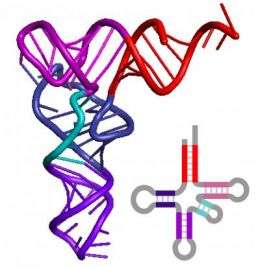
All tRNAs assemble themselves into a shape that, if flattened, resembles a cloverleaf. Patterns in these structures give clues to early evolutionary history. The red areas of the molecule pictured above are the most ancient. Credit: Image courtesy of Gustavo Caetano-Anollés

Transfer RNA is an ancient molecule, central to every task a cell performs and thus essential to all life. A new study from the University of Illinois indicates that it is also a great historian, preserving some of the earliest and most profound events of the evolutionary past in its structure.

The study, co-written by Gustavo Caetano-Anollés, a professor of crop sciences, and postdoctoral researcher Feng-Jie Sun, appears March 7 in PLoS Computational Biology. Caetano-Anollés is an affiliate of the U. of I. Institute for Genomic Biology.

Of the thousands of RNAs so far identified, transfer RNA (tRNA) is the most direct intermediary between genes and proteins. Like many other RNAs (ribonucleic acids), tRNA aids in translating genes into the chains of amino acids that make up proteins. With the help of a highly targeted enzyme, each tRNA molecule recognizes and latches onto a specific amino acid, which it carries into the protein-building machinery. In order to successfully add its amino acid to the end of a growing protein, tRNA must also accurately read a coded segment of messenger RNA, which gives instructions for the exact sequence of amino acids in the protein.

The fact that tRNA is so central to the task of building proteins probably means that it has been around for a long time, Caetano-Anollés said. His inquiry began with a hunch that understanding the structural properties of tRNA would shed light on how organisms and viruses evolved.

“Perhaps in evolution there are things that are so fundamental that they are kept, held onto, for millions or even billions of years,” Caetano-Anollés said. “Those are the fossils, the molecular fossils, that tell us about the past. Therefore, studying these molecules can address fundamental questions in biology and evolution.”

All tRNAs assemble themselves into a shape that, if flattened, resembles a cloverleaf. The team began by looking for patterns in this cloverleaf structure, using detailed data from hundreds of molecules representing viruses and each of the three superkingdoms of life: archaea, bacteria and eukarya.

The researchers converted all distinguishing features of the individual tRNA cloverleaf structures into coded characters, a process that allowed a computerized search for the most “parsimonious” (that is, the simplest, most probable) tRNA family tree. They conducted the same analysis on the tRNAs of each of the superkingdoms, to see how far these groupings diverged from the overall tree. This comparison allowed them to determine the order in which viruses and each of the superkingdoms diverged.

The new analysis supports an earlier study that suggested that the archaea were the first to arise as an evolutionarily distinguishable group. Archaea are microbes that can survive in boiling acid, near sulfurous ocean vents or in other extreme environments. The earlier study, also led by Caetano-Anollés, analyzed the vast catalog of protein folds – those precisely configured regions in proteins that give them their functionality – as a guidebook to evolutionary history.

“The transfer RNA data matches our earlier data,” Caetano-Anollés said. “This is important because two lines of independent evidence are supporting each other.”

The new analysis also indicates that viruses emerged not long after the archaea, with the superkingdoms eukarya and bacteria following much later – and in that order. This finding may influence the ongoing debate over whether viruses existed prior to, or after, the emergence of living cells, Caetano-Anollés said.

“This supports the idea that viruses arose from the cellular domain,” he said.

Source: University of Illinois at Urbana-Champaign


print this article email this article download pdf blog this article bookmark this article     Digg this Stumble it share on Facebook share on Reddit add to delicious save to Yahoo! bookmarks
4.8/5 after 29 votes


March 7th, 2008 all stories
Biology /

Comments: 0
Rank: 4.8/5 after 29 votes

  • Stumble this up

  • Digg this

  • Share it:
  • share on Facebook
  • share on MySpace
  • share on Slashdot
  • rss-newsfeed
  • share on Google
  • share on Reddit
  • add to delicious
  • save to Yahoo! bookmarks
  • share on Windows Live
  • Add to Mixx!
Rating: 4.8/5 after 29 votes

  • Related Stories

  • Study reveals surprising details of the evolution of protein translation
    created Aug 12, 2008 | popularity not rated yet | comments 0
  • Scientists observe human neurodegenerative disorder in fruit flies
    created Jun 24, 2009 | popularity not rated yet | comments 0
  • Fruit fly steps in to fight human disease
    created Jun 22, 2009 | popularity not rated yet | comments 0
  • Neurological disorder in golden retriever dogs caused by a mutation in mitochondrial DNA
    created May 29, 2009 | popularity not rated yet | comments 0
  • Genetic switch potential key to new class of antibiotics
    created Apr 17, 2009 | popularity not rated yet | comments 0

Tags


  • Physicists Demonstrate Quantum Memory with Matter Qubits
    Physicists Demonstrate Quantum Memory with Matter Qubits
    Physics / General Physics
    created Jul 03, 2009 | popularity 4.4 / 5 (17) | comments 1
  • 'Holey' Nanosheets for Wastewater Dye Removal
    Nanotechnology / Nanomaterials
    created Jul 01, 2009 | popularity 5 / 5 (5) | comments 1
  • Jellyfish Robot Swims Like its Biological Counterpart
    Jellyfish Robot Swims Like its Biological Counterpart
    Electronics / Robotics
    created Jun 26, 2009 | popularity 4.4 / 5 (8) | comments 1
  • Could Maxwell's Demon Exist in Nanoscale Systems?
    Could Maxwell's Demon Exist in Nanoscale Systems?
    Physics / General Physics
    created Jun 24, 2009 | popularity 4.4 / 5 (18) | comments 29
  • Living Safely with Robots, Beyond Asimov's Laws
    Living Safely with Robots, Beyond Asimov's Laws
    Electronics / Robotics
    created Jun 22, 2009 | popularity 4.6 / 5 (53) | comments 40
  • Other News

    Battle of the sexes benefits offspring, says research

    Battle of the sexes benefits offspring, says research

    Biology / Plants & Animals

    created 1hour ago | popularity not rated yet | comments 0

    Parents compensate for a lazy partner by working harder to bring up their offspring, but not enough to completely make up for the lack of parenting, says research by bird biologists at the University of Bath.


    Researchers uncover the potential for super-sized abalone

    Biology / Microbiology

    created 5 hours ago | popularity not rated yet | comments 0

    (PhysOrg.com) -- Designer abalone could be an option in the foreseeable future, thanks to a project conducted at UQ's Heron Island Research Station and the St Lucia campus.


    Scientists 'rebuild' giant moa using ancient DNA

    Biology / Plants & Animals

    created Jul 01, 2009 | popularity 5 / 5 (10) | comments 12

    (PhysOrg.com) -- Scientists have performed the first DNA-based reconstruction of the giant extinct moa bird, using prehistoric feathers recovered from caves and rock shelters in New Zealand.


    Pacific Giant Salamander (Dicamptodon tenebrosus)

    Salamanders, regenerative wonders, heal like mammals, people

    Biology / Microbiology

    created Jul 01, 2009 | popularity 5 / 5 (20) | comments 11

    The salamander is a superhero of regeneration, able to replace lost limbs, damaged lungs, sliced spinal cord -- even bits of lopped-off brain. But it turns out that remarkable ability isn't so mysterious after ...


    California water plan aims to save Puget Sound orcas

    Biology / Ecology

    created 21 hours ago | popularity 4 / 5 (1) | comments 0

    A plan to restore salmon runs on California's Sacramento River also could help revive killer whale populations 700 miles to the north in Puget Sound, as federal scientists struggle to protect endangered species in a complex ...