Seeing through the dark
March 7, 2008
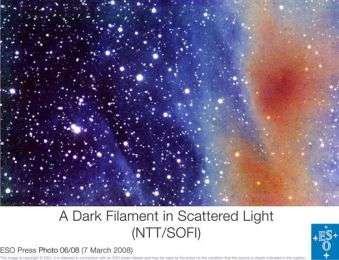
A Dark Filament in Scattered Light

Part of a filament in the Corona Australis molecular cloud. The image is a composite of J-, H-, and K-band near-infrared observations that were made with the SOFI instrument on ESO's NTT telescope in August 2006. The observations were made to test, how easily the scattered light can be observed and how good it is as a tracer of cloud structure. The J-, H-, and K-band intensities are coded with blue, green, and red colours. The gradual saturation of the near-infrared bands is visible as a change of colour. In diffuse regions the shorter wavelength J-band is strong and the colour is bluish. When the J-band saturates the colour changes first to green and finally, in the centre of the filament, the red colour corresponding to the K-band becomes the strongest. In the most saturated regions the surface brightness data can only be used to derive a lower limit for the total amount of dust on the line of sight. Credit: ESO

Astronomers have measured the distribution of mass inside a dark filament in a molecular cloud with an amazing level of detail and to great depth. The measurement is based on a new method that looks at the scattered near-infrared light or 'cloudshine' and was made with ESO's New Technology Telescope. Associated with the forthcoming VISTA telescope, this new technique will allow astronomers to better understand the cradles of newborn stars.

The vast expanses between stars are permeated with giant complexes of cold gas and dust opaque to visible light. Yet these are the future nurseries of stars to be.

"One would like to have a detailed knowledge of the interiors of these dark clouds to better understand where and when new stars will appear," says Mika Juvela, lead author of the paper in which these results are reported.

Because the dust in these clouds blocks the visible light, the distribution of matter within interstellar clouds can be examined only indirectly. One method is based on measurements of the light from stars that are located behind the cloud.

"This method, albeit quite useful, is limited by the fact that the level of details one can obtain depends on the distribution of background stars," says co-author Paolo Padoan.

In 2006, astronomers Padoan, Juvela, and colleague Veli-Matti Pelkonen, proposed that maps of scattered light could be used as another tracer of the cloud's inner structure, a method that should yield more advantages. The idea is to estimate the amount of dust located along the line of sight by measuring the intensity of the scattered light.

Dark clouds are feebly illuminated by nearby stars. This light is scattered by the dust contained in the clouds, an effect dubbed 'cloudshine' by Harvard astronomers Alyssa Goodman and Jonathan Foster. This effect is well known to sky lovers, as they create in visible light wonderful pieces of art called 'reflection nebulae'. The Chameleon I complex nebula is one beautiful example.

When making observations in the near-infrared, art becomes science. Near-infrared radiation can indeed propagate much farther into the cloud than visible light and the maps of scattered light can be used to measure the mass of the material inside the cloud.

To put this method to the test and use it for the first time for a quantitative estimation of the distribution of mass within a cloud, the astronomers who made the original suggestion, together with Kalevi Mattila, made observations in the near-infrared of a filament in the Corona Australis cloud. The observations were made in August 2006 with the SOFI instrument on ESO's New Technology Telescope at La Silla, in the Chilean Atacama Desert. The filament was observed for about 21 hours.

Their observations confirm that the scattering method is providing results that are as reliable as the use of background stars while providing much more detail.

"We can now obtain very high resolution images of dark clouds and so better study their internal structure and dynamics," says Juvela. "Not only is the level of details in the resulting map no longer dependent on the distribution of background stars, but we have also shown that where the density of the cloud becomes too high to be able to see any background stars, the new method can still be applied."

"The presented method and the confirmation of its feasibility will enable a wide range of studies into the interstellar medium and star formation within the Milky Way and even other galaxies," says co-author Mattila.

"This is an important result because, with current and planned near-infrared instruments, large cloud areas can be mapped with high resolution," adds Pelkonen. "For example, the VIRCAM instrument on ESO's soon-to-come VISTA telescope has a field of view hundreds of times larger than SOFI. Using our method, it will prove amazingly powerful for the study of stellar nurseries."

The report appears this week in the journal Astronomy and Astrophysics ("A Corona Australis cloud filament seen in NIR scattered light - I. Comparison with extinction of background stars", by Mika Juvela, Veli-Matti Pelkonen, Paolo Padoan, and Kalevi Mattila). Juvela, Pelkonen and Mattila are associated with the Helsinki University Observatory (Finland), while Padoan is at the University of California, San Diego, USA.

Source: ESO

4.4 /5 (18 votes)  

Rank 4.4 /5 (18 votes)
Tags

Related Stories
Relevant PhysicsForums posts
  • Never ending outer space.....
    created15 hours ago
  • Neutron Star fragments?
    created17 hours ago
  • stationary or not?
    created21 hours ago
  • Scale of the Universe
    createdFeb 10, 2012
  • Titan's lack of impact craters
    createdFeb 09, 2012
  • Real pictures of black hole eating a star?
    createdFeb 08, 2012
  • More from Physics Forums - General Astronomy

More news stories

Salvage workers begin pumping fuel from Italian shipwreck

Salvage workers Sunday began pumping fuel from the shipwrecked Italian cruise liner Costa Concordia, a day ahead of schedule, officials said.

Space & Earth / Environment

created 32 minutes ago | popularity not rated yet | comments 0

Latin America mining boom clashes with conservation

Latin America is experiencing a mining boom as prices rise fuelled by a hike in global demand, but the region is also being hit by a wave of violent protests, strikes and rallies by environmentalists.

Space & Earth / Environment

created 8 hours ago | popularity 5 / 5 (1) | comments 0

Political leaders play key role in how worried Americans are by climate change: study

More than extreme weather events and the work of scientists, it is national political leaders who influence how much Americans worry about the threat of climate change, new research finds.

Space & Earth / Environment

created Feb 06, 2012 | popularity 5 / 5 (6) | comments 73

NASA budget will axe Mars deal with Europe: scientists

US President Barack Obama's budget proposal to be submitted next week for 2013 will cut NASA's budget by 20 percent and eliminate a major partnership with Europe on Mars exploration, scientists said Thursday.

Space & Earth / Space Exploration

created Feb 10, 2012 | popularity 5 / 5 (3) | comments 55

Humans may have helped the decline of African rainforests 3000 years ago

(PhysOrg.com) -- Large areas of rainforests in Central Africa mysteriously disappeared over three thousand years ago, to be replaced by savannas. The prevailing theory has been that the cause was a change ...

Space & Earth / Environment

created Feb 10, 2012 | popularity 4.1 / 5 (14) | comments 20 | with audio podcast report


Scientists discover molecular secrets of 2,000-year-old Chinese herbal remedy

For roughly two thousand years, Chinese herbalists have treated Malaria using a root extract, commonly known as Chang Shan, from a type of hydrangea that grows in Tibet and Nepal. More recent studies suggest that halofuginone, ...

New method to examine batteries -- MRI from the inside

There is an ever-increasing need for advanced batteries for portable electronics, such as phones, cameras, and music players, but also to power electric vehicles and to facilitate the distribution and storage of energy derived ...

A mitosis mystery solved: How chromosomes align perfectly in a dividing cell

Although the process of mitotic cell division has been studied intensely for more than 50 years, Whitehead Institute researchers have only now solved the mystery of how cells correctly align their chromosomes during symmetric ...

Starve a virus, feed a cure? Findings show how some cells protect themselves against HIV

A protein that protects some of our immune cells from the most common and virulent form of HIV works by starving the virus of the molecular building blocks that it needs to replicate, according to research published online ...

Researchers find extensive RNA editing in human transcriptome

In a new study published online in Nature Biotechnology, researchers from BGI, the world's largest genomics organization, reported the evidence of extensive RNA editing in a human cell line by analysis of RNA-seq data, demons ...

The proteins ensuring genome protection

Researchers from the University of Geneva (UNIGE), Switzerland, have discovered the crucial role of two proteins in developing a cell 'anti-enzyme shield'. This protection system, which operates at the level of molecular ...