Low-cost reusable material could facilitate capture of carbon dioxide from power plants
Researchers have developed a new, low-cost material for capturing carbon dioxide (CO2) from the smokestacks of coal-fired power plants and other generators of the greenhouse gas. Produced with a simple one-step chemical process, the new material has a high capacity for absorbing carbon dioxide – and can be reused many times.
Combined with improved heat management techniques, the new material could provide a cost-effective way to capture large quantities of carbon dioxide from coal-burning facilities. Existing CO2 capture techniques involve the use of solid materials that lack sufficient stability for repeated use – or liquid adsorbents that are expensive and require significant amounts of energy.
“This is something that you could imagine scaling up for commercial use,” said Christopher Jones, a professor in the School of Chemical and Biomolecular Engineering at the Georgia Institute of Technology. “Our material has the combination of high capacity, easy synthesis, low cost and a robust ability to be recycled – all the key criteria for an adsorbent that would be used on an industrial scale.”
Details of the new material, known as hyperbranched aluminosilica (HAS), are scheduled to appear in the March 19th issue of the Journal of the American Chemical Society. The research was supported by the U.S. Department of Energy’s National Energy Technology Laboratory.
Growing concern over increased levels of atmospheric carbon dioxide has prompted new interest in techniques for removing the gas from the smokestacks of such large-scale sources as coal-fired electric power plants. But to minimize their economic impact, the cost of adding such controls must be minimized so they don’t raise the price of electricity significantly.
Once removed from the stack gases, the CO2 might be sequestered in the deep ocean, in mined-out coal seams or in depleted petroleum reservoirs. If the CO2 capture and sequestration process can be made practical, America’s large resources of coal could be used with less impact on global climate change.
Working with Department of Energy scientists Daniel Fauth and McMahan Gray, Jones and graduate students Jason Hicks and Jeffrey Drese developed a way to add CO2-adsorbing amine polymer groups to a solid silica substrate using covalent bonding. The strong chemical bonds make the material robust enough to be reused many times.
“Given the volumes involved, you must be able to recycle the adsorbent material for the process to be cost-effective,” said Jones. “Otherwise, you would be creating large and expensive waste streams of adsorbent.”
Production of the HAS material is relatively simple, and requires only the mixing of the silica substrate with a precursor of the amine polymer in solution. The amine polymer is initiated on the silica surface, producing a solid material that can be filtered out and dried.
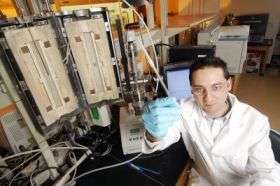
To test the effectiveness of their new material, the Georgia Tech researchers passed simulated flue gases through tubes containing a mixture of sand and HAS. The CO2 was adsorbed at temperatures ranging from 50 to 75 degrees Celsius. Then the HAS was heated to between 100 and 120 degrees Celsius to drive off the gas so the adsorbent could be used again.
The researchers tested the material across 12 cycles of adsorption and desorption, and did not measure a significant loss of capacity. The HAS material can adsorb up to 5 times as much carbon dioxide as some of the best existing reusable materials.
The HAS material works in the presence of moisture, an unavoidable by-product of the combustion process.
Adsorption of the CO2 generates considerable amounts of heat, which must be managed and thermally recycled. Removal of the carbon dioxide requires heating the adsorbent.
“How to manage this heat is one of the most critical issues controlling the economics of a potential large scale process,” Jones added. “You must control the production of heat by the adsorption step, and you don’t want to put any more energy into the desorption process than necessary.”
Because of their chemical structure, the amine groups provide three different classes of binding sites for carbon dioxide, each with a different binding energy. Optimizing the production of binding sites is a goal for future research, Jones said.
Beyond the material, other components of the separation and sequestration process must also be improved and optimized before it can become a practical technique for removing CO2 from flue gases. The best way to expose the flue gases to the adsorbent material is also key issue.
“There are many pieces that must fit together to make the overall economics of carbon dioxide capture and sequestration work,” Jones added. “The biggest challenge for this whole field of research right now is to do this as inexpensively as possible. We think that our class of materials – a hyperbranched amine polymer bound to a solid support – is potentially ideal because it is simple to make, reusable and has a high capacity.”
Source: Georgia Institute of Technology


