Theory explains why 25 percent of cultures cut male genitals
March 7th, 2008 Theory explains why 25 percent of cultures cut male genitals

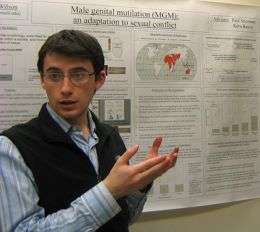
Chris Wilson explains his research on the evolution of male mutilation at a recent research symposium.

Almost 25 percent of indigenous societies practice some form of male genital cutting, ranging from circumcision to the ritual removal of a testicle. The reason, reports a Cornell scientist, may be to reduce pregnancies from extramarital sex. More subtly, it could be to reduce conflict among men.

Chris Wilson, a doctoral candidate in Cornell's Department of Neurobiology and Behavior, observes that cultures often express the reasons for what anthropologists call "male genital mutilation," in terms that have immediate meaning, such as religion, tradition, hygiene or initiation into adulthood. The new research suggests that these psychological rationales exist to serve a deeper evolutionary purpose in certain societies, even though men are not consciously aware of the complex evolutionary logic shaping their thoughts and behavior.

Writing in the journal Evolution and Human Behavior, Wilson says that because genital alteration is a painful and even risky procedure, especially under primitive conditions, it must have some evolutionary benefit or it would not have persisted.

Wilson hopes that the evolutionary explanation he offers for genital cutting will prove useful to anthropologists, doctors and policy-makers as they grapple with cultural, ethical and medical issues surrounding the ancient practice. The evolutionary origin of circumcision may be of especially broad interest, as this particular operation is not only performed in 20 percent of indigenous societies, but on approximately one-third of all men worldwide.

In his research article, Wilson asks, "Why have 180 cultures all converged on this practice?" The different types of cutting suggest that several societies independently developed the practice before recorded history.

Wilson, who works with Paul Sherman, Cornell professor of neurobiology and behavior, says that genital cutting may limit extramarital sex. In evolutionary terms, a man benefits from such affairs by passing his genes to a child who requires no further investment on his part.

"If natural selection has designed the genitals for fertilization, then changing that design will harm this function," says Wilson. "In particular, modifying the shape of the genitals makes it physically less likely that a man will impregnate a woman during an affair, and, therefore, the evolutionary incentive for adultery is smaller."

He explains that the procedure therefore allows men within a society to trust each other more, because it reduces conflict over paternity and sexual indiscretion. In the indigenous societies that practice genital cutting, Wilson suggests that the social benefits outweigh the costs, and so the custom persists.

His research found much higher rates of cutting in societies where men have multiple wives, especially when wives live far apart. In these cultures, the opportunities for extramarital affairs are high because a husband can't keep a close eye on all of his wives at once. Genital alteration acts as a physical signal of sexual honesty, reducing mistrust between the married and unmarried men.

After controlling for numbers of wives, Wilson also found lower rates of extramarital affairs in societies that practice male genital cutting, compared with those that do not, suggesting that it does indeed play a role in limiting adultery.

Finally, among societies practicing genital alteration, older men gave trust and benefits to younger men who underwent the procedure, supporting Wilson's theory that the procedure improves trust and social status.

Source: By Amelia Apfel, Cornell University


print this article email this article download pdf blog this article bookmark this article     Digg this Stumble it share on Facebook share on Reddit add to delicious save to Yahoo! bookmarks
3.4/5 after 34 votes

Rank Filter

Move the slider to adjust rank threshold, so that you can hide some of the comments.


Display comments: newest first

  • nilbud - Mar 07, 2008
    • Rank: 4 / 5 (3)
    Eek
  • MathieuHamaekers - Mar 08, 2008
    • Rank: 4 / 5 (1)
    It is a typical social theory, trying to explain the behaviour of men by statistics, while forgetting to make first a good study of the history of certain traditions of humans.
    Circumcision came in the place of sacrifising children. You can read this very clear in the old testament when Abram has to sacrifice his oldest son. He heard the voice of God, asking him to let him live and to circumsice his son in place of killing him. Abram is called Abraham ever since. Killing the first born was the tradition among his people and probably a tradition from the culture where he came from in Mesopotania.
    Ofcourse, it is just a story but I think it shows that existing traditions are mostly based on something much more crual in the past. For example football replaces the gladiator fights. I personally am very happy that Christiannity changed the tradition of circumsicion again, believing that spiritual circumsicion by the helpe of baptism is as effective as circumsicion.
    Circumsicion is part of a vast amount of body mutilation traditions, like tatoe's and pircings, rings around the neck and whatever to change the appearance of the body and to distinguish groups from one another, like a primitive pasport.
    It is even strange that in or modern society, these techniques come back. The younger people love pircings and tattoo. What to think of anything to change your apearance with the help of beauty shops, and plastci surgery in our times?
    Personally I think that all these strange body mutilation traditions over the century's have a link with psycho pathological behaviour patterns. If people are the victem of severe traumatic experiences some cut themselve as a reaction, even play suicide wich is the exstreem.
    As a scientist, I think that there is a link between these strange traditions in some cultures, and catastrophic event that where plenty during human evolution. If a whole society had to suffer from traumatic events like vulcano eruptions, earthquakes,floods,etc. the traumatic reaction of a whole society could have trigered different body mutulation traditions in different parts of the world. Maybe in the hope, the gods or the powers that coused these catastrophes would calm down.
    I personally think that all these traditions have lost there value and education is the main force to change these crual traditions, based on supersticion, into something accepteble for the third millenium. There is no God that causes the natural catastropy's. God has no fun in things like that. It is just nature just like superstition is human nature.
    Only ethics can prevent adultery, because ethics work from inside a human being and not from the outside.
    But ethics is based on a very simple thing, behaviorists should understand perfectly. All behaviour is exemplaric. Give the good example. The one rule of ethics is very simple. Don't do to others what you don't want that others do to you. Behaving in this way is spiritual circumsicion. It has to do with making choices with your mind, before your let nature do his thing.
    The body is perfect like it is in all his imperfection. And oh yes. Let him, who is without sins, trow the first stone.


  • Hugh7 - Mar 11, 2008
    • Rank: not rated yet
    With all its other detriments, male circumcision has not been shown to reduce fertility, whether with a man's bonded partner or someone else. As a "physical signal of sexual honesty" it is about the least reliable one could imagine.

    Mr Wilson's research "found much higher rates of cutting in societies where men have multiple wives" but this (and the map behind him) seems to ignore the prevalence of circumcision in the United States and until 30 or so years ago, the rest of the English-speaking world. Theories to explain genital cutting need to explain it among ourselves as much as any other culture.

    In my paper "Circumcision as a Memeplex" (the presentation on which it is based is at http://www.circum...me.html) I took another approach: the multiple reasons given for cutting male genitals interact to create a "selfish" complex of cultural units (memes) whose function is the promotion of its own survival.

    Thus the Jewish custom was medicalised in the UK and the US in the late 19th century to "cure" and then prevent masturbation (at which it obviously fails, though it may delay its onset), and once established, other medical "benefits" were enlisted, culminating to date in the claim that it is effective against HIV/AIDS. (Tomorrow Ebola?)

    Once it is prevalent, the claims that "a boy should look like his father" (which was never heard when fathers were intact) and "women prefer circumcised men" can be rolled out. (Both of those have an evolutionary component: a mother will want her son to look like his father to reassure the father that the boy is his - though the father's wish may just reflect his own penile insecurity; and people who think women prefer circumcised men will not buck the trend to suit their own preference any more than a peahen would prefer drab plumage.)

    Infant circumcision purports to be altruistic, which Susan Blackmore points out is an excellent tactic for promoting its own survival.
  • COCO - Mar 13, 2008
    • Rank: not rated yet
    forget these half measures - legislate castration - start with the Executive branch of the government. Less hookers and wars for damn sure!!

March 7th, 2008 all stories
Other Sciences / Other

Comments: 4
Rank: 3.4/5 after 34 votes

  • Stumble this up

  • Digg this

  • Share it:
  • share on Facebook
  • share on MySpace
  • share on Slashdot
  • rss-newsfeed
  • share on Google
  • share on Reddit
  • add to delicious
  • save to Yahoo! bookmarks
  • share on Windows Live
  • Add to Mixx!
Rating: 3.4/5 after 34 votes

  • Related Stories

  • Genital stimulation opens door for cryptic female choice in tsetse flies
    created May 14, 2009 | popularity not rated yet | comments 0
  • Dracula minnow has teeth, almost
    created Mar 11, 2009 | popularity not rated yet | comments 0
  • How 'secondary' sex characters can drive the origin of species
    created Aug 25, 2008 | popularity not rated yet | comments 0
  • Herpes infection may be symbiotic, help beat back some bacteria
    created May 16, 2007 | popularity not rated yet | comments 0
  • 'War Between the Sexes:' The Co-evolution of Genitalia in Waterfowl
    created May 01, 2007 | popularity not rated yet | comments 0

Tags


  • Physicists Demonstrate Quantum Memory with Matter Qubits
    Physicists Demonstrate Quantum Memory with Matter Qubits
    Physics / General Physics
    created 18 hours ago | popularity 4.5 / 5 (11) | comments 1
  • 'Holey' Nanosheets for Wastewater Dye Removal
    Nanotechnology / Nanomaterials
    created Jul 01, 2009 | popularity 5 / 5 (5) | comments 1
  • Jellyfish Robot Swims Like its Biological Counterpart
    Jellyfish Robot Swims Like its Biological Counterpart
    Electronics / Robotics
    created Jun 26, 2009 | popularity 4.4 / 5 (7) | comments 1
  • Could Maxwell's Demon Exist in Nanoscale Systems?
    Could Maxwell's Demon Exist in Nanoscale Systems?
    Physics / General Physics
    created Jun 24, 2009 | popularity 4.4 / 5 (18) | comments 29
  • Living Safely with Robots, Beyond Asimov's Laws
    Living Safely with Robots, Beyond Asimov's Laws
    Electronics / Robotics
    created Jun 22, 2009 | popularity 4.6 / 5 (50) | comments 39
  • Other News

    Creation Museum president Ken A. Ham

    Paleontologists brought to tears, laughter by Creation Museum

    Other Sciences / Other

    created Jun 30, 2009 | popularity 4.4 / 5 (35) | comments 54

    For a group of paleontologists, a tour of the Creation Museum seemed like a great tongue-in-cheek way to cap off a serious conference.


    Mummified dinosaur skin yields up new secrets

    Mummified dinosaur skin yields up new secrets

    Other Sciences / Archaeology & Fossils

    created Jul 01, 2009 | popularity 4.8 / 5 (13) | comments 9

    (PhysOrg.com) -- Scientists from The University of Manchester have identified preserved organic molecules in the skin of a dinosaur that died around 66-million years ago.


    Bush's court appointments emphasized ideology over diversity

    Other Sciences / Other

    created Jun 26, 2009 | popularity 2 / 5 (8) | comments 11

    The judicial appointments of former president George W. Bush suggests that his motivation for appointing nontraditional judges was driven more by ideology and strategy than concerns for diversity, a new analysis shows.


    Liberal? Conservative? Stanford study says mental nudge can make voters flip-flop

    Liberal? Conservative? Stanford study says mental nudge can make voters flip-flop

    Other Sciences / Social Sciences

    created Jul 02, 2009 | popularity 3.5 / 5 (4) | comments 3

    (PhysOrg.com) -- No doubt you’ve worked hard for your success. But chances are you’ve also had some help and lucky breaks along the way.


    Probing Question: How do Ponzi Schemes work?

    Other Sciences / Economics

    created Jul 02, 2009 | popularity not rated yet | comments 2

    Imagine the shock, the horror, and the sheer panic that would come with learning that the financial plan you’d sunk your life savings into was a sham, the financial experts you trusted were crooks, and all your money was ...