IBM researchers quell nanoscale interference
March 7, 2008
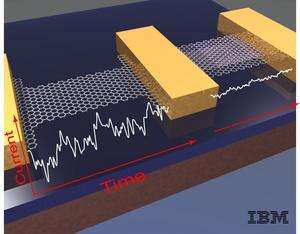
The image shows a single layer, or sheet of carbon molecules known as Graphene. The noise that occurs from electrical signals bouncing around in the material as a current is passed through it is greater as the device is made smaller and smaller, impeding the performance for nanoscale electronics. In the image on the right, the IBM scientists demonstrated for the first time that adding a second sheet of Graphene reduces the noise significantly, giving promise to this material for potential use in future nanoelectronics. Credit: IBM
IBM researchers have discovered a way to use graphite effectively in building nanoelectonic circuits vastly smaller than those in silicon-based computer chips.
IBM researchers today announced a discovery that combats one of the industry's most perplexing problems in using graphite -- the same material found inside pencils -- as a material for building nanoelectonic circuits vastly smaller than those found in today's silicon based computer chips.
For the first time anywhere, IBM scientists have found a way to suppress unwanted interference of electrical signals created when shrinking graphene, a two-dimensional, single-atomic layer thick form of graphite, to dimensions just a few atoms long.
Scientists around the world are exploring the use of graphene as a much smaller replacement for today's silicon transistors. Graphene is a two-dimensional honeycomb lattice of carbon atoms, similar to atomic-scale chicken-wire, which has attracted strong scientific and technological interest because it exhibits promising electrical properties and could be used in transistors and circuits at scales vastly smaller than components inside of today's tiniest computer chips.
One problem in using these nano-devices is the inverse relationship between the size of the device and the amount of uncontrolled electrical noise that is generated: as they are made smaller and smaller, the noise -- electrical charges that bounce around the material causing all sorts of interference that impede their usefulness -- grows larger and larger. This trend is known as Hooge's rule, and occurs in traditional silicon based devices as well as in graphene nano-ribbons and carbon nanotube based devices.
"The effect of noise from Hooge's rule is exaggerated at the nanoscale because the dimensions are approaching the nearly smallest limits, down to only a handful of atoms, and the noise that is created can overwhelm the electrical signal that needs to be achieved to be useful," said IBM Researcher Dr. Phaedon Avouris, who leads IBM's exploration into carbon nanotubes and graphene. "To quote the famous physicist Rolf Landauer, at the nanoscale 'the noise is your signal'; in other words, you cannot produce any useful electronic device at the nanoscale if the noise is comparable to the signal you are trying to switch on and off."
Now, IBM scientists have found that the noise in graphene-based semiconductor devices can, in fact, be suppressed and report the results today in the journal Nano Letters.
In their experiments, the IBM Researchers first used a single layer, or sheet, of graphene to build a transistor and noted that the device does in fact follow Hooge's Rule: as they are made smaller and smaller, there is an increase in the noise that is created.
Two Layers Are Better Than One
However, when the IBM Researchers built the same device with two sheets of graphene instead of one -- one stacked on top of the other -- they noted that the noise is suppressed, and is weak enough that these so-called bilayer graphene ribbons could prove useful for building future semiconductor devices for use in sensors, communications devices, computing systems and more. The noise is inhibited because of the strong electronic coupling between the two graphene layers that counteracts the influence of the noise sources: the system acts as a noise insulator.
While further detailed analysis and studies are required to better understand these phenomena, the findings provide exciting opportunities for graphene bilayers in a variety of applications.
The report on this work, entitled "Strong Suppression of Electrical Noise in Bilayer Graphene Nanoribbons" by Yu-Ming Lin and Phaedon Avouris of IBM's T.J.Watson Research Center in Yorktown Heights, N.Y. is available online at the journal Nano Letters: http://pubs.acs.or … 080241l.html
Source: IBM
-
Engineering professor wins award for pioneering work expected to improve electronic devices
Apr 20, 2011 |
4.5 / 5 (4) |
0
-
Engineers build first sub-10-nm carbon nanotube transistor
Feb 01, 2012 |
4.9 / 5 (31) |
30
-
Something old, something new: Evolution and the structural divergence of duplicate genes
Jan 31, 2012 |
4.6 / 5 (7) |
1
-
The hidden nanoworld of ice crystals: Revealing the dynamic behavior of quasi-liquid layers
Jan 30, 2012 |
5 / 5 (3) |
1
-
Stock market network reveals investor clustering
Jan 27, 2012 |
3.9 / 5 (23) |
8
-
Of microchemistry and molecules: Electronic microfluidic device synthesizes biocompatible probes
Jan 26, 2012 |
5 / 5 (1) |
0
-
polymer nanocomposites
20 hours ago
-
Corrosion Tests on Magnesium
Feb 09, 2012
-
polyethylene copper nanocomposite
Feb 09, 2012
-
Output of xrd analysis
Feb 08, 2012
-
Transport phenomena problem based on problems 18.B11 and 19B.6 from Bird, stewart, lw
Feb 06, 2012
-
Help with material selection - Car Piston
Feb 05, 2012
- More from Physics Forums - Materials & Chemical Engineering
More news stories
What lies beneath: Mapping hidden nanostructures
The ability to diagnose and predict the properties of materials is vital, particularly in the expanding field of nanotechnology. Electron and atom-probe microscopy can categorize atoms in thin sheets of material, ...
13 hours ago |
5 / 5 (1) |
1
New kind of solar cell could capture significantly more energy than current cells
New solar cells could increase the maximum efficiency of solar panels by over 25%, according to scientists from the University of Cambridge.
Feb 08, 2012 |
4.5 / 5 (12) |
14
|
Nanoshell whispering galleries improve thin solar panels
Visitors to Statuary Hall in the U.S. Capitol Building may have experienced a curious acoustic feature that allows a person to whisper softly at one side of the cavernous, half-domed room and for another on ...
Nanotechnology / Nanomaterials
Feb 07, 2012 |
4.3 / 5 (6) |
6
|
'Dark plasmons' transmit energy
Microscopic channels of gold nanoparticles have the ability to transmit electromagnetic energy that starts as light and propagates via "dark plasmons," according to researchers at Rice University.
Feb 09, 2012 |
5 / 5 (6) |
1
|
Revealing how a battery material works
Since its discovery 15 years ago, lithium iron phosphate (LiFePO4) has become one of the most promising materials for rechargeable batteries because of its stability, durability, safety and ability to deliver ...
Nanotechnology / Nanomaterials
Feb 08, 2012 |
5 / 5 (5) |
0
|
Google users warned of threat to smartphone wallets
Users of Google smartphone wallets were being warned on Friday that there is a way to crack pass codes intended to thwart thieves from going on illicit shopping sprees.
Anonymous knocks CIA website offline (Update)
The website of the Central Intelligence Agency was inaccessible on Friday after the hacker group Anonymous claimed to have knocked it offline.
New error-correcting codes guarantee the fastest possible rate of data transmission
Error-correcting codes are one of the triumphs of the digital age. Theyre a way of encoding information so that it can be transmitted across a communication channel such as an optical fiber o ...
Complex wiring of the nervous system may rely on a just a handful of genes and proteins
Researchers at the Salk Institute have discovered a startling feature of early brain development that helps to explain how complex neuron wiring patterns are programmed using just a handful of critical genes. ...
Humans may have helped the decline of African rainforests 3000 years ago
(PhysOrg.com) -- Large areas of rainforests in Central Africa mysteriously disappeared over three thousand years ago, to be replaced by savannas. The prevailing theory has been that the cause was a change ...
The power of estrogen -- male snakes attract other males
A new study has shown that boosting the estrogen levels of male garter snakes causes them to secrete the same pheromones that females use to attract suitors, and turned the males into just about the sexiest ...
Mar 07, 2008
Rank: not rated yet
Stacking adds an extra dimension and therefore degree of freedom for the electrons to travel.
Hency I expect 2 stacked sheets to work better than the same 2 sheets side by side. The more ways electrons can travel the more noise becomes averaged out.