Nearby star should harbor detectable, Earth-like planets
March 7, 2008
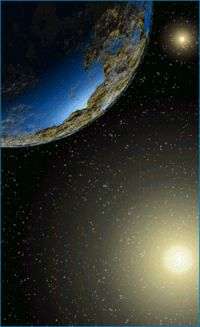
An artist's conception of a terrestrial planet in the star system Alpha Centauri. Image by Mark Fisher.
A rocky planet similar to Earth may be orbiting one of our nearest stellar neighbors and could be detected using existing techniques, according to a new study led by astronomers at the University of California, Santa Cruz.
The closest stars to our Sun are in the three-star system called Alpha Centauri, a popular destination for interstellar travel in works of science fiction. UCSC graduate student Javiera Guedes used computer simulations of planet formation to show that terrestrial planets are likely to have formed around the star Alpha Centauri B and to be orbiting in the "habitable zone" where liquid water can exist on the planet's surface. The researchers then showed that such planets could be observed using a dedicated telescope.
"If they exist, we can observe them," said Guedes, who is the first author of a paper describing the new findings. The paper has been accepted for publication by the Astrophysical Journal.
Coauthor Gregory Laughlin, professor of astronomy and astrophysics at UCSC, said a number of factors converge to make Alpha Centauri B an excellent candidate for finding terrestrial planets. The Doppler detection method, which has revealed the majority of the 228 known extrasolar planets, measures shifts in the light from a star to detect the tiny wobble induced by the gravitational tug of an orbiting planet. Factors that favor the use of this technique for Alpha Centauri B include the brightness of the star and its position in the sky, which gives it a long period of observability each year from the Southern Hemisphere, Laughlin said.
Detecting small, rocky planets the size of Earth is challenging, however, because they induce a relatively small wobble in their host stars. According to Laughlin, five years of observations using a dedicated telescope would be needed to detect an Earth-like planet around Alpha Centauri B.
Coauthor Debra Fischer of San Francisco State University is leading an observational program to intensively monitor Alpha Centauri using the 1.5-meter telescope at the Cerro Tololo Inter-American Observatory in Chile. The researchers hope to detect real planets similar to the ones that emerged in the computer simulations.
"I think the planets are there, and it's worth a try to have a look," Laughlin said.
To study planet formation around Alpha Centauri B, the team ran repeated computer simulations, evolving the system for the equivalent of 200 million years each time. Because of variations in the initial conditions, each simulation led to the formation of a different planetary system. In every case, however, a system of multiple planets evolved with at least one planet about the size of Earth. In many cases, the simulated planets had orbits lying within the habitable zone of the star.
In addition to Guedes, Laughlin, and Fischer, the authors of the paper include UCSC postdoctoral researcher Eugenio Rivera and graduate student Erica Davis, and Elisa Quintana of the SETI Institute. This research was supported by NASA and the National Science Foundation.
Source: University of California, Santa Cruz
-
Setting sight on a single star
May 16, 2011 |
4.6 / 5 (5) |
0
-
Voyager seeks the answer blowin' in the wind
Mar 09, 2011 |
4.9 / 5 (9) |
11
-
Planet hunters no longer blinded by the light
Oct 14, 2010 |
5 / 5 (48) |
14
-
Can we spot volcanoes on alien worlds? Astronomers say yes
Sep 07, 2010 |
4.5 / 5 (11) |
0
-
Seeing the Closest Aliens Will Take Centuries
Apr 29, 2010 |
4.2 / 5 (21) |
30
-
Engineers build first sub-10-nm carbon nanotube transistor
Feb 01, 2012 |
4.9 / 5 (31) |
30
-
Something old, something new: Evolution and the structural divergence of duplicate genes
Jan 31, 2012 |
4.6 / 5 (7) |
1
-
The hidden nanoworld of ice crystals: Revealing the dynamic behavior of quasi-liquid layers
Jan 30, 2012 |
5 / 5 (3) |
1
-
Stock market network reveals investor clustering
Jan 27, 2012 |
3.9 / 5 (23) |
8
-
Of microchemistry and molecules: Electronic microfluidic device synthesizes biocompatible probes
Jan 26, 2012 |
5 / 5 (1) |
0
-
Titan's lack of impact craters
Feb 09, 2012
-
Real pictures of black hole eating a star?
Feb 08, 2012
-
Hypothetical way to travel faster than light, but not technically exceed lightspeed
Feb 06, 2012
-
How do scientists monitor the Sun's activity?
Feb 05, 2012
-
Search patterns in observational studies
Feb 05, 2012
-
Derivation of Pogson's law
Feb 03, 2012
- More from Physics Forums - General Astronomy
More news stories
Humans may have helped the decline of African rainforests 3000 years ago
(PhysOrg.com) -- Large areas of rainforests in Central Africa mysteriously disappeared over three thousand years ago, to be replaced by savannas. The prevailing theory has been that the cause was a change ...
Could Venus be shifting gear?
(PhysOrg.com) -- ESAs Venus Express spacecraft has discovered that our cloud-covered neighbour spins a little slower than previously measured. Peering through the dense atmosphere in the infrared, the ...
Space & Earth / Space Exploration
7 hours ago |
5 / 5 (5) |
7
|
Mars Science Laboratory computer issue resolved
(PhysOrg.com) -- Engineers have found the root cause of a computer reset that occurred two months ago on NASA's Mars Science Laboratory and have determined how to correct it.
Space & Earth / Space Exploration
8 hours ago |
5 / 5 (5) |
3
|
Clam fields found at deep, low-temperature Mariana vents
(PhysOrg.com) -- Scientists have marveled at the unusual life forms thriving at high temperature hydrothermal vents of the deep ocean.
Space & Earth / Earth Sciences
7 hours ago |
not rated yet |
0
|
Two new moons for Jupiter
Advances in technology have lead to the discovery of new planets outside of our Solar System, and now even new moons in our own backyard.
Space & Earth / Space Exploration
7 hours ago |
not rated yet |
5
Complex wiring of the nervous system may rely on a just a handful of genes and proteins
Researchers at the Salk Institute have discovered a startling feature of early brain development that helps to explain how complex neuron wiring patterns are programmed using just a handful of critical genes. ...
CIA website offline, Anonymous takes credit
The website of the Central Intelligence Agency was unresponsive on Friday after the hacker group Anonymous claimed to have knocked it offline.
Q&A: Obama and the birth control controversy
(AP) -- What birth control debate? A half-century after the introduction of the pill, acceptance of birth control by American women is virtually universal.
The power of estrogen -- male snakes attract other males
A new study has shown that boosting the estrogen levels of male garter snakes causes them to secrete the same pheromones that females use to attract suitors, and turned the males into just about the sexiest ...
New error-correcting codes guarantee the fastest possible rate of data transmission
Error-correcting codes are one of the triumphs of the digital age. Theyre a way of encoding information so that it can be transmitted across a communication channel such as an optical fiber o ...
Both maternal and paternal age linked to autism
Older maternal and paternal age are jointly associated with having a child with autism, according to a recently published study led by researchers at The University of Texas Health Science Center at Houston (UTHealth).
Mar 07, 2008
Rank: 5 / 5 (4)
Certainly adds to the odds of planets all over the place too.
Mar 07, 2008
Rank: 5 / 5 (2)
Mar 07, 2008
Rank: 5 / 5 (2)
Mar 07, 2008
Rank: 2.7 / 5 (3)
1. The "perfect" mass of the earth and
2. its velocity allow it to have an
3. orbit of one year(even distribution of heat)
4. which is not extremely elliptical(requirement)
5. sun`s intensity is perfect for the earth`s
orbital distance, keeping us from
freezing/boiling
6. Our moon keeps the earth from shifting around
its spin axis(now at 20 something?)
7. Rotation period around its axis at 24 hrs(one
day.. too long or too short would at least
slow down "evolutionary" progress maybe even
stop it)
8. The right mix of elements allowing life to
form
9. non-binary system a MUST..
apparently about half of the stars in the sky
are binary or three stars in close proximity
10. Must be in a non-cluttered area of the galaxy
(along spiral arms somewhere i guess)
There must be other factors as well but i dont remember them/dont know them/havent been discovered yet.
the more time i spent looking at the article, the more i realised that "habitable" planets are not too easy to come by...
Mar 07, 2008
Rank: 3 / 5 (1)
Mar 08, 2008
Rank: 5 / 5 (3)
1) Earth doesn't have a "perfect mass". It has approximately the minimum mass for Plate Tectonics (could be a bit smaller, but not much). Anything larger than Earth, but small enough to have a reasonable surface gravity will do.
2) Orbital velocity is meaningless to life. Can you feel how fast the Earth is moving? No? Me either.
3) Orbital period is meaningless to life.
4) Yeah, overly elliptical isn't good. But Earth's orbit isn't all that circular. As long as it isn't TOO elliptical, it's fine. Other planets in the Sol system have orbits more circular than Earth's orbit.
5) The sun's intensity doesn't matter. As long as it is a stable, long lived star, and the planet is at the correct distance from that particular star for liquid water to form, it's all cool.
6) That one is kinda funny, cause I've read that before too in old books (not about the moon, but about Earth having the "right" axial tilt). However, more recent research has found that Earth has the SECOND WORST POSSIBLE axial tilt, other than having the poles pointed straight at the sun (70 to 110 degrees is the worst). Our axial tilt makes Earth's environment highly unstable and non-conductive to life.
7) Rotation period isn't all that important. If the planet were tidally locked it would decrease the likelyhood of life, but other than that, anything is fine.
8) Well, what's the right mix? Both Oxygen and water are highly corrosive, incredibly dangerous substances. In fact, our bodies spend a good portion of their energy repairing the constant, nagging damage done to us by the very air that we breath and water that we are made out of. What exists on Earth is the right mix for us because this is were we evolved. If different compounds had existed here (or if the amounts of the current ones were way different), then we would be different to compensate.
9) Not true. Stable planetary systems are more than capable of forming in binary systems. At least, as long as the stars aren't in a weird orbit around each other (... what were the numbers... I don't quite remember... something like... if they are more than 0.1AUs apart AND closer than 6 AUs then a planetary system couldn't form. The numbers were something like that. If they are closer together than 0.1 AU then the planets circle both stars. If they are farther than 6 AU apart then both stars can have their own, separate planets. I don't believe that a figure 8 around both stars is stable though (unfortunately, cause that would just be cool:)).
10) Yup. More or less anyway. It's less likely that a planet will be murdered by a supernovae, radiationed to death by nearby stars, or be tossed out of its orbit if it is in the "habitable zone" of a galaxy. Planets can still form in other locations, but it is less likely that life will be able to live there due to less than stellar conditions (or TOO stellar hehe).
Mar 10, 2008
Rank: not rated yet
Apr 16, 2008
Rank: not rated yet
Or could that actually mean more conductive to life since it would potentially mean more biodiversity and more motive to adapt?