Stratospheric ozone chemistry plays an important role for atmospheric airflow patterns
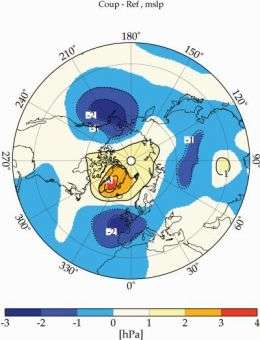
Interactions between the stratospheric ozone chemistry and atmospheric air flow lead to significant changes of airflow patterns from the ground up to the stratosphere. This is the result of climate simulations, which have just been published in the journal Geophysical Research Letters.
Scientists at the Research Unit Potsdam of the Alfred Wegener Institute for Polar and Marine Research, which is a member of the Helmholtz Association, have investigated a fundamental process for climate interactions in the Arctic. So far it is not known what causes natural variations of atmospheric air flow patterns which have been playing an important role for climate changes in the last decades. This basic knowledge is necessary to improve climate models that still hold much uncertainty.
Atmospheric airflows follow preferred patterns. The most important pattern for the northern hemisphere is the Arctic Oscillation. It’s a spacious oscillation of the atmosphere that is characterised by opposing anomalies in air pressure in the central Arctic region and in parts of the mid- and subtropical latitudes. This oscillation of the atmosphere lasts for decades and is more or less pronounced. In the positive phase, which has been predominant since 1970, the polar vortex during winter times is stable and the exchange of air masses between the mid- and higher latitudes is limited. In midlatitudes strong westerly winds bring warm air from the Atlantic Ocean to North and Central Europe and Siberia during the winter season. In the negative phase of the Arctic Oscillation cold polar air can penetrate further south and leads to harsh winter seasons in Europe.
So far feedbacks between chemical processes in the stratosphere and the circulation in the troposphere and stratosphere (height between 0 and 10 kilometres or 10 and about 50 kilometres) are not included in complex global climate models linking atmosphere and ocean. For the first time, scientists from the Alfred Wegener Institute have included a module of stratospheric ozone chemistry into a coupled global climate model. The scientists show that ozone chemistry significantly influences the Artic Oscillation by comparing simulations of the standard model with results from the model extended by the new ozone chemistry module. Changes of atmospheric air flows and temperature distribution lead to an increase of the negative phase of the Artic Oscillation during the winter seasons.
"Our research is an important contribution to reduce the uncertainty in the simulation of today’s climate. Today’s climate models carry, contrary to many claims, still a high level of uncertainty. Only by understanding the basic processes in the Arctic, can we quantify these deviations and eliminate them," said Sascha Brand of the Alfred Wegener Institute, main author of the published study. The results indicate that if interactions between atmospheric air flow and stratospheric ozone chemistry are being taken into account, they will also have an influence on the stability of the polar vortex in the simulation of future climate developments and should therefore be included in climate models. In a follow-up project, the new model will be used for the calculation of future climate developments.
Source: Alfred Wegener Institute for Polar and Marine Research


