Bringing Second Life To Life: Researchers Create Character With Reasoning Abilities of a Child
March 10, 2008
Troy, N.Y. – Today’s video games and online virtual worlds give users the freedom to create characters in the digital domain that look and seem more human than ever before. But despite having your hair, your height, and your hazel eyes, your avatar is still little more than just a pretty face.
A group of researchers from Rensselaer Polytechnic Institute is working to change that by engineering characters with the capacity to have beliefs and to reason about the beliefs of others. The characters will be able to predict and manipulate the behavior of even human players, with whom they will directly interact in the real, physical world, according to the team.
At a recent conference on artificial intelligence, the researchers unveiled the “embodiment” of their success to date: “Eddie,” a 4-year-old child in Second Life who can reason about his own beliefs to draw conclusions in a manner that matches human children his age.
“Current avatars in massively multiplayer online worlds — such as Second Life — are directly tethered to a user’s keystrokes and only give the illusion of mentality,” said Selmer Bringsjord, head of Rensselaer’s Cognitive Science Department and leader of the research project. “Truly convincing autonomous synthetic characters must possess memories; believe things, want things, remember things.”
Such characters can only be engineered by coupling logic-based artificial intelligence and computational cognitive modeling techniques with the processing power of a supercomputer, according to Bringsjord.
The principles and techniques that humans deploy in order to understand, predict, and manipulate the behavior of other humans is collectively referred to as a “theory of mind.” Bringsjord’s research group is now starting to engineer part of that theory, which would allow artificial agents to understand, predict, and manipulate the behavior of other agents, in order to be genuine stand-ins for human beings or autonomous intellects in their own right.
The logico-mathematical theory will include rigorous, declarative definitions of all of the concepts central to a theory of the mind, including lying, betrayal, and even evil, according to Bringsjord.
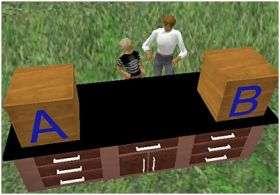
To test “Eddie’s” reasoning powers, the group created a demo in Second Life that subjected their theory to a false-belief test.
In a typical real-life version of this test, a child witnesses a series of events in which Person A places an object (such as a teddy bear) in a certain location (such as a cabinet). Person A then leaves the room, and during his absence Person B moves the object to a new location (such as the refrigerator). The child is then asked to predict where Person A will look for the object when he gets back.
The right answer, of course, is the cabinet, but children age 4 and under will generally say the refrigerator because they haven’t yet formed a theory of the mind of others.
The researchers recreated the same situation in Second Life, using an automated theorem prover coupled with procedures for converting conversational English in Second Life into formal logic, the native language of the prover.
When the code is executed, the software simulates keystrokes in Second Life. This enables control of “Eddie,” who demonstrates an incorrect prediction of where Person A will look for the teddy bear — a response consistent with that of a 4-year old child. But, in an instant, Eddie’s mind can be improved, and if the test is run again, he makes the correct prediction.
A video clip of the “False Belief in Second Life” demonstration is available online at: http://www.cogsci. … rair/asc_rca.
“Our aim is not to construct a computational theory that explains and predicts actual human behavior, but rather to build artificial agents made more interesting and useful by their ability to ascribe mental states to other agents, reason about such states, and have — as avatars — states that are correlates to those experienced by humans,” Bringsjord said. “Applications include entertainment and gaming, but also education and homeland defense.”
This research is supported by IBM and other outside sponsors, and the team hopes to engineer a version of the Star Trek holodeck — a virtual reality system used onboard the starships that allowed users to interact with the projected holograms of other individuals. Such a system could allow cognitively robust synthetic characters to interact directly with human beings, according to Bringsjord.
The proposed research would require the use of two of Rensselaer’s state-of-the-art research facilities — the Computational Center for Nanotechnology Innovations (CCNI) and the Experimental Media and Performing Arts Center (EMPAC).
The most powerful university-based supercomputing system in the world, the CCNI is made up of massively parallel Blue Gene supercomputers, POWER-based Linux clusters, and AMD Opteron processor-based clusters, providing more than 100 teraflops of computing power.
Video Clip -- False Belief in Second Life:
MOV: http://www.cogsci. … .Failure.mov
WMV: http://www.cogsci. … .Failure.wmv
Source: Rensselaer Polytechnic Institute
-
My connectome, myself
Feb 07, 2012 |
not rated yet |
2
-
A galactic magnetic field in a lab bolsters astrophysical theory
Jan 25, 2012 |
4.9 / 5 (14) |
10
-
5 Questions: Rando on resetting the 'aging clock,' cell by cell
Jan 23, 2012 |
4.7 / 5 (3) |
0
-
Briton with locked-in syndrome wants right to die
Jan 23, 2012 |
5 / 5 (1) |
0
-
Scientists replicate key evolutionary step in life on earth
Jan 16, 2012 |
4.8 / 5 (46) |
501
-
Engineers build first sub-10-nm carbon nanotube transistor
Feb 01, 2012 |
4.9 / 5 (30) |
30
-
Something old, something new: Evolution and the structural divergence of duplicate genes
Jan 31, 2012 |
4.6 / 5 (7) |
1
-
The hidden nanoworld of ice crystals: Revealing the dynamic behavior of quasi-liquid layers
Jan 30, 2012 |
5 / 5 (3) |
1
-
Stock market network reveals investor clustering
Jan 27, 2012 |
3.9 / 5 (23) |
8
-
Of microchemistry and molecules: Electronic microfluidic device synthesizes biocompatible probes
Jan 26, 2012 |
5 / 5 (1) |
0
-
Synergistic relations between computer science and technology.
Feb 06, 2012
-
how do iphone gloves work?
Feb 05, 2012
-
iPhone battery over time
Jan 30, 2012
-
Best alternate Tablet to an iPad for writing math or physics equations?
Jan 26, 2012
-
Sending SMS to a website
Jan 20, 2012
-
Need help with my technical fest!
Jan 19, 2012
- More from Physics Forums - Computing & Technology
More news stories
Zuckerberg's focus drives Facebook's ascent
When Mark Zuckerberg showed up to rent Judy Fusco's Los Altos, Calif., house in the fall of 2004, soon after he'd arrived in Silicon Valley, the landlord was immediately struck by his confidence.
36 minutes ago |
1 / 5 (1) |
0
Netflix light on flicks as viewers soak up TV shows
Like most fresh faces that arrive in Hollywood, Netflix wanted to be a movie star. But now it's learning what many in Tinseltown have known for decades: Movies are sexy, but the real money is in television.
1 hour ago |
not rated yet |
1
New error-correcting codes guarantee the fastest possible rate of data transmission
Error-correcting codes are one of the triumphs of the digital age. Theyre a way of encoding information so that it can be transmitted across a communication channel such as an optical fiber o ...
Technology / Computer Sciences
4 hours ago |
5 / 5 (3) |
2
|
Small modular reactor design could be a 'SUPERSTAR'
(PhysOrg.com) -- Though most of today's nuclear reactors are cooled by water, we've long known that there are alternatives; in fact, the world's first nuclear-powered electricity in 1951 came from a reactor ...
Technology / Energy & Green Tech
4 hours ago |
5 / 5 (6) |
10
|
Sony's Hirai refuses to abandon dire TV business
Struggling Japanese entertainment giant Sony will not abandon its cash-bleeding television business, its incoming CEO says, but he acknowledges tough decisions lie ahead including over redundancies.
2 hours ago |
not rated yet |
0
New understanding of DNA repair could eventually lead to cancer therapy
A research group in the Faculty of Medicine & Dentistry at the University of Alberta is hoping its latest discovery could one day be used to develop new therapies that target certain types of cancers.
Antidepressants and pregnancy: Women must consider the impact of drugs on baby, and of depression on baby, themselves
Upon learning they are pregnant, most women dutifully nix the alcohol, sushi and caffeine. But what about antidepressants?
Both maternal and paternal age linked to autism
Older maternal and paternal age are jointly associated with having a child with autism, according to a recently published study led by researchers at The University of Texas Health Science Center at Houston (UTHealth).
Night, weekend delivery OK for babies with birth defects
Weekday delivery is no better than night or weekend delivery for infants with birth defects, according to a new study presented today at The Pregnancy Meeting, the Society for Maternal-Fetal Medicine's annual conference. ...
Sonic Cradle lands spot in TED exhibition
A Simon Fraser University graduate student project that melds music, meditation and modern technology has landed a rare spot as an exhibit at TEDActive 2012 in Palm Springs, California this month.
From virginity to Viagra
Americans will spend more than $17 billion on Valentine's Day, but far less on programs like sex education for adolescents. The editors of the new book, Sex for Life, From Virginity to Viagra, How Sexuality Changes Throughout ...
Mar 10, 2008
Rank: not rated yet
Mar 10, 2008
Rank: 1 / 5 (1)
Mar 11, 2008
Rank: not rated yet
I have yet to understand the fascination with second life, it looks worse than a 10-15 year old game.
Mar 11, 2008
Rank: not rated yet
Mar 11, 2008
Rank: not rated yet
The research item is something I have some reservations with. Why have an avatar answering stupid questions as if it is stupid? Why not some insights in the logarithms developed? Sorry, but I am very skeptic here. I've seen online bots that show more intelligence than this. Bots didn't need to be adjusted to anticipate in a custom 3D engine. How is sight defined here?
Further, logarithms like these are triggered by understanding language. There is no other way besides scripting or cheating. Understanding language in context is the biggest goal right now since language is actually intelligence. Somehow these researchers figured out something to surpass the language quest and come up with a algorithm that remembers the first state of a proposition? Within a custom 3D environment?
I am very sorry if I'm wrong. I do encourage research and I do enjoy publications, but this article is not convincing on several points.
Mar 14, 2008
Rank: not rated yet
Sure, much of Second Life has been seen before (virtual world, lots of people, what's new?). But believe me, no other platform has ever come close to the user-driven content creation it offers. *Anybody* can make potentially permanent content for it, without much effort at all or separate software.
Sure, the graphics aren't as pretty as lots of games, but there are several reasons. The onus is partly on the users... if you learn how to make pretty things, then you'll see pretty things! Besides that, the performance suffers due to the fact that, again, all the content is user-created, so it needs to be downloaded/updated regularly to maintain itself. And so on...
Anyway, on to this research!
First of all, these guys are not developing a bot. A bot is generally a fairly dumb system built on rules, states, and/or neural-networks, using various tricks and illusions, built for a particular purpose (e.g. fighting).
These guys are trying to go much deeper, creating a generic reasoning system. Remember: understanding is not knowledge. Machines are largely limited from human-level intelligence by the difficulty in storing and searching such large quantities of data as the human mind (machines store knowledge and infer association, whereas humans store associations *and* knowledge).
Furthermore, this AI does not run within SL. The scripting language (LSL) is indeed far too slow and limited for this (16k VM's!). Rather, as the article states, the AI runs as a separate entity, interacting with SL in very much the same way as a human would (through keystrokes or whatever).
Phew... what a long comment! :)
Mar 11, 2009
Rank: not rated yet
I think the game itself due to its nature offers a perfect interaction of Eddie with the simulated real world, but not so less-than-real for Eddie since it would be no difference for his brain cognition (as for the specific project) to having engineered hands and eyes and acting in a physical environment, than having simulation routines which is much easier, considering the fact that the characters in the game making decisions are real people.
That said, I second your idea, in fact I was thinking about this last night after a class on "philosophy of mind" and a reportage about avatars.
In conclusion, I hope your Eddie will grow smart and pass the Turing test.