Finally, the 'planet' in planetary nebulae? New studies may vindicate 300-year-old astronomical 'mistake'
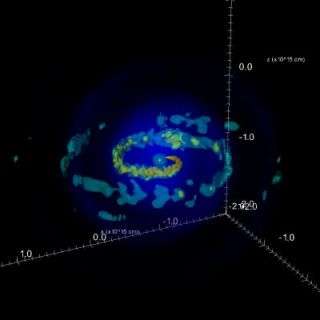
Astronomers at the University of Rochester, home to one of the world’s largest groups of planetary nebulae specialists, have announced that low-mass stars and possibly even super-Jupiter-sized planets may be responsible for creating some of the most breathtaking objects in the sky.
The news is ironic because the name “planetary” nebula has always been a misnomer. When these objects were discovered 300 years ago, astronomers couldn’t tell what they were and named them for their resemblance to the planet Uranus. But as early as the mid-19th century, astronomers realized these objects are really great clouds of dust emitted by dying stars.
Now, Rochester researchers have found that planets or low-mass stars orbiting these aged stars may indeed be pivotal to the creation of the nebulae’s fantastic appearance.
In a new paper in Astrophysical Journal Letters, and in recent papers in Monthly Notices of the Royal Astronomical Society, a team of astronomers anchored by Eric Blackman, professor of physics and astronomy at the University of Rochester, has studied the consequences of a dying star that possesses an orbiting companion.
“Few researchers have explored how something as small as a very low-mass star, a brown dwarf, or even a massive planet can produce several flavors of nebulae and even change the chemical composition of the dust around these evolved stars,” says Blackman. “If the companions can be this small, it’s important because low-mass stars and high-mass planets are likely quite common and could go a long way toward explaining the many dusty shapes we see surrounding these evolved stars.”
Most medium-sized stars, such as our Sun, will end their lives as planetary nebulae, says Blackman. The stage lasts only several tens of thousands of years—a blink of an eye for stars that typically live ten billion—so it is a relatively rare sight. Of the 200 billion stars in our own galaxy, only about 1,500 have so far been identified in the planetary nebula stage.
As the star begins to deplete its fuel near the end of its life, its core contracts and its envelope expands, eventually throwing off its outermost layers millions of miles into space. Blackman says one time in five, this envelope keeps its roughly spherical shape as it expands, but much more often this envelope contorts and elongates into new and fantastic shapes.
The Rochester team’s work explored the role of low-mass companions in shaping planetary nebulae stars, both when the companion is in a large orbit and interacts with only the very outer edges of the envelope, and when the companion is in a very tight orbit and so close to the evolved star that the companion is fully engulfed by the envelope.
Blackman, along with post-doctoral fellow Richard Edgar, graduate student Jason Nordhaus, and professor of astrophysics Adam Frank, showed that in the case when the planet or companion star is in a very wide orbit, the planet’s gravity begins to drag some of the envelope material around with it. The envelope material—essentially a thin mixture of gas and dust—becomes compressed in spiral waves radiating out from the central star like a twisted wagon wheel, says Blackman. The dust and gas compresses more and more in these spiral waves until they crest, much like waves breaking on a beach. Eventually, a torus of dust forms around the star’s mid-section, likely blocking much of the expanding envelope like a belt around an inflating balloon. Over time, such constrained expansion can lead to striking shapes, such as seen in the appropriately named Dumbbell Nebula.
“Originally, we set out just to model the geometry of the envelope under the influence of a binary companion” says Blackman, “but Richard Edgar discovered that as the spiral waves break, they release their compressed, pent-up energy in a burst of heat, sufficient to melt the dust into liquid globules.” The globules cool slowly enough to give the molecules within time to align into crystal lattices. Blackman says the team’s work show’s how a waist-cinching torus could originate to produce certain types of planetary nebula patterns, but it also suggests an answer for why astronomers have detected the puzzling signature of crystallized dust around evolved stars before the nebulae is formed.
In the case when the planet orbits so closely to the primary star that it becomes engulfed by the envelope, a new type of model is needed. Nordhaus and Blackman modeled what might happen as the envelope slows the low-mass star or high-mass planet companion, and found that one of three outcomes is likely to occur.
First, as the companion plows through the envelope material, it can “spin up” the envelope so quickly that the material is ejected, deforming into a large disk or torus around the star’s equator.
A second possibility is that the companion spins up the envelope more gently. This causes the inner regions of the envelope to spin around the parent star faster than the outer envelope material. This difference in rotation speeds, combined with the convection of material in the envelope, stretches and amplifies the star’s magnetic fields. The stretched magnetic fields can act like a giant spring, ejecting the envelope material out the star’s poles as jets.
The third outcome sees the companion itself ejecting out the star’s jets, says Blackman. This scenario applies when the companion is an extremely low-mass star or a massive planet that is too small to eject the envelope before it falls to a violent fate. The parent’s intense gravity can shred the planet as its orbit shrinks, eventually smearing the planet into a disk of debris around the star. This disk is very turbulent and different parts are orbiting at different speeds, generating a magnetic dynamo that again can throw material out the star’s poles at tremendous speeds. Unlike the previous scenario, however, Blackman says that material fired out by these jets would include the remains of the planet or companion star itself.
The Rochester team is now calculating the dynamics of the binary relationship and the characteristics of the magnetic dynamos with more precision. They hope to better understand how these dynamos might facilitate the mixing and transportation of different elements within the nebulae to help produce the distinct chemical signatures astronomers now detect in planetary nebulae.
Source: University of Rochester


