Silver Nanoparticles Deadly to Bacteria
March 10, 2008 Silver Nanoparticles Deadly to Bacteria

Enlarge

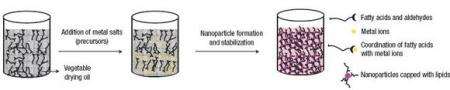
Schematic diagram of in situ synthesis and stabilization of silver nanoparticles in drying oils. Copyright: Nature Materials, 2008.

Hygienic, antibacteria sprays can be harmful to the environment as well as germs. Toxic solvents are necessary to ensure that bacteria is destroyed but now there could be a new way to achieve this without the environment paying the price.

In new work published this month in Nature Materials, George John and his team at the City College of New York, in collaboration with Pulickel Ajayan's research group at Rice University, Houston, US, have developed an antibacterial paint based on silver nanoparticles embedded vegetable oils that can be used to coat a wide range of surfaces, including wood, plastic, and glass.

Silver, and silver-based compounds, is highly antimicrobial thanks to its antiseptic properties to several species of bacteria, including the common kitchen microbe, E. coli. Silver nanoparticles interact with the outer membrane of bacteria, causing structural changes that lead to degradation and eventually death of the microbe.

In contrast to the usual methods of producing metal nanoparticles, which involve the use of toxic solvents and highly reactive chemical reducing agents, the paint is produced in a simple, cost-effective, and environmentally safe manner, because the nanoparticles are synthesized directly in the paint itself. The team's new method makes use of a natural, oxidative property of paint that occurs during drying.

In most household paints the binding agent is based on alkyd resin, vegetable-derived drying oils that release free-radical particles during the drying process. When a silver compound is added to the paint, the free radicals act as a natural reducing agent, transforming the metal salt into metal nanoparticles. The nanoparticles are relatively low in concentration and are tightly bound into the polymer network of the binder. The process is simple, inexpensive, and importantly, harmless to the environment.

To test the antibacterial properties of the paint, the team incubated E. coli bacteria overnight on a plain glass slide, a slide coated in normal paint, and a slide coated with the nanoparticle paint. They found that the paint embedded with silver particles killed all the bacteria in comparison to the control slides, a result that confirms that the nanoparticles are toxic to bacteria.

The novel fabrication technique is good news for the environment and the germ-killing paint has far-reaching applications, particularly in the medical, cleaning, and food-preparation industries. "The alkyd paints could be used for both indoor and exterior uses," explained George John. "The excellent antibacterial activity means that the paint could easily be used to coat hospital counter tops, for example, and similar places where there is a potential bacterial contamination."

Article information: Nature Materials, 2008, doi:10.1038/nmat2099

Source: by Sophie Ladden, Wiley


print this article email this article download pdf blog this article bookmark this article     Stumble it Digg this share on Facebook retweet share on Reddit add to delicious
Rate this story - 3.6 /5 (36 votes)


March 10, 2008 all stories

Comments: 0

3.6 /5 (36 votes)
  • Stumble this up

  • Digg this

  • share this

  • hide
  • Related Stories

  • Switched-on new nanotechnology paints for hospitals could kill superbugs
    created Sep 09, 2008 | popularity not rated yet | comments 0
  • Fate of nanoparticles
    created Aug 30, 2004 | popularity not rated yet | comments 0
  • Nanoparticles used in common household items caused genetic damage in mice
    created Nov 16, 2009 | popularity not rated yet | comments 0
  • TraDIS technique tackles typhoid
    created Oct 16, 2009 | popularity not rated yet | comments 0
  • School drinking water contains toxins
    created Sep 25, 2009 | popularity not rated yet | comments 0


  • hide
  • Relevant PhysicsForums posts

  • What is transpulmonary pressure?
    created 2 hours ago
  • Is there a gay gene?
    created Nov 23, 2009
  • Super quick question about Starling forces?
    created Nov 22, 2009
  • Questions about diffusion
    created Nov 22, 2009
  • More from Physics Forums - Biology

Other News

Peptides control crystal growth with 'switches, throttles and brakes'

Peptides control crystal growth with 'switches, throttles and brakes'

Nanotechnology / Bio & Medicine

created 18 hours ago | popularity 5 / 5 (3) | comments 0

(PhysOrg.com) -- By producing some of the highest resolution images of peptides attaching to mineral surfaces, scientists have a deeper understanding how biomolecules manipulate the growth crystals. This research ...


Water droplets direct self-assembly process in thin-film materials

Nanotechnology / Nanomaterials

created 18 hours ago | popularity 5 / 5 (4) | comments 2

You can think of it as origami - very high-tech origami. Researchers at the University of Illinois have developed a technique for fabricating three-dimensional, single-crystalline silicon structures from thin films by coupling ...


Nanoparticles used in common household items caused genetic damage in mice

Nanotechnology / Bio & Medicine

created Nov 16, 2009 | popularity 4.8 / 5 (24) | comments 11

Titanium dioxide (TiO2) nanoparticles, found in everything from cosmetics to sunscreen to paint to vitamins, caused systemic genetic damage in mice, according to a comprehensive study conducted by researchers at UCLA's Jonsson ...


Nanotube defects equal better energy and storage systems

Nanotube defects equal better energy and storage systems

Nanotechnology / Nanomaterials

created Nov 19, 2009 | popularity 4.4 / 5 (10) | comments 2

(PhysOrg.com) -- Most people would like to be able to charge their cell phones and other personal electronics quickly and not too often. A recent discovery made by UC San Diego engineers could lead to carbon ...


Using superconducting probes to get a picture of what it's like inside CNTs

Nanotechnology / Nanophysics

created Nov 20, 2009 | popularity 4.4 / 5 (9) | comments 0

(PhysOrg.com) -- "Carbon nanotubes are exciting for fundamental physics, and for potential technological applications," Nadya Mason tells PhysOrg.com. "However, we are generally limited in the way that we can study them. ...