Microneedles Could Replace Syringe
March 10, 2008
Microneedles Could Replace Syringe

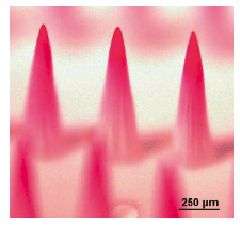
Side view of PVP polymer microneedles with sulforhodamine encapsulated within microneedles. Each microneedle measures 750 µm in height, 250 µm in base diameter, and 5 µm in tip radius. Credit: Advanced Materials, 2008.

The common needle phobia and painful injections could soon be a thing of the past, thanks to a revolutionary new drug-delivery technique developed by a team at the Georgia Institute of Technology, US. The long-practiced method of drug administration has up to now involved the use of hypodermic needles but they have many drawbacks, including pain, risk of infection, and the need for trained staff to perform the injection.

The very few non-invasive methods of drug delivery, such as the transdermal patch, best known in its role as the smokers' nicotine patch, are unsuitable for most drugs as only very small molecules can be transported across intact skin, which excludes the large biotherapeutic molecules found in many medicines.

But what if there was another way, one that was as safe and painless as a patch but as fast and effective as an injection? In a revolutionary new study published in this month's Advanced Materials, the researchers at Georgia Tech. have designed tiny "microneedles", only five micrometers wide at the tip, which can quickly and painlessly deliver drugs into the body and are as effective as a hypodermic.

The drug, in the form of biomolecules, is encapsulated within the microneedles, which are then inserted into the skin in the same way that nicotine is released into the bloodstream from a patch. The needles dissolve within minutes, releasing the trapped cargo at the intended delivery site. They do not need to be removed and no dangerous or biohazardous substance is left behind on the skin.

The researchers chose the mechanically strong polymer poly(vinyl pyrrolidone) (PVP) to fabricate the microneedles because it is robust enough to pierce the skin, dissolves quickly, and is harmless to the body. The molding technique used to prepare the needles means that the rate at which they dissolve can be precisely tuned, depending on how much time is needed for them to travel through the body to the delivery site.

This innovative new treatment method means that vaccines, proteins, and hormones could soon be delivered into the body as effortlessly and painlessly as wearing a plaster. So could needle phobia soon be a thing of the past?

"We expect that microneedles will be able to replace hypodermic needles in some scenarios, but certainly not all cases," said Dr. Mark Prausnitz, who headed up the research. "They won't be useful for withdrawing significant quantities of blood for analysis, for example."

However, the team does expect that the microneedles will have important medical and biotechnology applications. "They are a useful way to deliver vaccines," explained Prausnitz. "Microneedles could possibly enable self-administration of the annual flu vaccine and a number of drugs, including insulin and growth hormone."

Article information: Advanced Materials, 2008, 20, 933; doi: 10.1002/adma.200701205

Source: by Sophie Ladden, Wiley

4.7 /5 (15 votes)  

Filter


Move the slider to adjust rank threshold, so that you can hide some of the comments.


Display comments: newest first

sheber
Mar 10, 2008

Rank: not rated yet
Finally, the 21st century may see an end to the sadistic practice of shoving several large needles into babies thighs!!!
googleplex
Mar 11, 2008

Rank: not rated yet
Ditto.
PVP appears to be safe so long as it's pure and not de-polymerized back to its monomer. The monomer is very bad. http://en.wikiped...povidone
weewilly
Mar 11, 2008

Rank: not rated yet
This scares me when you think about what has happened in a mighty big way in Las Vegas recently. How will any patient ever know if it is safe and germ free??? Will it be an improvement or will this be a source of worry for us as short cuts are used by our long trusted Medical professionals. Some trust huh?
Rank 4.7 /5 (15 votes)
Tags

Relevant PhysicsForums posts
  • Doubts about surface plasmons
    createdFeb 11, 2012
  • excited U-236 decay time in the U235 fission chain
    createdFeb 09, 2012
  • Polar catastrophe?
    createdFeb 09, 2012
  • Large scale field sonication
    createdFeb 09, 2012
  • states and energy of paired electrons in BCS
    createdFeb 08, 2012
  • difference between longitudinal and transverse refractive indices
    createdFeb 08, 2012
  • More from Physics Forums - Atomic, Solid State, Comp. Physics

More news stories

Explained: Sigma

It's a question that arises with virtually every major new finding in science or medicine: What makes a result reliable enough to be taken seriously? The answer has to do with statistical significance -- but ...

Physics / General Physics

created Feb 09, 2012 | popularity 5 / 5 (20) | comments 76

Quantum physicist explains $100K offer for proof scaled-up quantum computing is impossible

(PhysOrg.com) -- MIT researcher Scott Aaronson has certainly riled the physics community with his offer this past Friday, of $100,000 to anyone who can prove that scaled-up quantum computing is impossible. ...

Physics / Quantum Physics

created Feb 08, 2012 | popularity 4.3 / 5 (15) | comments 37 | with audio podcast weblog

Diamond light, brighter than the sun

It’s the size of five football pitches and generates light 10 billion times brighter than the sun. As the Diamond Light Source celebrates its tenth anniversary this year, Penny Bailey visits one of the ...

Physics / General Physics

created Feb 07, 2012 | popularity 4.1 / 5 (10) | comments 18 | with audio podcast

Physicists 'record' magnetic breakthrough

An international team of scientists has demonstrated a revolutionary new way of magnetic recording which will allow information to be processed hundreds of times faster than by current hard drive technology.

Physics / General Physics

created Feb 07, 2012 | popularity 4.6 / 5 (43) | comments 15 | with audio podcast

Hints of the Higgs - papers are submitted

Back in December 2011, the ATLAS and CMS experiments at CERN presented some exciting results that provided tantalising hints of the Higgs boson.

Physics / General Physics

created Feb 08, 2012 | popularity 4.3 / 5 (8) | comments 10


Declining health-care productivity in England: Who says so?

Reports that the National Health Service in England has been declining in productivity in the last decade appear to have been accepted as fact. However, a Viewpoint published Online First by The Lancet disputes this. The Vi ...

Scientists discover molecular secrets of 2,000-year-old Chinese herbal remedy

For roughly two thousand years, Chinese herbalists have treated Malaria using a root extract, commonly known as Chang Shan, from a type of hydrangea that grows in Tibet and Nepal. More recent studies suggest that halofuginone, ...

Overeating may double risk of memory loss

New research suggests that consuming between 2,100 and 6,000 calories per day may double the risk of memory loss, or mild cognitive impairment (MCI), among people age 70 and older. The study was released today and will be ...

New method to examine batteries -- MRI from the inside

There is an ever-increasing need for advanced batteries for portable electronics, such as phones, cameras, and music players, but also to power electric vehicles and to facilitate the distribution and storage of energy derived ...

A mitosis mystery solved: How chromosomes align perfectly in a dividing cell

Although the process of mitotic cell division has been studied intensely for more than 50 years, Whitehead Institute researchers have only now solved the mystery of how cells correctly align their chromosomes during symmetric ...

Lab study raises questions over nano-particle impact

Tests involving chickens have raised questions about the impact on health from engineered nano-particles, the ultra-fine grains commonly used in drugs and processed foods, scientists said on Sunday.