New detector can 'see' single neutrons over broad range
March 10, 2008 New NIST Detector Can 'See' Single Neutrons Over Broad Range

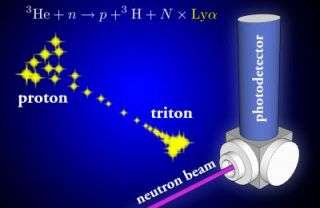
Neutron absorption by 3He yields tens of Lyman alpha photons, which result from the most fundamental energy jump in the hydrogen atom. This schematic illustrates the operation of a prototype Lyman alpha neutron detector. Credit: NIST

Researchers at the National Institute of Standards and Technology (NIST) and the University of Maryland have developed a new optical method that can detect individual neutrons and record them over a range of intensities at least a hundred times greater than existing detectors.

The new detector, described at the March Meeting of the American Physical Society by Charles Clark, a Fellow of the Joint Quantum Institute of NIST and the University of Maryland, promises to improve existing neutron measurements and enable tests of new phenomena beyond the Standard Model, the basic framework of particle physics.

The prototype laboratory device is based on a process first observed by the research team: the emission of light from hydrogen atoms produced when neutrons are absorbed by helium-3 atoms (3He). Lyman alpha light, discovered by Harvard physicist Theodore Lyman in 1906, results from the jump between the two lowest-energy states of the hydrogen atom.

Although it is the brightest light emitted by the sun and is one of the most abundant forms of light in the universe, Lyman alpha is invisible to the eye because it lies in the far ultraviolet region of the optical spectrum. It is strongly absorbed by most substances and can travel through only about a millimeter of air.

Helium gas, however, does not absorb Lyman alpha light. When a neutron is absorbed by a helium-3 atom, one atom of hydrogen and one atom of tritium (a heavy form of hydrogen) are produced. These atoms fly apart at high speeds, can be excited by collisions with surrounding helium gas, and subsequently emit Lyman alpha light. This light is recorded by the new device, known as the Lyman alpha neutron detector (LAND).

Using an ultracold neutron beam at the NIST Center for Neutron Research, the research team has discovered that Lyman alpha light is generated with surprisingly high efficiency: about 40 photons are generated per neutron for helium gas at atmospheric pressure. According to Alan Thompson, neutron expert on the team, “This device thus has the potential to detect both single neutrons and large numbers of neutrons, which is very difficult to do with present neutron detectors based on electrical discharges.”

The use of an optical means of detection, rather than an electronic one, also offers the prospect of at least a hundredfold improvement in neutron detectors’ dynamic range (the spread in recordable neutron intensity from faint to bright). This stems from the fact that optical detectors respond more quickly than electronic detectors (which suffer from longer periods of inactivity known as “dead time.”)

With further development, this new method can potentially lead to better measurements at existing neutron facilities (for example, neutron diffraction instruments at the NIST Center for Neutron Research) and enable new tests of physics beyond the Standard Model. Measurements at NIST of a property in neutrons known as the electric dipole moment and more precise measurements of the neutron lifetime are planned.

Source: National Institute of Standards and Technology


print this article email this article download pdf blog this article bookmark this article     Stumble it Digg this share on Facebook retweet share on Reddit add to delicious
Rate this story - 4.6 /5 (7 votes)


March 10, 2008 all stories

Comments: 0

4.6 /5 (7 votes)
  • Stumble this up

  • Digg this

  • share this

  • hide
  • Related Stories

  • Lunar Reconnaissance Orbiter's first moon images available
    created Jul 02, 2009 | popularity not rated yet | comments 0
  • Crafty Tricks for Finding Moon Water
    created Mar 28, 2008 | popularity not rated yet | comments 0
  • Prospecting for Lunar Water
    created Apr 29, 2005 | popularity not rated yet | comments 0
  • The Crab Nebula: Energy for 100,000 Suns
    created Nov 23, 2009 | popularity not rated yet | comments 0
  • Rich Ore Deposits Linked to Ancient Atmosphere
    created Nov 19, 2009 | popularity not rated yet | comments 0


  • hide
  • Relevant PhysicsForums posts

  • Elementary question involving turkey thaw process!
    created 3 hours ago
  • Spin Polarization
    created 5 hours ago
  • Entropy
    created 5 hours ago
  • Bicycle wheel size question.
    created 6 hours ago
  • More from Physics Forums - General Physics

Other News

Scientists react as they stand in front of a screen at CERN

First atoms reported smashed in Large Hadron Collider (Update)

Physics / General Physics

created Nov 23, 2009 | popularity 4.6 / 5 (29) | comments 21

Two circulating beams on Monday produced the first particle collisions in the world's biggest atom smasher, the Large Hadron Collider (LHC), three days after its restart, scientists announced.


Restored machine to explore mysteries of Big Bang (AP)

Restored machine to explore mysteries of Big Bang

Physics / General Physics

created Nov 21, 2009 | popularity 4.6 / 5 (18) | comments 26

(AP) -- Scientists are preparing the world's largest atom smasher to explore the depths of matter after successfully restarting the $10 billion machine following more than a year of repairs.


In the Brain, Seven Is A Magic Number

In the Brain, Seven Is A Magic Number

Physics / General Physics

created Nov 23, 2009 | popularity 4.5 / 5 (32) | comments 9

Having a tough time recalling a phone number someone spoke a few minutes ago or forgetting items from a mental grocery list is not a sign of mental decline; in fact, it's natural.


nuclear power plant

Doubts raised on nuclear industry viability

Physics / General Physics

created Nov 19, 2009 | popularity 3.1 / 5 (21) | comments 19

(PhysOrg.com) -- The investment in nuclear power has been growing around the world over the last few years, being viewed as a means for countries to control their energy security, avoid the price fluctuations ...


Proton's party pals may alter its internal structure

Proton's party pals may alter its internal structure

Physics / General Physics

created Nov 18, 2009 | popularity 4.6 / 5 (20) | comments 9

A recent experiment at the DOE's Thomas Jefferson National Accelerator Facility has found that a proton's nearest neighbors in the nucleus of the atom may modify the proton's internal structure.