New purdue facility aims to improve NASA moon rocket engine
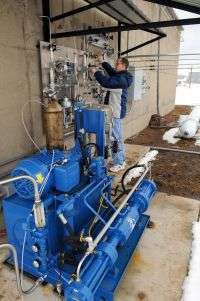
Purdue University engineers are conducting experiments using a new hydrogen facility to help NASA create designs to improve the cooling efficiency and performance of the J-2X rocket engine, critical for future missions to Mars and the moon.
More efficient cooling improves performance and reduces the need for costly overhauls, said William Anderson, an associate professor in Purdue's School of Aeronautics and Astronautics.
The new hydrogen facility allows Purdue researchers to study fundamental processes in hydrogen-oxygen engines, such as the J-2X and the engine that will be used by astronauts during their descent to the moon.
In addition to its use as a fuel in these engines, liquid hydrogen serves as a coolant before entering the combustion chamber. The frigid liquid hydrogen, which is about 420 degrees below zero Fahrenheit, circulates through channels in a cooling jacket surrounding the combustor, absorbing heat and raising its temperature before it is injected into the chamber.
The Purdue research focuses on accurately measuring the heat flux, which is caused by differences in temperature between the hot combustion gases and the cooled walls of the combustor. Combusted gases in the rocket's chamber reach 6,000 degrees Fahrenheit, which is more than three times higher than the melting temperature of the combustor's copper wall.
The measurements are used to improve detailed computational models of how propellants mix inside the combustor. The work also aims at better understanding the behavior of coolant inside channels surrounding the combustor.
"Extreme heating takes place in specific locations, and this localized heating tends to limit the combustor life," Anderson said. "Without knowing exactly how the overheating occurs, we tend to overcool the whole combustor. This limits how much propellant energy can be converted into useful thrust."
High-purity hydrogen is provided by the new hydrogen facility, located at Purdue's Maurice J. Zucrow Laboratories.
The hydrogen source is made possible by an intricate feed system designed by Timothee Pourpoint, a senior research scientist in the School of Aeronautics and Astronautics who is in charge of the hydrogen facility, which became operational in 2007. Another major focus of the facility is work funded by General Motors Corp. to develop a hydrogen-storage system for future cars.
Hydrogen gas not used for rocket research is piped 1,000 feet away to the Hydrogen Systems Laboratory for the General Motors hydrogen research.
"Because of the new facility, we are able to conduct research on a scale that is directly comparable to the J-2X," Anderson said. "That's because the facility allows significant hydrogen-flow rates at pressures exceeding 5,000 pounds per square inch."
It is critical to measure the heat flux because engineers need to know how much liquid hydrogen or liquid oxygen to flow through the outside of the engine in order to keep it cool, said Lloyd Droppers, a doctoral student in Purdue's School of Aeronautics and Astronautics.
Purdue researchers measured how much the heat flux varied at different points on the inner wall of the combustion chamber when propellant was being fed into the chamber with a carefully designed set of injectors.
"Until now, these detailed measurements were made using only one injector element, whereas this experiment contains seven elements." Anderson said. "This is important because having seven elements allows you to get precise spatial measurements to tell you how the heat flux changes due to interactions between elements and how it changes relative to the location of the injector elements."
The J-2X rocket is an upgraded version of the J-2 rocket, which was part of the Saturn V vehicles that carried astronauts to the moon in the Apollo missions. The J-2X is part of the Ares rocket that will be used to launch the Orion spacecraft to the International Space Station after the end of the Space Shuttle program in 2010. The rocket also will be needed to carry materials into Earth orbit for retrieval by other spacecraft bound for the moon and Mars.
Measurements taken in the experiments will help engineers more precisely size the cooling jacket for optimal cooling in the J-2X. Better cooling could be achieved by changing the size of the tubing or channels to match areas of highest and lowest heating.
Better computational models would enable engineers to see how a design would perform before building the engine, saving time and money.
"It costs millions of dollars to build these engines, and additional millions of dollars to test them," Anderson said. "So before building a rocket engine, you want to have a good idea of how it's going to perform."
Doctoral student Reuben Schuff is leading work ultimately aimed at improving designs for the cooling channels.
Heat is controlled in such rockets with a method called "regenerative cooling," so called because the fuel serves as a coolant before it is injected into the combustion chamber.
The research is being funded through NASA's Constellation University Institute Program, which supports rocket research at universities around the nation. Missions using the J-2X rocket are planned for the next decade.
The new hydrogen facility is funded primarily by General Motors and NASA, with additional support from the Indiana 21st Century Research and Technology Fund and Purdue's Energy Center in Discovery Park.
Research findings were detailed in two research papers presented last summer during the American Institute of Aeronautics and Astronautics' joint propulsion conference in Cincinnati.
Source: Purdue University


