Snakes vault past toxic newts in evolutionary arms race
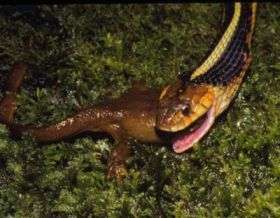
Snakes don't eat fugu, the seafood delicacy prepared from blowfish meat and famed for its poisonous potential. However, should a common garter snake wander into a sushi restaurant, it could fearlessly order a fugu dinner.
The snakes have evolved resistance to the blowfish poison, tetrodotoxin (TTX), by preying on rough-skinned newts, which also secrete the toxin. Some newts are so poisonous that they harbor enough TTX to kill a roomful of adult humans.
Why would a small animal produce such an excessive amount of poison" The answer lies in the evolutionary back-and-forth between newts and garter snakes. Throughout much of their shared territory, newts and snakes have been locked in a kind of arms race: TTX-resistant snakes cause natural selection to favor ever-more poisonous newts, and the new-and-improved newts drive selection for higher resistance in snakes.
In a paper to be published March 11 in the Public Library of Science: Biology, Charles Hanifin, a postdoctoral scholar at Stanford's Hopkins Marine Station, and his co-authors say that snakes in some areas may have prevailed in the evolutionary arms race between predator and prey. Surprisingly, snakes in several geographic locations have developed such extreme resistance to TTX that newt production of the toxin cannot keep up.
The most toxic amphibians in the world
Some populations of newts produce enough TTX to kill thousands of mice or 10 to 20 humans. Ounce for ounce, Hanifin said, they are even more toxic than South America's famed poison dart frogs.
"Some populations of these newts may very well represent the most toxic amphibians on the planet," Hanifin said.
The poisonous newts have even killed off humans. The Journal of the American Medical Association reports the case of a 29-year-old man who died after swallowing an 8-inch-long newt on a dare. The journal also describes the case of a 26-year-old man in Oregon who managed to survive his encounter with the newts. After swallowing five of the animals to win a bet, he felt dizzy, began vomiting and was too weak to walk, though he later recovered under a doctor's care.
These incidents aside, the newts rarely harm humans. It is safe to handle the newts with bare hands, since the toxin is not absorbed through the skin. A newt must be ingested to be toxic, and Hanifin said the animal emits an acrid smell that probably discourages most pets and children from tasting it.
Escaping the arms race
At first glance, the newt and garter snake populations seem to be evenly matched. The most toxic newts are found in the same areas as highly resistant snakes, and areas without toxic newts house only non-resistant snakes.
Data on the garter snakes came from Hanifin's collaborators, Edmund Brodie Jr. of Utah State University and Edmund Brodie III of the University of Virginia, who measured snake resistance to TTX by injecting the animals with the toxin and measuring how fast they subsequently slithered. Although TTX does not kill resistant snakes, it often slows them down for a while. Less-resistant snakes move slower after TTX injection, and some are even temporarily paralyzed.
To get a closer look at the snake-newt interaction, Hanifin and colleagues tested 383 newts from 28 locations where the Brodies had previously examined garter snake TTX resistance. Collection spots stretched down the West Coast from British Columbia to Central California.
Hanifin found that snakes were pulling ahead of the newts in several places. In one third of the locations, the most toxic newt could still be eaten by the least resistant snake. This means that all snakes in the population do just as well regardless of their TTX resistance level, and there is no evolutionary pressure for the snakes to develop stronger resistance.
"In these areas, I think the snakes have won," Hanifin said.
How have snakes managed to become super-resistant to TTX, while newt production of the toxin lagged behind" It seems there are only a handful of snake genes involved in resistance, meaning TTX resistance in snakes can evolve quickly and in great leaps, Hanifin said. Newt genetics appear to work differently, with increasing toxicity arriving only through smaller incremental changes.
Newts are also limited by their own biology. They are only resistant to TTX, not immune to it. A few milligrams of TTX injected into a newt's gut are lethal, so the animal sequesters the toxin in its skin. While the most toxic newts had 14 to 15 milligrams of TTX, some garter snakes are resistant to up to 100 milligrams of TTX. To hold that much toxin, the tiny newts would be one part toxin to nine parts skin-a near physical impossibility, according to Hanifin.
Though snakes may have won this round, Hanifin said their good fortune may not last forever. There is some evidence that TTX resistance comes at a price: Really resistant snakes have slower crawl speeds than snakes with little or no resistance. If there is no advantage to a snake for being super-resistant, and super-resistance has an evolutionary cost, the snakes could eventually end up with a lowered resistance, to the point where the newts' toxin levels would again be effective. Though Hanifin said the idea was plausible, it would take years of experiments to confirm.
Collecting and testing newts
Together with his father, a research dermatologist, Hanifin devised a method of measuring the newt's toxin levels using the same kind of surgical punch used to take skin for biopsies. Hanifin removed a half-centimeter circle of skin from the backs of anesthetized newts and then ground up the skin samples to analyze the amount of toxin present.
Getting accurate measurements was tough, and Hanifin spent two months in Japan learning techniques from blowfish researchers. After the procedures were ironed out, Hanifin and his colleagues spent five years collecting enough newts to test.
Hanifin said the newts make convenient field animals. "They're pretty mellow; they don't get real worked up about being handled," he said. "If you're collecting them in a pond, they just kind of float around you."
The newts' toxicity means they can afford to be lax about evading rubber-booted researchers, and Hanifin caught most of the animals by hand. He said he did not envy the snake collectors, who chased the rapid-slithering animals through grass and underbrush.
Hanifin got help collecting from people in his lab and from Oregon State University, the University of Oregon, researchers in Washington and California, and the California Department of Fish and Wildlife.
"Literally dozens of people contributed," Hanifin said. "It was a really collaborative effort."
Future directions of Hanifin's research include learning more about human disease by exploring the genetics of resistant garter snakes. TTX blocks electrical signaling in nerve cells by stopping up a sodium channel, and TTX-resistant snakes have a modified channel that the toxin does not recognize. In humans, defects in similar sodium channels can lead to serious illness, including some types of epilepsy, and insight into sodium channel biology could help treat these diseases.
Source: Stanford University


