Columbus camera captures first views of Earth
March 11, 2008 Columbus camera captures first views of Earth

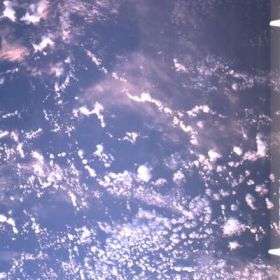
Image from Columbus laboratory's Earth Viewing Camera -- the first to be produced on command from the ground. The image was taken soon after dawn on March 7, 2008, and shows a scattering of white and pink clouds close to the Aleutian Islands in the north Pacific. Credit: ESA/CGS

One of the experiments housed on the European Columbus laboratory’s external platform is an automated eye in the sky known as the Earth Viewing Camera (EVC). Now, after several weeks of troubleshooting by the EVC team in the Netherlands, the first pictures from the orbiting camera have arrived safely back on Earth.

The initial image, showing a dimly illuminated cloud-covered region was successfully downloaded on 6 March. A second picture – the first to be produced on command from the ground – was taken soon after dawn on 7 March and shows a scattering of white and pink clouds close to the Aleutian Islands in the north Pacific.

“It was really exciting to see the first image arriving from space after the long period of developing the camera and testing it in orbit,” said Massimo Sabbatini, ESA Principal Investigator for the EVC. “This success would not have been possible without the major contribution of Carlo Gavazzi Space and the hard work of the integration and operations teams at the European Space Technology and Research Centre (ESTEC) in the Netherlands.”

“We are just starting to experiment with the various camera parameters to adjust for the vast range of lighting conditions we encounter. That’s why the second picture is slightly blurred,” explains Sabbatini. “The ISS is travelling at about 7 km per second, so we have to adjust the exposure time to compensate for this rapid motion. At that speed the camera moves over hundreds of metres on the ground in a matter of milliseconds.”

The camera is intended to be a valuable resource for public outreach and education. Sabbatini says, "We hope to encourage teachers and students to use the EVC as a tool for studying all aspects of Earth observation from space – imaging, telemetry, telecommunications links and orbit predictions. We are also hoping to receive requests for images of particular regions over which the ISS is passing.”

The story of the EVC began in 2003, when the company Carlo Gavazzi Space of Milan, Italy, approached ESA with a proposal to fly a digital camera as a low cost payload on one of the external platforms on Columbus. ESA and Carlo Gavazzi Space signed an agreement in March 2004 whereby each partner would provide half of the required funding for the development of the camera.

The EVC points continuously at a fixed angle toward the Earth. The camera weighs 7.8 kg and measures 0.4 x 0.28 x 0.16 m. It uses a commercial, off the shelf, sensor provided by Kodak, with a 2k x 2k detector. It is able to capture colour images of the Earth’s surface that cover an area of 200 x 200 km.

The images are received in Europe by the Columbus Control Centre at Oberpfaffenhofen in Germany and then forwarded to the ESA User Support Operation Centre in the Erasmus Centre at ESTEC. In the future, the EVC image acquisition process and exploitation will be coordinated from the EVC User Home Base, also located at the Erasmus Centre.

EVC is part of the European Technology Exposure Facility (EuTEF) installed on the European Columbus laboratory’s external platform during a spacewalk on 15 February 2008 by NASA astronauts Rex Walheim and Stanley Love.

Located on the starboard side of the International Space Station, Columbus sweeps around the Earth once every 90 minutes. Since the Station’s orbital path is inclined at about 52 degrees to the equator, the Earth Viewing Camera has the potential to take pictures of anywhere on the Earth’s surface from England to the southern tip of South America. This includes almost all of the densely populated parts of the world.

Source: European Space Agency


print this article email this article download pdf blog this article bookmark this article     Stumble it Digg this share on Facebook retweet share on Reddit add to delicious
Rate this story - 3.6 /5 (10 votes)

Rank Filter

Move the slider to adjust rank threshold, so that you can hide some of the comments.


Display comments: newest first

  • MikeV - Mar 11, 2008
    • Rank: 3 / 5 (1)
    The U.S. has been doing this since 1996. The program is called EarthKAM http://earthkam.ucsd.edu . UCSD works directly with NASA so kids around the world can take pictures from space. Maybe ESA got jealous?

March 11, 2008 all stories

Comments: 1

3.6 /5 (10 votes)
  • Stumble this up

  • Digg this

  • share this

  • hide
  • Related Stories

  • Cassini's Big Sky: The View from the Center of Our Solar System
    created Nov 20, 2009 | popularity not rated yet | comments 0
  • NASA Provides Venerable Hubble Hardware to Smithsonian
    created Nov 19, 2009 | popularity not rated yet | comments 0
  • NGC 4710 galaxy: Baffling boxy bulge (w/ Video)
    created Nov 18, 2009 | popularity not rated yet | comments 0
  • Swirling clouds over the South Pacific
    created Nov 17, 2009 | popularity not rated yet | comments 0
  • Geeky 'tweeters' to report on space shuttle launch
    created Nov 15, 2009 | popularity not rated yet | comments 0


  • hide
  • Relevant PhysicsForums posts

  • Are there green, purple and pink stars?
    created 5 hours ago
  • Sideral question
    created Nov 21, 2009
  • Doppler shifted blackbody spectrum
    created Nov 21, 2009
  • Earth v. Moon
    created Nov 21, 2009
  • More from Physics Forums - General Astronomy

Other News

The shore of Deception Island in Antarctica, in 2008

Antarctic ice loss vaster, faster than thought: study

Space & Earth / Earth Sciences

created 9 hours ago | popularity 2.6 / 5 (12) | comments 9

The East Antarctic icesheet, once seen as largely unaffected by global warming, has lost billions of tonnes of ice since 2006 and could boost sea levels in the future, according to a new study.


Astronaut's baby daughter born as he circles Earth (AP)

Astronaut's baby daughter born as he circles Earth

Space & Earth / Space Exploration

created 9 hours ago | popularity 5 / 5 (1) | comments 0

(AP) -- Astronaut Randolph Bresnik jubilantly welcomed his new daughter into the world Sunday as he floated 220 miles above it.


Denmark: 65 world leaders for UN climate summit (AP)

Denmark: 65 world leaders for UN climate summit

Space & Earth / Environment

created 9 hours ago | popularity 1 / 5 (2) | comments 2

(AP) -- Sixty-five world leaders have said they will attend the Copenhagen climate summit in December, and several more have responded positively to invitations, Danish officials said Sunday.


Commuters wait on the platform shrouded by fog in London

Climate change not man-made, say majority of Britons: poll

Space & Earth / Environment

created Nov 15, 2009 | popularity 3.4 / 5 (16) | comments 46

Less than half of Britons believes that human activity is to blame for global warming, according to a poll carried out for The Times newspaper and published on Saturday.


Mysteriously warm times in Antarctica

Mysteriously warm times in Antarctica

Space & Earth / Earth Sciences

created Nov 18, 2009 | popularity 4.2 / 5 (21) | comments 31

(PhysOrg.com) -- A new study of Antarctica's past climate reveals that temperatures during the warm periods between ice ages (interglacials) may have been higher than previously thought. The latest analysis ...