Royal corruption is rife in the ant world
March 11, 2008 Royal corruption is rife in the ant world

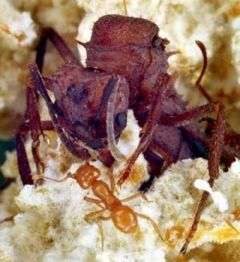
Leaf cutting ant queen and worker. Credit: D.R. Nash

Far from being a model of social co-operation, the ant world is riddled with cheating and corruption – and it goes all the way to the top, according to scientists from the Universities of Leeds and Copenhagen.

Ants have always been thought to work together for the benefit of the colony rather than for individual gain. But Dr Bill Hughes from Leeds’ Faculty of Biological Sciences has found evidence to shatter this illusion.

With Professor Jacobus Boomsma from the University of Copenhagen, he’s discovered that certain ants are able to cheat the system, ensuring their offspring become reproductive queens rather than sterile workers.

“The accepted theory was that queens were produced solely by nurture: certain larvae were fed certain foods to prompt their development into queens and all larvae could have that opportunity,” explains Dr Hughes. “But we carried out DNA fingerprinting on five colonies of leaf-cutting ants and discovered that the offspring of some fathers are more likely to become queens than others. These ants have a ‘royal’ gene or genes, giving them an unfair advantage and enabling them to cheat many of their altruistic sisters out of their chance to become a queen themselves.”

But what intrigued the scientists was that these ‘royal’ genetic lines were always rare in each colony.

Says Dr Hughes: “The most likely explanation has to be that the ants are deliberately taking steps to avoid detection. If there were too many of one genetic line developing into queens in a single colony, the other ants would notice and might take action against them. So we think the males with these royal genes have evolved to somehow spread their offspring around more colonies and so escape detection. The rarity of the royal lines is actually an evolutionary strategy by the cheats to escape suppression by the altruistic masses that they exploit.”

A few times each year, ant colonies produce males and new queens which fly off from their colonies to meet and mate. The males die shortly after mating and the females go on to found new colonies. The researchers are keen to study this process, to determine if their hypothesis is correct and the mating strategy of males with royal genes ensures their rarity, to keep their advantages undetected by their ‘commoner’ counterparts.

However, the scientists’ discovery does prove that, although social insect colonies are often cited as proof that societies can be based on egalitarianism and cooperation, they are not quite as utopian as they appear.

“When studying social insects like ants and bees, it’s often the cooperative aspect of their society that first stands out,” says Dr Hughes. “However, when you look more deeply, you can see there is conflict and cheating – and obviously human society is also a prime example of this. It was thought that ants were an exception, but our genetic analysis has shown that their society is also rife with corruption – and royal corruption at that!”

Source: University of Leeds


print this article email this article download pdf blog this article bookmark this article     Stumble it Digg this share on Facebook retweet share on Reddit add to delicious
Rate this story - 4.4 /5 (14 votes)

Rank Filter

Move the slider to adjust rank threshold, so that you can hide some of the comments.


Display comments: newest first

  • Antryg - Mar 12, 2008
    • Rank: 1 / 5 (1)
    I fail to see how "corruption" is proven by some genes being more successful than others. . .

    That's like saying that corruption is the cause of educated-populations living longer than non-educated populations.

    While it is one single possible explanation, it doesn't even seem to be the "likely" cause.

    Why not collect enough data so that its true nature can be seen, instead of this bogus "meaning" being declared?
  • nilbud - Mar 27, 2008
    • Rank: not rated yet
    Illuminanti

March 11, 2008 all stories

Comments: 2

4.4 /5 (14 votes)
  • Stumble this up

  • Digg this

  • share this

  • hide
  • Related Stories

  • Orphan army ants join nearby colonies
    created Nov 04, 2009 | popularity not rated yet | comments 0
  • Homebound Termites Answer 150-Year-Old Evolution Question
    created Oct 05, 2009 | popularity not rated yet | comments 0
  • Ant has given up sex completely, researchers say
    created Aug 26, 2009 | popularity not rated yet | comments 0
  • Temporary infidelity may contribute to the stability of ancient relationships
    created Jun 01, 2009 | popularity not rated yet | comments 0
  • Homebody queen ants help preserve family ties in large populations
    created Mar 31, 2009 | popularity not rated yet | comments 0


Other News

Beyond sunlight: Explorers census 17,650 ocean species between edge of darkness and black abyss

Beyond sunlight: Explorers census 17,650 ocean species between edge of darkness and black abyss (w/ Video)

Biology / Plants & Animals

created 8 hours ago | popularity 5 / 5 (4) | comments 0

Census of Marine Life scientists have inventoried an astonishing abundance, diversity and distribution of deep sea species that have never known sunlight - creatures that somehow manage a living in a frigid ...


Rare Charles Darwin book found on toilet bookshelf (AP)

Rare Charles Darwin book found on toilet bookshelf

Biology / Other

created 7 hours ago | popularity 5 / 5 (1) | comments 0

(AP) -- An auction house says it is selling a rare first edition of Charles Darwin's "On the Origin of Species" found in a family's guest lavatory in southern England.


Bigger not necessarily better, when it comes to brains

Bigger not necessarily better, when it comes to brains

Biology / Plants & Animals

created Nov 17, 2009 | popularity 4.5 / 5 (19) | comments 11

(PhysOrg.com) -- Tiny insects could be as intelligent as much bigger animals, despite only having a brain the size of a pinhead, say scientists at Queen Mary, University of London.


Extinct goat Myotragus balearicus

Extinct goat was cold-blooded

Biology / Plants & Animals

created Nov 18, 2009 | popularity 4.9 / 5 (34) | comments 10

(PhysOrg.com) -- An extinct goat that lived on a barren Mediterranean island survived for millions of years by reducing in size and by becoming cold-blooded, which has never before been discovered in mammals.


Right-handed chimpanzees provide clues to the origin of human language

Biology / Plants & Animals

created Nov 16, 2009 | popularity 3 / 5 (1) | comments 7

Most of the linguistic functions in humans are controlled by the left cerebral hemisphere. A study of captive chimpanzees at the Yerkes National Primate Research Center (Atlanta, Georgia), reported in the January 2010 issue ...