Modern physics is critical to global warming research
March 11, 2008
More Robust Models of the Big Picture

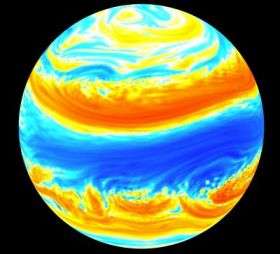
Even a highly simplified model of the Earth's atmosphere shows great complexity in jet streams and macroturbulence. Mathematical approaches that focus on average statistics rather than detailed patterns can deepen our understanding of climate and climate change. Credit: Brad Marston, Brown University

Science has come a long way with predicting climate. Increasingly sophisticated models and instruments can zero in on a specific storm formation or make detailed weather forecasts – all useful to our daily lives. But to understand global climate change, scientists need more than just a one-day forecast. They need a deeper understanding of the complex and interrelated forces that shape climate.

This is where modern physics can help, argues Brad Marston, professor of physics at Brown University. Marston is working on sets of equations that can be used to more accurately explain climate patterns. Marston will explain his research as part of a panel discussion titled “The Physics of Climate and Climate Change,” today at the American Physical Society’s meeting in New Orleans.

“Climate is a statement about the statistics of weather, not the day-to-day or minute-by-minute fluctuations,” Marston said. “That’s really the driving concept. We know we can’t predict the weather more than a couple of weeks out. But we can turn that to our advantage, by using statistical physics to look directly at the climate itself.”

Take the drying of Lake Mead in the western United States. Scientists think the lake, which straddles Nevada and Arizona, may already be getting less rain due to shifting weather patterns caused by a warming world. Computer models can follow those rainfall patterns and forecast the likely effects on the lake. But current models obscure the larger mechanisms – such as shifting storm tracks – that can drive changes in rainfall.

“If we’re just mesmerized by the details of the model,” Marston said, “we could be missing the big picture of why it’s happening.”

Marston’s statistical approach can be used to help crack the code of complicated, dynamic atmospheric processes poorly understood through models, such as convection, cloud formation, and macroturbulence, which refers to the currents, swirls and eddies in the global atmosphere. More fundamentally, Marston said this approach can help to deepen understanding of what is happening in today’s climate and what those changes can mean for climate in the future.

“We’re trying to make the models more robust, to give better insights into what is actually going on,” he said.

Marston’s research, on which he teamed with former Brown undergraduate Emily Conover and Tapio Schneider of the California Institute of Technology, was selected last fall for publication in the Journal of the Atmospheric Sciences. Marston’s ultimate research goal is to create a more realistic rendering of the global atmospheric system that can be used to understand the atmosphere of the past and to gauge future changes.

“We’re improving the statistical methods themselves, so that they’re more accurate,” Marston said. “At the same time we are applying the methods to progressively more complete models of the Earth’s atmosphere.”

Source: Brown University

3.9 /5 (11 votes)  

Filter


Move the slider to adjust rank threshold, so that you can hide some of the comments.


Display comments: newest first

superhuman
Mar 12, 2008

Rank: not rated yet
Where in this article is anything that implies that "modern physics is critical to global warming research"?!
Doug_Huffman
Mar 12, 2008

Rank: not rated yet
They PhysOrg.asm didn't understand the significance of the 'post' in post-modern physics and so edited it out. You know, it's the same thing. MoveOn now, nothing new here.
Rank 3.9 /5 (11 votes)
Tags

Relevant PhysicsForums posts

More news stories

Fast photon control brings quantum photonic technologies closer

(PhysOrg.com) -- Using photons instead of electrons to transmit information could lead to faster and more secure ways to communicate, among other advantages. Now a team of physicists has taken another step toward realizing ...

Physics / Optics & Photonics

created 8 hours ago | popularity 5 / 5 (4) | comments 0 | with audio podcast feature

Tandem polymer solar cells that set record for energy-conversion

(PhysOrg.com) -- In the effort to convert sunlight into electricity, photovoltaic solar cells that use conductive organic polymers for light absorption and conversion have shown great potential. Organic polymers ...

Physics / Optics & Photonics

created 4 hours ago | popularity 5 / 5 (4) | comments 2 | with audio podcast

Leading the quest to crack cosmological mysteries

Sometimes a scientist can only laugh in the face of a seemingly insurmountable challenge.

Physics / General Physics

created 2 hours ago | popularity 3.8 / 5 (4) | comments 0 | with audio podcast

Researchers make better heat sensor based on butterfly wings

(PhysOrg.com) -- Scientists have long known that butterfly wings produce their iridescent colors by bouncing light around and between tiny ridges in structures made of chitin. More recently they’ve discovered ...

Physics / Optics & Photonics

created 10 hours ago | popularity 5 / 5 (2) | comments 0 | with audio podcast report

Rapunzel, Leonardo and the physics of the ponytail

(PhysOrg.com) -- New research provides the first mathematical understanding of the shape of a ponytail and could have implications for the textile industry, computer animation and personal care products.

Physics / General Physics

created 13 hours ago | popularity 4.4 / 5 (9) | comments 1 | with audio podcast


Plants use circadian rhythms to prepare for battle with insects

In a study of the molecular underpinnings of plants' pest resistance, Rice University biologists have shown that plants both anticipate daytime raids by hungry insects and make sophisticated preparations to ...

Sensing self and non-self: New research into immune tolerance

At the most basic level, the immune system must distinguish self from non-self, that is, it must discriminate between the molecular signatures of invading pathogens (non-self antigens) and cellular constituents that usually ...

Missing dark matter located: Intergalactic space is filled with dark matter

Researchers at the University of Tokyo’s Institute for the Physics and Mathematics of the Universe (IPMU) and Nagoya University used large-scale computer simulations and recent observational data of gravitational ...

Fetal exposure to radiation increases risk of testicular cancer

Male fetuses of mothers that are exposed to radiation during early pregnancy may have an increased chance of developing testicular cancer, according to a study in mice at The University of Texas MD Anderson Cancer Center. ...

Challenges of identifying cognitive abilities in severely brain-injured patients

Only by employing complex machine-learning techniques to decipher repeated advanced brain scans were researchers at NewYork-Presbyterian/Weill Cornell able to provide evidence that a patient with a severe brain injury could, ...

Radiation treatment transforms breast cancer cells into cancer stem cells

Breast cancer stem cells are thought to be the sole source of tumor recurrence and are known to be resistant to radiation therapy and don't respond well to chemotherapy.