NRL to design lunar telescope to see into the dark ages
March 11, 2008
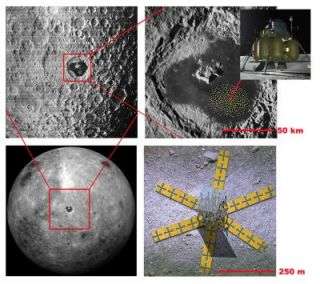
The crater Tsiolkovsky is a relatively level region on the far side of the Moon. A lander would deposit a series of rovers, which would then move out and unroll a set of arms containing individual antennas. The astronomical signals picked up by the antennas would be transmitted to back to the central lander for processing. Credit: NRL
A team of scientists and engineers led by the Naval Research Laboratory (NRL) will study how to design a telescope on the Moon for peering into the last unexplored epoch in the Universe’s history. NASA has announced that it will sponsor a series of studies focusing on next-generation space missions for astronomy. These studies will contribute to the Decadal Survey, an effort undertaken every 10 years by astronomers and physicists to help establish priorities for future research directions in astronomy and astrophysics. The upcoming Decadal Survey occurs over the next two years.
Among the missions to be studied is the Dark Ages Lunar Interferometer (DALI), the NRL-led concept for a telescope based on the Moon and studying an era of the young Universe, during the first 100 million years of its existence.
Although the night sky is filled with stars, these stars did not form instantaneously after the Big Bang. There was an interval, now called the “Dark Ages,” in which the Universe was unlit by any star. The most abundant element in the Universe, and the raw material from which stars, planets, and people are formed, is hydrogen. Fortunately, the hydrogen atom can produce a signal in the radio-wavelength part of the spectrum, at 21 cm; a wavelength far longer than what the human eye can detect. If these first signals from hydrogen atoms in the Dark Ages can be detected, astronomers can essentially probe how the first stars, the first galaxies, and ultimately the modern Universe evolved.
Because the Universe is expanding, the signals from these distant hydrogen atoms will be stretched (or redshifted) to much longer wavelengths, as large as several meters. While astronomical observations at radio wavelengths have a long history, this portion of the electromagnetic spectrum is now heavily used for various civil and military transmissions, all of which are millions of times brighter than the hydrogen signal that astronomers seek to detect. Additionally, the upper layers of the Earth’s atmosphere are ionized (the ionosphere), which introduce distortions into astronomical signals as they pass through on their way to telescopes on the ground.
With no atmosphere and shielding from the Earth, the far side of the Moon presents a nearly ideal environment for a sensitive Dark Ages telescope. In NRL’s DALI concept, scientists and engineers will investigate novel antenna constructions, methods to deploy the antennas, electronics that can survive in the harsh lunar environment, and related technology in preparation for developing a roadmap for research and development of a lunar telescope over the next decade. The team will also build on their experience in developing the Radio Observatory for Lunar Sortie Science, a NASA-funded study of a pathfinding array that would be located on the near side of the Moon.
The project leader at NRL, Dr. Joseph Lazio, pointed out that DALI will be one of the most powerful telescopes ever built and will bring us closer than we have ever been to understanding where our Universe came from and where it is going. “Probing the Dark Ages presents the opportunity to watch the young Universe evolve,” Dr. Lazio said. “Just as current cosmological studies have both fascinated and surprised us, I anticipate that DALI will lead both to increased understanding of the Universe and unexpected discoveries.”
When asked about the program, NRL Senior Astronomer Dr. Kurt Weiler remarked: “Building telescopes on the Moon is clearly a long-term project, but I am very excited about us getting started on this proposal.”
Source: Naval Research Laboratory
-
The wild early lives of today's most massive galaxies
Jan 25, 2012 |
4.4 / 5 (5) |
2
-
NASA's NuSTAR ships to Vandenberg for March 14 launch
Jan 25, 2012 |
5 / 5 (1) |
0
-
UA makes mirrors for world's largest telescope
Jan 18, 2012 |
4.8 / 5 (5) |
1
-
Astronomers find a dark matter galaxy far, far away
Jan 18, 2012 |
4.3 / 5 (9) |
8
-
New map of the universe reveals its history for the past six-billion years
Jan 13, 2012 |
4.6 / 5 (9) |
19
-
Engineers build first sub-10-nm carbon nanotube transistor
Feb 01, 2012 |
4.9 / 5 (31) |
30
-
Something old, something new: Evolution and the structural divergence of duplicate genes
Jan 31, 2012 |
4.6 / 5 (7) |
1
-
The hidden nanoworld of ice crystals: Revealing the dynamic behavior of quasi-liquid layers
Jan 30, 2012 |
5 / 5 (3) |
1
-
Stock market network reveals investor clustering
Jan 27, 2012 |
3.9 / 5 (23) |
8
-
Of microchemistry and molecules: Electronic microfluidic device synthesizes biocompatible probes
Jan 26, 2012 |
5 / 5 (1) |
0
-
Never ending outer space.....
9 hours ago
-
Neutron Star fragments?
11 hours ago
-
stationary or not?
15 hours ago
-
Scale of the Universe
Feb 10, 2012
-
Titan's lack of impact craters
Feb 09, 2012
-
Real pictures of black hole eating a star?
Feb 08, 2012
- More from Physics Forums - General Astronomy
More news stories
Latin America mining boom clashes with conservation
Latin America is experiencing a mining boom as prices rise fuelled by a hike in global demand, but the region is also being hit by a wave of violent protests, strikes and rallies by environmentalists.
2 hours ago |
not rated yet |
0
Europe stakes billion-dollar bet on new rocket
A pencil-slim rocket is scheduled to lift into space from South America on Monday, carrying a billion-dollar bet that Europe can grab a juicy slice of the market to place satellites in low orbit.
Space & Earth / Space Exploration
21 hours ago |
4 / 5 (3) |
0
Political leaders play key role in how worried Americans are by climate change: study
More than extreme weather events and the work of scientists, it is national political leaders who influence how much Americans worry about the threat of climate change, new research finds.
Feb 06, 2012 |
5 / 5 (6) |
72
NASA budget will axe Mars deal with Europe: scientists
US President Barack Obama's budget proposal to be submitted next week for 2013 will cut NASA's budget by 20 percent and eliminate a major partnership with Europe on Mars exploration, scientists said Thursday.
Space & Earth / Space Exploration
Feb 10, 2012 |
5 / 5 (3) |
55
Humans may have helped the decline of African rainforests 3000 years ago
(PhysOrg.com) -- Large areas of rainforests in Central Africa mysteriously disappeared over three thousand years ago, to be replaced by savannas. The prevailing theory has been that the cause was a change ...
Google might launch Drive for cloud storage soon
(PhysOrg.com) -- Google's next big move, according to the Wall Street Journal, is a cloud storage service called Drive. Hardly first to the plate, Google is simply catching up to introducing its cloud reposi ...
Love a click away in Indonesia's Twitter Republic
He was a geeky kid from Yogyakarta, she a glamorous city girl in Jakarta. In a country with one of the world's most vibrant social networking scenes they fell in love on Twitter.
Walney offshore wind farm is world's biggest (for now)
(PhysOrg.com) -- The Walney wind farm on the Irish Sea--characterized by high tides, waves and windy weather--officially opened this week. The farm is treated in the press as a very big deal as the Walney ...
GPS court ruling leaves US phone tracking unclear
A US Supreme Court decision requiring a warrant to place a GPS device on the car of a criminal suspect leaves unresolved the bigger issue of police tracking using mobile phones, legal experts say.
Europeans protest controversial Internet pact
Tens of thousands of people marched in protests in more than a dozen European cities Saturday against a controversial anti-online piracy pact that critics say could curtail Internet freedom.
Study finds that anti-diabetic medication can prevent the long-term effects of maternal obesity
In a study to be presented today at the Society for Maternal-Fetal Medicine's annual meeting, The Pregnancy Meeting, in Dallas, Texas, researchers will report findings that show that short therapy with the anti-diabetic medication ...