Amphibians respond behaviorally to impact of clear cutting
March 11, 2008 Annulatum (Ring Salamander)

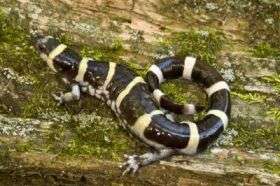
The Ringed Salamander (Ambystoma annulatum) is a species unique to the Ozarks. Credit: Photo by Bill Peterman

The number of amphibians drastically decreases in forest areas that are clearcut, according to previous studies. A University of Missouri researcher, however, has found that some animals may not be dying. Instead, the Mizzou biologist said some animals may be moving away (possibly to return later) or retreating underground. The finding could have major implications for both the timber industry and the survival of amphibians.

“Everyone jumped to the conclusion that the frogs and salamanders were dying after a clearcut had occurred,” said Ray Semlitsch, professor of biological sciences in the MU College of Arts and Science. “Anecdotal data accumulated through the years indicated there were potentially three things amphibians could do: stay and die, retreat underground or evacuate the site. We have never been sure of how they respond to strong habitat changes, especially behaviorally.”

Semlitsch and his graduate students at MU found, during a period of two years, that significantly more salamanders and frogs evacuated clearcut treatments than entered, although the researchers cannot say what portion also may have died or retreated underground. Documenting this evacuation response is important because animals are potentially available later for re-colonization once the forest begins to grow back.

The results of the study present two primary implications for timber management that would benefit amphibians. First, timber harvesters producing clear cuts that are small (within a six-acre area) may improve the chances of amphibians being able to move out of the area until sufficient reforestation occurs. Second, if harvesters leave coarse woody debris (everything over two inches in diameter) on the ground, it will contribute to the amphibians’ survival by creating food, maintaining moisture and providing shelter.

Semlitsch said amphibians are potential bio-indicators of ecosystem health and are the most threatened vertebrate type globally, with one-third, or 1,896 species, currently at risk of extinction. Studies done in the past indicate harvesting forest is particularly detrimental. Amphibians are very sensitive to water loss, heat and changes in temperature. They have no natural barrier to water loss. Semlitsch found that amphibians may be able to react to changes in their environment in an effort to alleviate risk in ways previously undocumented.

Semlitsch said one of his goals is trying to maintain ecosystem health and function and developing principles to help species persist.

“I am trying to develop general principles to help us manage our natural resources without exploiting them to a point where ecosystems begin to fall apart,” he said. “I am not against cutting trees, but let’s do it in a way that’s responsible and will maintain forests and the timber industry, as well as amphibians, for generations to come.”

Source: University of Missouri-Columbia


print this article email this article download pdf blog this article bookmark this article     Stumble it Digg this share on Facebook retweet share on Reddit add to delicious
Rate this story - not rated yet


March 11, 2008 all stories

Comments: 0

not rated yet
  • Stumble this up

  • Digg this

  • share this

  • hide
  • Related Stories

  • Scientists find frog legs trade may facilitate spread of pathogens
    created Nov 19, 2009 | popularity not rated yet | comments 0
  • Amphibians as environmental omen disputed
    created Nov 11, 2009 | popularity not rated yet | comments 0
  • Scientists launch effort to sequence the DNA of 10,000 vertebrates
    created Nov 04, 2009 | popularity not rated yet | comments 0
  • Timber harvest impacts amphibians differently during life stages
    created Nov 03, 2009 | popularity not rated yet | comments 0
  • Over 17,000 species threatened by extinction
    created Nov 02, 2009 | popularity not rated yet | comments 0


Other News

Measuring and modeling blood flow in malaria

Biology / Cell & Microbiology

created 55 minutes ago | popularity not rated yet | comments 0

When people have malaria, they are infected with Plasmodium parasites, which enter the body from the saliva of a mosquito, infect cells in the liver, and then spread to red blood cells. Inside the blood cells, the parasites ...


Beyond sunlight: Explorers census 17,650 ocean species between edge of darkness and black abyss

Beyond sunlight: Explorers census 17,650 ocean species between edge of darkness and black abyss (w/ Video)

Biology / Plants & Animals

created 16 hours ago | popularity 4.9 / 5 (9) | comments 0

Census of Marine Life scientists have inventoried an astonishing abundance, diversity and distribution of deep sea species that have never known sunlight - creatures that somehow manage a living in a frigid ...


Rare Charles Darwin book found on toilet bookshelf (AP)

Rare Charles Darwin book found on toilet bookshelf

Biology / Other

created 15 hours ago | popularity 4.8 / 5 (4) | comments 1

(AP) -- An auction house says it is selling a rare first edition of Charles Darwin's "On the Origin of Species" found in a family's guest lavatory in southern England.


Bigger not necessarily better, when it comes to brains

Bigger not necessarily better, when it comes to brains

Biology / Plants & Animals

created Nov 17, 2009 | popularity 4.5 / 5 (19) | comments 11

(PhysOrg.com) -- Tiny insects could be as intelligent as much bigger animals, despite only having a brain the size of a pinhead, say scientists at Queen Mary, University of London.


Extinct goat Myotragus balearicus

Extinct goat was cold-blooded

Biology / Plants & Animals

created Nov 18, 2009 | popularity 4.9 / 5 (34) | comments 10

(PhysOrg.com) -- An extinct goat that lived on a barren Mediterranean island survived for millions of years by reducing in size and by becoming cold-blooded, which has never before been discovered in mammals.