Scientist answers how Peruvian meteorite made it to Earth
March 11, 2008
Scientist answers how Peruvian meteorite made it to Earth

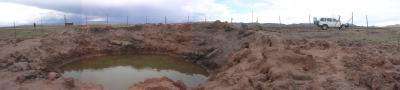
Planetary geologists had thought that stony meteorites would be destroyed when they passed through Earth's atmosphere. This one struck ground near Carancas, Peru, at about 15,000 miles per hour. Brown University geologists have advanced a new theory that would upend current thinking about stony meteorites. Credit: Peter Schultz, Brown University

It made news around the world: On Sept. 15, 2007, an object hurtled through the sky and crashed into the Peruvian countryside. Scientists dispatched to the site near the village of Carancas found a gaping hole in the ground.

Peter Schultz, professor of geological sciences at Brown University and an expert in extraterrestrial impacts, went to Peru to learn more. For the first time, he will present findings from his travels at the 39th annual Lunar and Planetary Science Conference in League City, Texas, in a talk scheduled for 2 p.m. on March 11, 2008. Brown graduate student Robert “Scott” Harris collaborated on the research, joined by Jose Ishitsuka, a Peruvian astrophysicist, and Gonzalo Tancredi, an astronomer from Uruguay.

What Schultz and his team found is surprising. The object that slammed into a dry riverbed in Peru was a meteorite, and it left a 49-foot-wide crater. Soil ejected from the point of impact was found nearly four football fields away. When Schultz’s team analyzed the soil where the fireball hit, he found “planar deformation features,” or fractured lines in sand grains found in the ground. Along with evidence of debris strewn over a wide area, the shattered sand grains told Schultz that the meteorite had maintained a high rate of speed as it shot through the atmosphere. Scientists think it was traveling at roughly 15,000 miles per hour at the moment of impact.

“Normally with a small object like this, the atmosphere slows it down, and it becomes the equivalent of a bowling ball dropping into the ground,” Schultz said. “It would make a hole in the ground, like a pit, but not a crater. But this meteorite kept on going at a speed about 40 to 50 times faster than it should have been going.”

Scientists have determined the Carancas fireball was a stony meteorite – a fragile type long thought to be ripped into pieces as it enters the Earth’s atmosphere and then leaves little more than a whisper of its journey.

Yet the stony meteorite that struck Peru survived its passage mostly intact before impact.

“This just isn’t what we expected,” Schultz said. “It was to the point that many thought this was fake. It was completely inconsistent with our understanding how stony meteorites act.”

Schultz said that typically fragments from meteorites shoot off in all directions as the object speeds to Earth. But he believes that fragments from the Carancas meteorite may have stayed within the fast-moving fireball until impact. How that happened, Schultz thinks, is due to the meteorite’s high speed. At that velocity, the fragments could not escape past the “shock-wave” barrier accompanying the meteorite and instead “reconstituted themselves into another shape,” he said.

That new shape may have made the meteorite more aerodynamic – imagine a football passing through air versus a cinderblock – meaning it encountered less friction as it sped toward Earth, hitting the surface as one large chunk.

“It became very streamlined and so it penetrated the Earth’s atmosphere more efficiently,” Schultz said.

Schultz’s theory could upend the conventional wisdom that all small, stony meteorites disintegrate before striking Earth. If correct, it could change the thinking about the size and type of extraterrestrial objects that have bombarded the Earth for eons and could strike our planet next.

“You just wonder how many other lakes and ponds were created by a stony meteorite, but we just don’t know about them because when these things hit the surface they just completely pulverize and then they weather,” said Schultz, director of the Northeast Planetary Data Center and the NASA/Rhode Island University Space Grant Consortium.

Schultz’s research could have implications for Mars, where craters have been discovered in recent missions. “They could have come from anything,” he said. “It would be interesting to study these small craters and see what produced them. Perhaps they also will defy our understanding.”

Source: Brown University

4.2 /5 (46 votes)  

Filter


Move the slider to adjust rank threshold, so that you can hide some of the comments.


Display comments: newest first

TimESimmons
Mar 11, 2008

Rank: 1 / 5 (2)
"rate of speed"?
Doug_Huffman
Mar 11, 2008

Rank: 1 / 5 (3)
Hey, this is PhysOrg.asm and 'show prep' for SLimbaugh, whaddya want?
Soylent
Mar 11, 2008

Rank: 1 / 5 (1)
"rate of speed"?

That's just silly jargon for high speed(it ought to mean acceleration).
superhuman
Mar 12, 2008

Rank: 1 / 5 (2)
>Scientists dispatched to the site near the village of Carancas found a gaping hole in the ground.

So it was a hole not meteorite that fell from the sky! Must have been a black hole which radiated all its fuel...
seanpu
Mar 12, 2008

Rank: 1 / 5 (2)
"The object that slammed into a dry riverbed in Peru"

If the riverbed was dry why was the hole full of water? Could the thing that fell have been water in some form? Hugh lump of ice maybe?
trantor
Mar 12, 2008

Rank: 3 / 5 (2)
duh... if you dig on any dry riverbed, you will find water.

out7x
Mar 13, 2008

Rank: 1 / 5 (1)
Nothing known about meteorite mass or velocity upon entry. Just speculation.
Rank 4.2 /5 (46 votes)
Tags

Relevant PhysicsForums posts
  • Titan's lack of impact craters
    created17 hours ago
  • Real pictures of black hole eating a star?
    createdFeb 08, 2012
  • Hypothetical way to travel faster than light, but not technically exceed lightspeed
    createdFeb 06, 2012
  • How do scientists monitor the Sun's activity?
    createdFeb 05, 2012
  • Search patterns in observational studies
    createdFeb 05, 2012
  • Derivation of Pogson's law
    createdFeb 03, 2012
  • More from Physics Forums - General Astronomy

More news stories

New views show old NASA Mars landers

(PhysOrg.com) -- The High Resolution Imaging Science Experiment (HiRISE) camera on NASA's Mars Reconnaissance Orbiter recorded a scene on Jan. 29, 2012, that includes the first color image from orbit showing ...

Space & Earth / Space Exploration

created 21 hours ago | popularity 4.9 / 5 (7) | comments 9 | with audio podcast

Black holes and star formation

(PhysOrg.com) -- It has long been recognized that galaxy mergers or even close interactions can play a vital role in shaping the morphology of galaxies. One way they can do so, it is thought, is by triggering ...

Space & Earth / Astronomy

created 20 hours ago | popularity 4.1 / 5 (7) | comments 5 | with audio podcast

Deconstructing a mystery: What caused Snowmaggedon?

In the quiet after the storms, streets and cars had all but disappeared under piles of snow. The U.S. Postal Service suspended service for the first time in 30 years. Snow plows struggled to push the evidence ...

Space & Earth / Earth Sciences

created 13 hours ago | popularity 4.7 / 5 (3) | comments 1 | with audio podcast

Ocean microbe communities changing, but long-term environmental impact is unclear

As oceans warm due to climate change, water layers will mix less and affect the microbes and plankton that pump carbon out of the atmosphere – but researchers say it's still unclear whether these processes ...

Space & Earth / Earth Sciences

created 15 hours ago | popularity 5 / 5 (2) | comments 2 | with audio podcast

Researchers create 3-D laser maps that show how earthquake changes landscape

Geologists have a new tool to study how earthquakes change the landscape down to a few inches, and it's giving them insight into how earthquake faults behave. In the Feb. 10 issue of the journal Science, a team ...

Space & Earth / Earth Sciences

created 15 hours ago | popularity 5 / 5 (4) | comments 0 | with audio podcast


Fighting crimes against biodiversity: How to catch a killer weed

Invasive species which have the potential to destroy biodiversity and influence global change could be tracked and controlled in the same way as wanted criminals, according to new research from Queen Mary, University of London.

A novel method for simultaneously measuring blood pressure and arterial stiffness

Arterial stiffness due to is a major contributor to cardiovascular disease but is very difficult to measure. It also can influence blood pressure readings since these rely on the time taken for arteries to return to normal ...

Study finds that red blood cell transfusion decreases fatigue in women with acute postpartum anemia

In a study to be presented today at the Society for Maternal-Fetal Medicine's annual meeting, The Pregnancy Meeting ™, in Dallas, Texas, researchers will report findings that show that in women with acute postpartum ...

Study weighs risks and benefits of birthing facilities

In a study to be presented today at the Society for Maternal-Fetal Medicine's annual meeting, The Pregnancy Meeting ™, in Dallas, Texas, researchers will report findings that indicate that the risk of obstetric intervention ...

FDA-approved drug rapidly clears amyloid from the brain, reverses Alzheimer's symptoms in mice

Neuroscientists at Case Western Reserve University School of Medicine have made a dramatic breakthrough in their efforts to find a cure for Alzheimer's disease. The researchers' findings, published in the journal Science, show t ...

'Dark plasmons' transmit energy

Microscopic channels of gold nanoparticles have the ability to transmit electromagnetic energy that starts as light and propagates via "dark plasmons," according to researchers at Rice University.