Which came first, social dominance or big brains? Wasps may tell
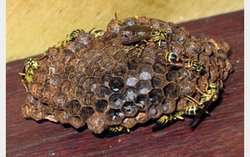
There’s new evidence supporting the idea that bigger brains are better. A study of a tropical wasp suggests that the brainpower required to be dominant drives brain capacity.
University of Washington researchers have found that key processing regions in the brains of both males and females of one wasp species not only increased in size with age but were also associated with being dominant. The study also showed different patterns of brain development in males and females. Certain subregions were larger in males and others were larger in females. This matched expectations based on males’ greater use of vision and females’ greater reliance on their antennae.
UW researchers Sean O’Donnell and Yamile Molina found increased brain growth in areas of the insects’ brains called the mushroom bodies, which vaguely resemble the cerebrum in humans and other vertebrates. A mushroom body sits atop each hemisphere of the wasp brain. The mushroom bodies process input from the eyes and antennae, and are involved in learning and memory.
The social paper wasp that was studied, Mischocyttarus mastigorphorus, is unusual because males are dominant over females, a rarity among social insects, said O’Donnell, a UW associate professor of psychology. Most social insect societies – bees, ants and wasps – are predominantly female, with males short-lived and subordinate.
O’Donnell and Molina, a UW doctoral student, focused on a part of the insects’ mushroom body, called the calyx, where neural connections are made. While the overall size of the calyces did not differ between the males and females, specific subregions were larger in each sex. Males rely on vision when they leave the nest for mating opportunities, and the part of the calyx that receives visual input was larger. In contrast, most female interaction takes place on the nest, where tactile and odor senses are important and the part of the calyx that received input from the antennae was bigger among the females.
“When you are dominant among insects you get more food,” O’Donnell said, “and in this case it gives males more energy to leave the nest and mate. The fact that the males are dominant and long-lived makes this species interesting from a neurobiological standpoint. We think they have pretty sophisticated cognition compared to males of other wasp species.”
The researchers studied five wasp colonies in a tropical cloud forest near Monteverde, Costa Rica. They first marked all resident adult wasps on the nests and these individuals were excluded from further analyses. Newly emerged wasps then were captured and marked over the next several days and returned to their nest. Each colony then was observed in the morning and afternoon every three days over the course of more than a month. Behavioral data such as giving and receiving aggression were collected, as well as time spent on and off the nest. After this observation period, sections of the wasps’ brains were examined under a microscope.
Among the unanswered questions stemming from this study include how long these wasps live and how long these patterns of brain growth continued.
“We only followed them for 42 days, so we don’t know how long they live,” said O’Donnell. “We also don’t know if their brain development is similar to humans in terms of if and when they start to decline cognitively.
He said an exciting new idea – the social challenge hypothesis – suggests that large human brains evolved in response to the demands of complex social interactions. The wasp work extends this idea to individual brain variation.
“Do you get to be dominant because of a big brain or does being dominant drive brain size? That’s still an open question and we don’t know which comes first,” said O’Donnell. “This study suggests the high cognitive demands of being dominant drive brain capacity and supports the social brain hypothesis. The next step is to broaden the scope of the research by looking at more species of paper wasps. We are interested in how brains evolve in concert with social evolution. There is the intriguing possibility that there are similar patterns across wide spans of evolutionary time. My goal is to get a bigger sample of social wasp species and examine this.”
“You are looking at super-distant animals when you compare wasps and people. Yet there may be an interesting commonality between them. Increased brainpower may be part of being social, no matter who you are. What makes this exciting is we see some common patterns in how brains change as societies evolve. As we see changes in social complexity, there are changes in brain structure. If it is good for people it should be good for wolves, dolphins and paper wasps.”
The research, funded by the National Science Foundation, has been published in the online edition of the journal Developmental Neurobiology.
Source: University of Washington


