Short-term stress can affect learning and memory
March 11, 2008 Short-term stress can affect learning and memory

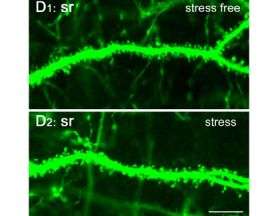
Spine stress.

Short-term stress lasting as little as a few hours can impair brain-cell communication in areas associated with learning and memory, University of California, Irvine researchers have found.

It has been known that severe stress lasting weeks or months can impair cell communication in the brain’s learning and memory region, but this study provides the first evidence that short-term stress has the same effect. The study appears in the March 12 edition of the Journal of Neuroscience.

“Stress is a constant in our lives and cannot be avoided,” said Dr. Tallie Z. Baram, the Danette Shepard Chair in Neurological Sciences in the UC Irvine School of Medicine and study leader. “Our findings can play an important role in the current development of drugs that might prevent these undesirable effects and offer insights into why some people are forgetful or have difficulty retaining information during stressful situations.”

In their study, Baram and her UC Irvine colleagues identified a novel process by which stress caused these effects. They found that rather than involving the widely known stress hormone cortisol, which circulates throughout the body, acute stress activated selective molecules called corticotropin releasing hormones, which disrupted the process by which the brain collects and stores memories.

Learning and memory take place at synapses, which are junctions through which brain cells communicate. These synapses reside on specialized branchlike protrusions on neurons called dendritic spines.

In rat and mouse studies, Baram’s group saw that the release of CRH in the hippocampus, the brain’s primary learning and memory center, led to the rapid disintegration of these dendritic spines, which in turn limited the ability of synapses to collect and store memories.

The researchers discovered that blocking the CRH molecules’ interaction with their receptor molecules eliminated stress damage to dendritic spines in the hippocampal cells involved with learning and memory.

In addition, the authors replicated the effects of stress on dendritic spines by administering low levels of synthetic CRH, and watching how the spines retracted over minutes. “Fortunately, once we removed the CRH, the spines seemed to grow back,” Baram said.

Baram also noted that there are compounds under development that show the ability to block CRH receptors, and that this study can play a role in the creation of therapies based on these compounds to address stress-related learning and memory loss.

Source: University of California, Irvine


print this article email this article download pdf blog this article bookmark this article     Stumble it Digg this share on Facebook retweet share on Reddit add to delicious
Rate this story - 4.3 /5 (18 votes)

Rank Filter

Move the slider to adjust rank threshold, so that you can hide some of the comments.


Display comments: newest first


March 11, 2008 all stories

Comments: 1

4.3 /5 (18 votes)
  • Stumble this up

  • Digg this

  • share this

  • hide
  • Related Stories


  • hide
  • Relevant PhysicsForums posts

  • Improving the brain through chemistry
    created 21 hours ago
  • Sleep / REM Sleep and homeostasis
    created Nov 07, 2009
  • The Biceps Reflex
    created Nov 05, 2009
  • Consequenses of striking a Vein and an artery?
    created Nov 05, 2009
  • More from Physics Forums - Medical Sciences

Other News

Developmental delay could stem from nicotinic receptor deletion

Medicine & Health / Genetics

created 7 hours ago | popularity 4.5 / 5 (2) | comments 0

The loss of a gene through deletion of genetic material on chromosome 15 is associated with significant abnormalities in learning and behavior, said a consortium of researchers led by Baylor College of Medicine in a report ...


Expanding drug treatment: Is US ready to step up? (AP)

Expanding drug treatment: Is US ready to step up?

Medicine & Health / Other

created 2 hours ago | popularity not rated yet | comments 0

(AP) -- Based on the rhetoric, America's war on drugs seems poised to shift into a more enlightened phase where treatment of addicts gains favor over imprisonment of low-level offenders. Questions abound, ...


House passes health care bill on close vote (AP)

Landmark health bill passes House on close vote

Medicine & Health / Health

created 15 hours ago | popularity 3.7 / 5 (9) | comments 2

(AP) -- The Democratic-controlled House narrowly passed far-reaching health care legislation, handing President Barack Obama a hard-won victory on his chief domestic priority though the road ahead in the ...


Children who often drink full-fat milk weigh less

Medicine & Health / Health

created Nov 03, 2009 | popularity 5 / 5 (4) | comments 5

Eight-year-old children who drink full-fat milk every day have a lower BMI than those who seldom drink milk. This is not the case for children who often drink medium-fat or low-fat milk. This is one conclusion of a thesis ...


Turn On, Tune In, Develop?

Turn On, Tune In, Develop? Researchers Examine How Brain Benefits From Musical Training

Medicine & Health / Neuroscience

created Nov 06, 2009 | popularity 5 / 5 (11) | comments 4

For most people music is an enjoyable, although momentary, form of entertainment. But for those who seriously practiced a musical instrument when they were young, perhaps when they played in a school orchestra ...