Nanomaterials Show Unexpected Strength Under Stress
In yet another twist on the strangeness of the nanoworld, researchers at the National Institute of Standards and Technology and the University of Maryland-College Park have discovered that materials such as silica that are quite brittle in bulk form behave as ductile as gold at the nanoscale. Their results may affect the design of future nanomachines.
NIST scientists Pradeep Namboodiri and Doo-In Kim and colleagues first demonstrated the latest incongruity between the macro and micro worlds this past fall with direct experimental evidence for nanoscale ductility.
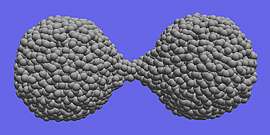
In a new paper presented today at the March Meeting of the American Physical Society, NIST researchers Takumi Hawa and Michael Zachariah and guest researcher Brian Henz shared the insights they gained into the phenomenon through their computer simulations of nanoparticle aggregates.
At the macroscale, the point at which a material will fail or break depends on its ability to maintain its shape when stressed. The atoms of ductile substances are able to shuffle around and remain cohesive for much longer than their brittle cousins, which contain faint structural flaws that act as failure points under stress.
At the nanoscale, these structural flaws do not exist, and hence the materials are nearly “perfect.” In addition, these objects are so small that most of the atoms that comprise them reside on the surface. According to Namboodiri and Kim, the properties of the surface atoms, which are more mobile because they are not bounded on all sides, dominate at the nanoscale. This dominance gives an otherwise brittle material such as silica its counterintuitive fracture characteristics.
“The terms ‘brittle’ and ‘ductile’ are macroscopic terminology,” Kim says. “It seems that these terms don’t apply at the nanoscale.”
Using an atomic force microscope (AFM), Kim and Namboodiri were able to look more closely at interfacial fracture than had been done before at the nanoscale. They found that the silica will stretch as much as gold or silver and will continue to deform beyond the point that would be predicted using its bulk-scale properties.
Hawa, Henz and Zachariah’s simulations reaffirmed their study and added some additional details. They showed that both nanoparticle size and morphology—whether the material is basically crystalline or amorphous, for example—have an effect on the observed ductility and tensile strength because those factors influence the mobility of surface atoms. In the simulations, the smaller the particles in the aggregate the more ductile the material behaved. Crystalline structures exhibited greater strength when stressed and deformed long after the critical yield point observed macroscopically.
Namboodiri explained that although the work is very basic, these findings might one day inform the design of microelectronic mechanical devices.
Citation: N. Pradeep, D-I. Kim, J. Grobelny, T. Hawa, B. Henz, and M. R. Zachariah. Ductility at the nanoscale: Deformation and fracture of adhesive contacts using atomic force microscopy. Applied Physics Letters, published online 15 November 2007.
T. Hawa, B. Henz, and M. Zachariah. Computer simulations of nanoparticle aggregate fracture. Presented Wednesday, March 12, 2008, at the 2008 APS meeting in New Orleans, La.
Source: National Institute of Standards and Technology


