Rare North Island brown kiwi hatches at the Smithsonian's National Zoo
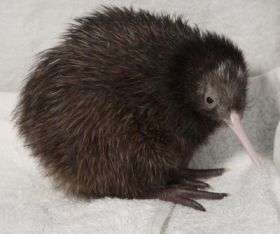
March 12, 2008 National Zoo Kiwi

The National Zoo welcomed a new kiwi chick on March 7, 2008. The chick, whose sex has yet to be determined by DNA testing, is the third chick to ever hatch at the National Zoo. The first hatching occurred in 1975 and was the first to occur outside of New Zealand. Kiwis are endangered and are extremely rare to see in captivity -- only four zoos outside of New Zealand have successfully bred kiwis, and only three US zoos exhibit them, including the National Zoo which has exhibited kiwis since 1967. Credit: Jessie Cohen, Smithsonian's National Zoo

Early Friday morning, March 7, one of the world’s most endangered species—a North Island brown kiwi—hatched at the Smithsonian’s National Zoo Bird House. Keepers had been incubating the egg for five weeks, following a month long incubation by the chick’s father, carefully monitoring it for signs of pipping: the process in which the chick starts to break through the shell. The chick remained in an isolet for four days and is now in a specially designed brooding box.

The box will be not be on exhibit, but will be accessible on Friday, March 14, by webcam on the Zoo’s Web site at http://nationalzoo.si.edu/Animals/Birds/Kiwi/default.cfm. Since kiwis are nocturnal, the best time to view the chick exploring and foraging in its box will be in the evening.

The sex of the chick is still unknown and is difficult to determine by sight. For this reason, Bird House staff enlisted the help of National Zoo geneticists. Using DNA samples swabbed from the inside of the egg and from the bird’s beak, the geneticists hope to decipher its sex in the coming weeks.

This is only the third time in the Zoo’s history that a kiwi has successfully hatched. The first hatching occurred in 1975 and was the first to occur outside of New Zealand. The National Zoo did not have another successful hatching until 2005; that male bird, Manaia, may currently be seen Mondays, Wednesdays and Fridays at the 11 a.m. “Meet a Kiwi” program at the National Zoo’s Bird House. Kiwis in captivity are extremely rare—only four zoos outside of New Zealand have successfully bred kiwis, and only three U.S. zoos, including the National Zoo, exhibit them.

There are five species of kiwi and all are unique to New Zealand. The North Island brown species of kiwi is the national bird of New Zealand. They are widely thought to be the most ancient bird and have existed in New Zealand for more than 30 million years. Kiwis typically mate for life, and both parents share the responsibility of caring for the egg. After kiwi chicks hatch, however, they receive no parental care. Unlike other bird species, kiwis hatch fully feathered and equipped with all of the necessary skills they need to survive.

The North Island brown kiwi species is classified as endangered by the International Union of Conservation of Nature. The wild population is declining at a rate of approximately 5.8 percent a year. Nearly 60 percent of all wild North Island brown kiwi chicks are killed by stoats, a species of weasel and an introduced predator. The remaining wild population of the North Island brown kiwi is estimated at roughly 24,000, down from 60,000 in the 1980s.

Source: Smithsonian’s National Zoo


print this article email this article download pdf blog this article bookmark this article     Stumble it Digg this share on Facebook retweet share on Reddit add to delicious
Rate this story - 5 /5 (2 votes)


March 12, 2008 all stories

Comments: 0

5 /5 (2 votes)
  • Stumble this up

  • Digg this

  • share this

  • hide
  • Related Stories


Other News

Destruction spreads 'like a disease'

Biology / Ecology

created 1hour ago | popularity not rated yet | comments 0

(PhysOrg.com) -- People have cleared more than a quarter of the world’s forests and half of its grasslands, according to a paper published today in the Proceedings of the Royal Society by researchers from The University of Que ...


Beer Here

Biology / Other

created 42 minutes ago | popularity 4 / 5 (1) | comments 0

(PhysOrg.com) -- Drinking beer is a simple act, but making beer is not. It starts out with genetics and tens of thousands of barley varieties and ends with a clear ambrosia that belies the time, effort and technology that ...


When camouflage is a plant's best protection

Rare woodland plant uses 'cryptic coloration' to hide from predators

Biology / Plants & Animals

created 2 hours ago | popularity not rated yet | comments 0

It is well known that some animal species use camouflage to hide from predators. Individuals that are able to blend in to their surroundings and avoid being eaten are able to survive longer, reproduce, and ...


'Safety valve' protects photosynthesis from too much light

Biology / Cell & Microbiology

created 3 hours ago | popularity not rated yet | comments 0

Photosynthetic organisms need to cope with a wide range of light intensities, which can change over timescales of seconds to minutes. Too much light can damage the photosynthetic machinery and cause cell death. Scientists ...


Cells defend themselves from viruses, bacteria with armor of protein errors

Biology / Cell & Microbiology

created 3 hours ago | popularity 5 / 5 (4) | comments 0

When cells are confronted with an invading virus or bacteria or exposed to an irritating chemical, they protect themselves by going off their DNA recipe and inserting the wrong amino acid into new proteins to defend them ...