The world's largest fusion experiment of the stellarator type taking shape
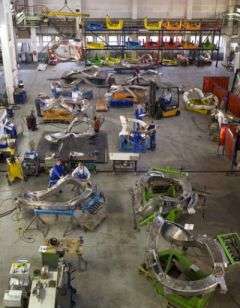
The first milestone in the successive assembly of the Wendelstein 7-X fusion device at the Greifswald branch of Max Planck Institute of Plasma Physics (IPP), Germany, has been reached on schedule with the completion of the first two half-modules of the large-scale experiment: Two-tenths of the inner core of the device is now ready and is being assembled. Industrial production of the essential components for Wendelstein 7-X is almost complete. Construction of the complex device will take about another six years.
The objective of fusion research is to derive energy from fusion of atomic nuclei, as in the sun. To ignite the fusion fire the fuel in a future power plant, a hydrogen plasma, has to be confined in magnetic fields and heated to temperatures exceeding 100 million degrees. Wendelstein 7-X, which on completion will be the world’s largest fusion device of the stellarator type, will be concerned with investigating the suitability of this concept for a power plant. With discharges lasting up to 30 minutes it is to demonstrate the stellarator’s essential property, viz. that it is capable of continuous operation.
Production of the core of the device – 50 superconducting magnet coils about 3.5 metres high – will soon be completed. Their bizarre shapes are the result of sophisticated optimisation calculations: They are to provide a particularly stable and thermally insulating magnetic cage for the plasma. They are cooled with liquid helium to superconduction temperature close to absolute zero and so consume hardly any energy once switched on. They are being manufactured by a German-Italian consortium headed by Babcock Noell GmbH in Würzburg and ASG Superconductors S.p.A. in Genoa.
In order to vary the magnetic field, a second set of 20 planar, likewise superconducting coils is superposed on the stellarator coils. All 20 coils have meanwhile been delivered by the manufacturer, Tesla in the UK. A massive ring-shaped support structure, already half completed by the Spanish company, ENSA, will keep the coils in the exact positions despite the high magnetic forces exerted.
The entire wreath of coils will be enclosed by a thermally insulating outer casing 16 metres in diamater, the cryostat. Two of its five sections have also been finished by MAN DWE in Deggendorf, Germany. A refrigeration plant will later provide 5000 watts of cold helium to cool the magnets and supports to superconduction temperature. Inside the wreath of coils is the plasma vessel, whose peculiar shape is matched to the twisting of the plasma hose. Its 20 sections were likewise produced by MAN DWE. The more than 250 apertures in the vessel will later allow the plasma to be observed and heated and the vessel to be cooled. An equal number of ports produced and supplied by the Romabau Gerinox company in Switzerland connect these apertures with the outer wall of the cryostat.
The first milestone
The entire device will be assembled from five structurally almost identical modules that are pre-assembled before being joined into a circle in the experiment hall. Installation of the first two half-modules in meanwhile finished – the first milestone in the 29-stage assembly has thus been reached on schedule.
For this purpose two sections of the plasma vessel were lifted into the two pre-assembly rigs Ia and Ib and two of the six-ton magnet coils carefully strung with a special grab device onto the two vessel segments, leaving gaps just millimetres wide. Only then was it possible to braze onto each of them a second plasma vessel sector and complete the thermal insulation at the seams. This superinsulation – exactly fitting fibreglass-reinforced plastic panels lined with several layers of aluminium-coated kapton foil and glass fabric – separates the low-temperature magnet coils from their warm surroundings. Then four further stellarator coils and two of the auxiliary coils were strung onto each of the vessel sections and geometrically exactly aligned on installation ports of their own. The coils were finally braced with a segment of the support ring. After various other auxiliary work and numerous control measurements the first two half-modules were ready and in succession were then lifted with a special hoist into the second assembly rig – with this the first installation milestone was reached on 28 February.
While the next two half-modules are progressing almost routinely in pre-assembly rigs Ia and Ib, new challenges wait in pre-assembly rig II: Once the two parts of the support ring are aligned and braced together, the sections of the plasma vessel are brazed and the thermal insulation at the seam is closed, the first of the five modules will be structurally complete. Then the conductors for the electrical connections of the coils will have to be attached – a rather difficult procedure. The rigid superconductors up to 14 metres long, manufactured by Jülich Research Centre, have already been bent to the right shape. Twenty-four lengths of the unwieldy, but sensitive conductors are needed per module. Once the superconductors are electrically connected and brazed, the joints will be insulated against high voltages and checked to be helium-proof. In parallel – the space available now being very tight – the piping for the helium cooling of the coils will be installed. Everything has to be checked to ensure that it is leak-proof. When the sensors and test cables are in place, the first module can leave assembly rig II – according to schedule after about 25 weeks of construction.
In the experiment hall
The completed module will be hoisted into the lower casing of the outer vessel on the third assembly rig in the experimentation hall: connections and ports will then be installed. The meanwhile 120-ton component will now be lifted onto the actual machine foundation and additionally placed on auxiliary supports. The upper casing of the outer vessel will be placed on top and brazed. This is when about 60 ports, which connect the plasma vessel and the outer vessel, have to be incorporated with their thermal insulation.
Next come the interior components in the plasma vessel, particularly the numerous parts of the divertor. Its collector plates will ensure that impurities and some of the thermal energy are removed from the plasma. The rest of the energy is caught by the wall shielding, steel panels or a heat shield clad with graphite titles. A lot of the components – including pumps, heat shield and divertor modules – are now being made in the Central Technical Services of IPP at Garching; the collector plates, control coils and steel panels are being manufactured by industrial companies.
Until all five modules have been set up in the experiment hall, every work step has to be performed five times. Finally, the five large-scale components have to be linked: The seams of the plasma vessel and outer vessel have to sealed, and the magnets connected with the power and helium supplies. Then come the main power connections, cooling pipes and repeated control measurements and leak checks. The basic machine is now ready.
In parallel, the microwave system for heating the plasma will be set up. Karlsruhe Research Centre is in overall charge of this task, experts from the University of Stuttgart being responsible for the transmission lines. Then there are the supply facilities for electric power and cooling, machine control and, finally, the numerous measuring instruments for diagnosing the behaviour of the plasma. If everything goes according to schedule, Wendelstein 7-X should go into operation in about six years.
Source: Helmholtz Association of German Research Centres


