Tackling traffic’s biggest killer
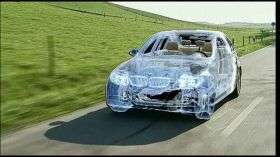
Each year, over 40,000 people meet their end on Europe’s roads in car accidents. It is the equivalent of several small-scale wars. The biggest killer is head-on collisions, with 6,000 casualties annually. But now new car and road technology developed here could bring peace to Europe’s roads.
It is the most powerful impact a car can suffer and it is very difficult to predict or avoid; twin fatal factors that make head-on collisions the most devastating killer on the continent’s roads. Of the 40,000 people who meet their tragic end on Europe’s roads and streets each year, 20% are head-on collisions.
In many ways, that is just the horrifying beginning. Head-on collisions are more likely to lead to multiple car pile-ups, they demand huge rescue efforts, and they lead to more serious, lifelong injuries too.
These shocking facts demonstrate the desperate need to improve safety on Europe’s roads. Tackling traffic’s biggest killer is one of the key aims of PReVENT.
PReVENT is the biggest research initiative into road safety ever launched on the continent. It is big in every sense: 54 partners, a €55m budget and dozens of major projects covering every aspect of road and car safety.
But the biggest impact will be the lives saved.
It is already happening, with life-saving technologies developed by PReVENT continuously entering the market.
Virtual safety belt
It has over a dozen major sub-projects focusing on almost every aspect of road safety, creating a virtual safety belt that encompasses the whole car. Take the SAFELANE and LATERAL SAFE sub-projects. The first supports lane changing, while the second alerts drivers to cars, motorcycles or pedestrians in the blind spot.
Yet another, INTERSAFE, deals with safely turning at intersections, while a series of related passive safety projects protect vulnerable road users like cyclists and pedestrians, and mitigate the impact of crashes when they do occur. APALACI, for example, is the ‘Advanced pre-crash and longitudinal collision management system, while COMPOSE can even apply the brakes before the driver can react. And UseRCams can spot obstacles, or people, in front and obliquely.
One project, called PReVAL, also looks at the impact of these technologies. It is building a reliable test of the impact a new system might have on lives saved in the real world. It can track benefit against cost and the simplicity of a system, offering insight into the greatest returns – a vital tool for policy-makers.
MAPS&ADAS developed a warning system using enhanced satellite navigation maps to tell the driver of upcoming hazards – like intersections, blind turns, and dips in the road. It has huge potential, and should appear in cars in the next two to three years.
Others, like INSAFES and PROFUSION, integrate various sensors so they co-operate, offering greater functionality at the cost of software development, which is very cheap to make and easy to deploy. The upshot? Total functionality becomes greater than the sum of its parts.
“Not only will this help make Europe’s roads safer, it will make the carmakers and ancillary industries enormously competitive,” explains Matthias Schulze, coordinator of the EU-funded PReVENT and Senior Manager for ITS & Services at Daimler AG.
New era of traffic safety
All PReVENT projects feed into each other in some way, and nowhere is this more important than in head-on collisions. But two projects focus closely on traffic’s biggest killer.
SASPENCE deals with safe following distance and speed, using long-range sensors and map data. It also integrates with another vital project, WILLWARN, which promotes car-to-car wireless communication to warn you and other drivers of oncoming traffic or hazards, like black ice, up ahead.
SASPENCE uses long-range sensors to assess the distance to the car in front and tracks this against your speed and the safe braking distance. This can have enormous impact.
Studies show that driving just 1 km/h faster in dense traffic will increase the probability of an accident with injuries by 3 percent. The difference seems small, but with over 260 million vehicles on Europe’s roads, tiny changes make a big difference. PReVENT tested the SASPENCE system in two demonstration vehicles.
WILLWARN is even cleverer and ushers in a new era of traffic safety. It can detect potential road hazards using data from various in-vehicle systems, such as the automatic breaking systems (ABS), and inform other vehicles about these hazards via WLAN-based communication. On the one hand, WILLWARN maps nearby vehicles, and on the other it can send or receive information about upcoming road conditions. The system was tested in BMW’s 520i and 120d, Mercedes A 200 and S350 and the Smart Fortwo.
PReVENT also tested the system using its PReVAL assessment scheme and both were effective, WILLWARN especially so. They proved popular with drivers, too. The technologies, particularly WILLWARN, could appear in cars in the next two to three years.
This practically demonstrates the impact of PReVENT and its raft of sub-projects. If that is not enough, PReVENT has ties with a host of other European projects, including EASIS, APROSYS, AIDE and many others. It also links with Europe’s Intelligent Car Initiative and its safety programme. PReVENT’s work even became a flagship demonstration of the Intelligent Car Initiative.
It might seem like overkill, but in 2001 Europe pledged to cut traffic fatalities by 50% in 2010. A tough target, and one that will need all the help it can get.
Source: ICT Results


