Sensors for bat-inspired spy plane under development
March 13th, 2008 Sensors for bat-inspired spy plane under development

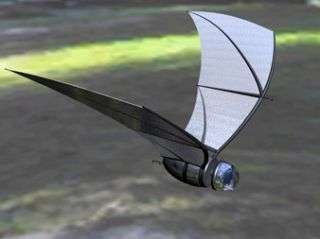
Engineers envision a six-inch, robotic spy plane modeled after a bat that could gather data and send it back to soldiers in real time. Credit: Eric Maslowski, research computer specialist in the University of Michigan 3D Lab

A six-inch robotic spy plane modeled after a bat would gather data from sights, sounds and smells in urban combat zones and transmit information back to a soldier in real time.

That's the Army's concept, and it has awarded the University of Michigan College of Engineering a five-year, $10-million grant to help make it happen. The grant establishes the U-M Center for Objective Microelectronics and Biomimetic Advanced Technology, called COM-BAT for short. The grant includes an option to renew for an additional five years and $12.5 million.

U-M researchers will focus on the microelectronics. They will develop sensors, communication tools and batteries for this micro-aerial vehicle that's been dubbed "the bat." Engineers envision tiny cameras for stereo vision, an array of mini microphones that could home in on sounds from different directions, and small detectors for nuclear radiation and poisonous gases.

Low-power miniaturized radar and a very sensitive navigation system would help the bat find its way at night. Energy scavenging from solar, wind, vibration and other sources would recharge the bat's lithium battery. The aircraft would use radio to send signals back to troops.

"These are all concepts, and many of them are the next generation of devices we have already developed. We're trying to push the edge of our technologies to achieve functionality that was not possible before," said Kamal Sarabandi, the COM-BAT director and a professor in the U-M Department of Electrical Engineering and Computer Science.

COM-BAT also involves the University of California at Berkeley and the University of New Mexico. It is one of four centers the Army launched as a collaborative effort among industry, academia and the Army Research Laboratory to work toward this vision of a small, robotic aircraft that could sense and communicate. Each of the four centers is charged with developing a different subsystem of the bat, a self-directed sensor inspired by the real thing.

"Bats have a highly-attuned echolocation sense providing high-resolution navigation and sensing ability even in the dark, just as our sensor must be able to do," Sarabandi said.

Echolocation allows real bats to navigate by emitting sounds and detecting the echoes.

The bat robot's body would be about six inches long. It would weigh about a quarter of a pound and use about 1 W of power.

U-M researchers intend to improve on current technologies. They'll work to develop quantum dot solar cells that double the efficiency of current cells. They expect their autonomous navigation system, which would allow the robot to direct its own movements, to be 1,000 times smaller and more energy efficient than systems being used now. They believe they can deliver a communication system that's 10 times smaller, lighter and more energy efficient than today's technologies.

The bat would be designed to perform short-term surveillance in support of advancing soldiers. Or it could perch at a street corner or building for longer assignments and send back reports of activity as it takes place.

"Throughout this research, we expect to make technological breakthroughs and have a much wider range of applications for other types of engineering problems, from medical to industrial," Sarabandi said.

COM-BAT will support 12 faculty members and 18 graduate students at U-M.

Source: University of Michigan


print this article email this article download pdf blog this article bookmark this article     Digg this Stumble it share on Facebook share on Reddit add to delicious save to Yahoo! bookmarks
4.2/5 after 25 votes

Rank Filter

Move the slider to adjust rank threshold, so that you can hide some of the comments.


Display comments: newest first

  • zevkirsh - Mar 13, 2008
    • Rank: 1.5 / 5 (2)
    10 million for what? it sonuds like they are just giong to make something out of thin air.
    jeesus. spending is up!
  • vlam67 - Mar 14, 2008
    • Rank: not rated yet
    10 million for what? it sonuds like they are just giong to make something out of thin air.
    jeesus. spending is up!


    Look at China. They spent trillions on R&D on everything and try any means fair or foul to build themselves into the next superpower.
    The US governments meanwhile as always are hellbent on a fundamentalist mindset to keep the oil flowing from Middle East or they will be out on the streets in days. Can't really blame them though. The whole nation grew strong by believing and practicing their God Given Right To Copious Consumption. Bible in hand, gas pedal to the firewall. It has always worked. Which means technologies useful for global military superiority have to be first rate.
    Which means concerns for the foul-smelling common rabbles both nationally and internationally get screwed. NASA for example is struggling to make ends meet, buying rides from the Russians to deliver food, water and toilet papers for years to come while waiting for their next neo-retro pile of crap known as Appolo on steroids to get off CADCAM screens.
  • Argiod - Mar 14, 2008
    • Rank: not rated yet
    Wow! Our tax dollars at work to produce yet another way for our government to poke their noses into our lives. Uncle Sam must be the worlds biggest voyeur (read; peeping Tom)...
    Of course, that's just my opinion; I could be wrong... [Dennis Miller disclaimer]

March 13th, 2008 all stories
Technology / Engineering

Comments: 3
Rank: 4.2/5 after 25 votes

  • Stumble this up

  • Digg this

  • Share it:
  • share on Facebook
  • share on MySpace
  • share on Slashdot
  • rss-newsfeed
  • share on Google
  • share on Reddit
  • add to delicious
  • save to Yahoo! bookmarks
  • share on Windows Live
  • Add to Mixx!
Rating: 4.2/5 after 25 votes

  • Related Stories

  • To protect threatened bat species, street lights out
    created Jun 18, 2009 | popularity not rated yet | comments 0
  • Bats recognize the individual voices of other bats
    created Jun 05, 2009 | popularity not rated yet | comments 0
  • Study of gecko feet leads to advances in the science of friction (w/Video)
    created Jun 04, 2009 | popularity not rated yet | comments 0
  • Scientists unravel the mystery of white-nose syndrome
    created Jun 03, 2009 | popularity not rated yet | comments 0
  • National study finds youth baseball-related injuries down 25 percent
    created May 26, 2009 | popularity not rated yet | comments 0

Tags


  • Physicists Demonstrate Quantum Memory with Matter Qubits
    Physicists Demonstrate Quantum Memory with Matter Qubits
    Physics / General Physics
    created Jul 03, 2009 | popularity 4.4 / 5 (17) | comments 1
  • 'Holey' Nanosheets for Wastewater Dye Removal
    Nanotechnology / Nanomaterials
    created Jul 01, 2009 | popularity 5 / 5 (5) | comments 1
  • Jellyfish Robot Swims Like its Biological Counterpart
    Jellyfish Robot Swims Like its Biological Counterpart
    Electronics / Robotics
    created Jun 26, 2009 | popularity 4.4 / 5 (8) | comments 1
  • Could Maxwell's Demon Exist in Nanoscale Systems?
    Could Maxwell's Demon Exist in Nanoscale Systems?
    Physics / General Physics
    created Jun 24, 2009 | popularity 4.4 / 5 (18) | comments 29
  • Living Safely with Robots, Beyond Asimov's Laws
    Living Safely with Robots, Beyond Asimov's Laws
    Electronics / Robotics
    created Jun 22, 2009 | popularity 4.6 / 5 (52) | comments 40
  • Other News

    Japan demands 119 million dlrs in tax from Amazon: report

    Technology / Business

    created 18 hours ago | popularity 3.6 / 5 (5) | comments 1

    Japanese authorities told a sales affiliate of US retail giant Amazon.com to pay about 119 million dollars in tax for unreported income over a three-year period, a newspaper said Sunday.


    Iconic skyscrapers find new luster by going green (AP)

    Iconic skyscrapers find new luster by going green

    Technology / Energy

    created 19 hours ago | popularity 1 / 5 (1) | comments 0

    (AP) -- When owners of the Empire State Building decided to blanket its towering facade this year with thousands of insulating windows, they were only partly interested in saving energy. They also needed ...


    Geeks double as scourges and sages at media summit

    Technology / Business

    created 14 hours ago | popularity not rated yet | comments 0

    (AP) -- The media moguls attending an annual powwow staged by investment bank Allen & Co. used to be able to rest comfortably in the Idaho mountains as they mulled their next moves.


    Downturn dating: Hearts flutter as markets stutter (AP)

    Downturn dating: Hearts flutter as markets stutter

    Technology / Internet

    created 19 hours ago | popularity not rated yet | comments 0

    (AP) -- Credit the recession for "staycations" and bringing us more game-night parties at home. But also give it a shout for spurring more first dates.


    UK spy chief's family details posted on Facebook

    Technology / Internet

    created 19 hours ago | popularity not rated yet | comments 0

    (AP) -- He's the spy who came in from the beach.