A sub-femtosecond stop watch for 'photon finish' races
March 13, 2008
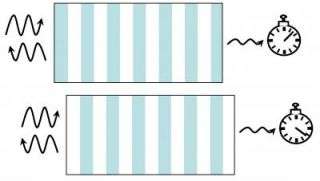
Diagram of two stack configurations with odd numbers of layers. Blue layers have a high index of refraction, white layers a low. The stacks are nearly identical with the exception of where the extra layer is deposited. Credit: NIST
Using a system that can compare the travel times of two photons with sub-femtosecond precision, scientists at the Joint Quantum Institute (a partnership of the National Institute of Standards and Technology and the University of Maryland) and Georgetown University have found a remarkably large difference in the time it takes photons to pass through nearly identical stacks of materials with different arrangements of refractive layers.
The technique, described at the annual March Meeting of the American Physical Society, ultimately could provide an empirical answer to a long-standing puzzle over how fast light crosses narrow gaps that do not permit the passage of conventional electromagnetic waves.
Alan Migdall and his colleagues set up a race course using “correlated” pairs of photons—indistinguishable photons created simultaneously. One photon passes through the sample to be tested while the other is directed along a path of adjustable length. The finish line is a so-called Hong-Ou-Mandel interferometer, a beamsplitter that the photons strike obliquely. Individual photons have a fifty-fifty chance of either passing through the beamsplitter or bouncing off it, but when two correlated photons arrive simultaneously, the rules of physics say they both must come out in the same direction.
As a result, this arrangement can detect when the first photon has taken exactly as long to get through the test object as the second photon did to traverse its path. This changes the difficult problem of measuring extraordinarily short intervals of time into the easier one of measuring distances. Through refinements to the design of their interferometer, Migdall and his colleagues can measure simultaneity with sub-femtosecond precision.
The team measured photon transit times through stacks consisting of alternating layers of material with high and low refractive index—the kind of arrangement that makes a light beam seem to bend as it crosses the boundary.
The new experiments verify the theoretical prediction that photon transit time will vary significantly depending on how you arrange the stack. Migdall and his team found that a photon takes about 20 femtoseconds less to get through a stack of 31 layers, totaling a few microns across, when the stack begins and ends with high refractive index layers rather than the opposite.
The shorter time delay is apparently superluminal i.e., shorter than the time needed for light in a vacuum to traverse the same distance. (This is possible because of a loophole in the speed-of-light limit that says that some wave-related phenomena can propagate superluminally if they do not transmit equivalent information faster than the speed of light.)
The team hopes to move on to a more perplexing case. Light striking the boundary between two refractive materials at a sufficiently shallow angle glances off completely as a reflection rather than passing through, but also creates a decaying field known as an evanescent wave on the other side of the boundary. This evanescent wave can reach across a narrow gap and strike up a new light wave in an adjacent medium. Theorists have presented discrepant calculations of how long light takes to traverse such a gap, but Migdall says the new system should be precise enough to measure such transits directly.
Ref:
1. N. Rutter, S.V. Polyakov, P. Lett amd A. Migdall. Photon tunneling through dielectric bandgaps and evanescent gaps. Presented at the American Physical Society March Meeting, New Orleans, La. Session: W14.00010.
2. S.V. Polyakov, D. Papoular, C. McCormick, P. Lett, D. Josell and A. Migdall. Photon Tunneling through Evanescent Gaps and Bandgaps, Slow and Fast Light, Salt Lake City, Utah, July 2007
Source: National Institute of Standards and Technology
-
Adding up photons with a transition edge sensor
Nov 14, 2011 |
5 / 5 (1) |
1
-
Single photon management for quantum computers advanced by NIST
Jan 20, 2011 |
5 / 5 (7) |
1
-
Loopy photons clarify 'spookiness' of quantum physics
Mar 18, 2008 |
4.6 / 5 (50) |
5
-
Mass weddings -- NIST's new efficient 2-photon source
Apr 12, 2007 |
3.7 / 5 (3) |
0
-
New kind of solar cell could capture significantly more energy than current cells
Feb 08, 2012 |
4.5 / 5 (11) |
14
-
Engineers build first sub-10-nm carbon nanotube transistor
Feb 01, 2012 |
4.9 / 5 (33) |
30
-
Something old, something new: Evolution and the structural divergence of duplicate genes
Jan 31, 2012 |
4.6 / 5 (7) |
1
-
The hidden nanoworld of ice crystals: Revealing the dynamic behavior of quasi-liquid layers
Jan 30, 2012 |
5 / 5 (4) |
1
-
Stock market network reveals investor clustering
Jan 27, 2012 |
3.9 / 5 (23) |
8
-
Of microchemistry and molecules: Electronic microfluidic device synthesizes biocompatible probes
Jan 26, 2012 |
5 / 5 (2) |
0
-
Can Plasma Be Solid
3 hours ago
-
What is delta Δ ?
4 hours ago
-
Need some help understanding Hertz–Knudsen formula
4 hours ago
-
Anatomy of Fat man: implosion-critical bomb
6 hours ago
-
what makes two sounds similar???
7 hours ago
-
What would happen when a jet travelling at Mach 10 experiences engine failure
13 hours ago
- More from Physics Forums - General Physics
More news stories
Explained: Sigma
It's a question that arises with virtually every major new finding in science or medicine: What makes a result reliable enough to be taken seriously? The answer has to do with statistical significance -- but ...
Feb 09, 2012 |
5 / 5 (20) |
76
Quantum physicist explains $100K offer for proof scaled-up quantum computing is impossible
(PhysOrg.com) -- MIT researcher Scott Aaronson has certainly riled the physics community with his offer this past Friday, of $100,000 to anyone who can prove that scaled-up quantum computing is impossible. ...
Diamond light, brighter than the sun
Its the size of five football pitches and generates light 10 billion times brighter than the sun. As the Diamond Light Source celebrates its tenth anniversary this year, Penny Bailey visits one of the ...
Feb 07, 2012 |
4.1 / 5 (10) |
18
|
Physicists 'record' magnetic breakthrough
An international team of scientists has demonstrated a revolutionary new way of magnetic recording which will allow information to be processed hundreds of times faster than by current hard drive technology.
Feb 07, 2012 |
4.6 / 5 (43) |
15
|
Hints of the Higgs - papers are submitted
Back in December 2011, the ATLAS and CMS experiments at CERN presented some exciting results that provided tantalising hints of the Higgs boson.
Feb 08, 2012 |
4.3 / 5 (8) |
10
Scientists discover molecular secrets of 2,000-year-old Chinese herbal remedy
For roughly two thousand years, Chinese herbalists have treated Malaria using a root extract, commonly known as Chang Shan, from a type of hydrangea that grows in Tibet and Nepal. More recent studies suggest that halofuginone, ...
New method to examine batteries -- MRI from the inside
There is an ever-increasing need for advanced batteries for portable electronics, such as phones, cameras, and music players, but also to power electric vehicles and to facilitate the distribution and storage of energy derived ...
Google might launch Drive for cloud storage soon
(PhysOrg.com) -- Google's next big move, according to the Wall Street Journal, is a cloud storage service called Drive. Hardly first to the plate, Google is simply catching up to introducing its cloud reposi ...
A mitosis mystery solved: How chromosomes align perfectly in a dividing cell
Although the process of mitotic cell division has been studied intensely for more than 50 years, Whitehead Institute researchers have only now solved the mystery of how cells correctly align their chromosomes during symmetric ...
Lab study raises questions over nano-particle impact
Tests involving chickens have raised questions about the impact on health from engineered nano-particles, the ultra-fine grains commonly used in drugs and processed foods, scientists said on Sunday.
Starve a virus, feed a cure? Findings show how some cells protect themselves against HIV
A protein that protects some of our immune cells from the most common and virulent form of HIV works by starving the virus of the molecular building blocks that it needs to replicate, according to research published online ...