Researchers push resonator frequency limit
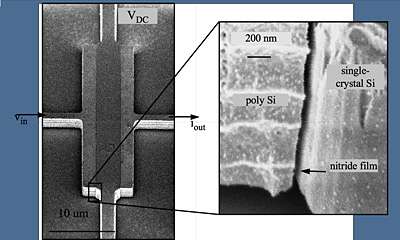
Many researchers in microelectromechanical systems (MEMS) have focused on resonators -- tiny devices that vibrate at radio frequencies -- to replace quartz crystals and other oscillators and can be economically integrated directly into a silicon chip.
Cornell scientists are pushing the upper limits of microresonator frequency with a device that generates a 4.5 gigahertz (GHz) signal, the highest ever achieved in silicon, with a quality factor, or Q, close to 10,000. Q, which is a measure of how sharply tuned an oscillator is and, therefore, of the amount of energy stored in the resonator, commonly decreases with increasing frequency.
"You can trade off quality factor for frequency, so you want to maximize their product [frequency multiplied by Q]," explains Sunil Bhave, Cornell assistant professor of electrical and computer engineering. If both are high, designers have more leeway.
Bhave and graduate student Dana Weinstein described the new device at the International Electronic Devices Meeting in Washington, D.C., in December, and their paper appears in the conference proceedings.
The device consists of a silicon bar set into vibration by a process called "dielectric transduction." An alternating voltage is applied to an electrode separated from the bar by a dielectric, or insulator. Attractive forces between electric charges in the electrode and the bar create mechanical vibrations that travel back and forth along the bar like sound waves in a flute or organ pipe.
Previously researchers have used an air gap as the dielectric. Substituting a solid dielectric makes it easier to read out oscillations at higher frequencies, but the solid dielectric damps vibrations and reduces the efficiency of transmission of energy to the oscillator.
Weinstein found by mathematical analysis that efficiency could be increased by moving the dielectric layers from the ends of the bar partway toward the middle. The ideal positions are two-thirds of the way from the middle to the end of the bar, which are the points of maximum strain when it is vibrating.
The resulting device is a silicon bar 8.5 microns long, 40 microns wide and 2.5 microns thick, divided by two dielectric layers of silicon nitride just 15 nanometers (billionths of a meter) thick. The 4.5 GHz signal is the ninth harmonic of the resonator's fundamental vibration along its length. The method could produce resonators with frequencies exceeding 10 GHz, the researchers said.
Source: By Bill Steele, Cornell University


