Brain images show schizophrenic's memory usage differs
March 14, 2008
Brain images show schizophrenic's memory usage differs

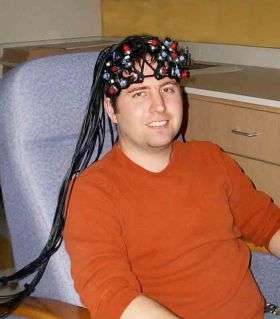
Research assistant Randy Minas wearing a near infrared spectroscopy rig. NIRS is a new and promising way to study schizophrenia. Courtesy of Park Laboratory

T he enduring memory problems that people with schizophrenia experience may be related to differences in how their brains process information, new research has found. The Public Library of Science published the report by Vanderbilt University researchers Junghee Lee, Bradley S. Folley, John Gore and Sohee Park in the online journal PLOS One on March 12.

"We found that schizophrenic patients use different areas of their brain than healthy individuals do for working memory, which is an active form of short-term memory," Park says. "Both groups used their frontal cortex while remembering and forgetting. However, while healthy subjects groups used the right side of this brain area when asked to remember spatial locations, the schizophrenic patients used a wider network in both hemispheres.

"This suggests that while healthy people recruit a specialized and focused network of brain areas for specific memory functions, schizophrenic patients seem to rely on a more diffuse and wider network to achieve the same goal."

The researchers also found a fundamental difference in the way healthy people and schizophrenic patients made errors. When healthy people forgot, they had no confidence in their response for that trial and the brain areas that were recruited during correct memory trials remained inactive. A more complex picture emerged for schizophrenic patients.

"When healthy people are correct, there is an increased activation of the right frontal cortex. When they forget, there is no such increase. Their brain activation pattern is tightly coupled with their memory performance. Not so with schizophrenic patients," Park says.

"Schizophrenic patients may encode and remember incorrect information. The brain activation pattern during such error trials indicate that indeed they were remembering something, albeit incorrect," she continues. "Such coupling of storing incorrect information and feeling confident of one's response may be one way to think about how delusions get initiated," Park says.

Researchers have known since the early 1990s that working memory problems are a consistent symptom of schizophrenia. The researchers sought to better understand what is occurring in the brain that may be causing these problems.

"The right hemisphere is usually recruited during spatial information processing but if it is malfunctioning, as it may be in schizophrenia, the left hemisphere may also be recruited," Park says. "Another possible explanation is that schizophrenic patients may have more difficulty with these tasks, and as a result recruit more brain areas to assist them."

In the experiment, the subjects were shown a point on a computer screen and told to concentrate upon it. Three identical black circles were then flashed on a gray background, each in a different location. After a short delay, the subjects were shown a probe and told to press one key if the probe matched one of the circles shown earlier and another if it did not. They then were told to press another key ranking on a scale from one to five their confidence in their answer about the probe.

The researchers captured images of brain activity during these tasks using functional magnetic resonance imaging, or fMRI. They repeated the experiment to capture data using another tool, near infrared spectroscopy, or NIRS. NIRS is a new and promising way to study schizophrenia, the researchers believe.

"Many patients exceed the fMRI safety weight limit due to the side effects of their medication. The paranoia and anxiety that are often part of this disorder also make fMRI, which involves entering a tube while laying down, impossible for many patients. Also, individuals with metal implants cannot be scanned," Park says. "NIRS does not have these problems. As a participant, you sit in an office chair while the experimenter places a plastic 'probe set' on your head with a couple of straps. Even babies tolerate it pretty well. Our study demonstrates that NIRS can be used as a viable alternative to fMRI, which means many more people can participate in experiments."

The researchers chose to publish their work in PLOS One, a relatively new, open access journal, because it is freely available to the public.

"We felt that the fact that anybody can access scientific papers in this journal was a big plus," Park says. "One normally has to pay for access to journals. Most schizophrenic patients, including the individuals who participated in our study, simply do not have the money to do so. This article is available for free to anyone."

Source: Vanderbilt University

3.7 /5 (12 votes)  

Filter


Move the slider to adjust rank threshold, so that you can hide some of the comments.


Display comments: newest first

NeilFarbstein
Mar 14, 2008

Rank: 1 / 5 (1)
What do they mean "shown a probe." I thought the probe is an infrared device that reads blood flow inside the brain. Maybe the schizophrenic's brains are compensating for brain damage and they use diffuse networks that include the left and right hemispheres together.
Bushidoboy
Mar 15, 2008

Rank: not rated yet
These people are looking in the exact wrong direction- once again a failure of aristotlian and newtonian science. I'm no armchair scientist either. If you want real answers that are completely logical and solve the problem spend a month studying cognitive enhancers, sociobiology, and pre-christian archeology and social anthropology based on accounts of the bicameral mind before the onset of christian rule. You can find the truth out there yourself- and there many scientists- just not the ones who seem to think people are just 'malfunctioning biological units' who believe the same way I do. This publishing is just promoting erroneous and ultimately flawed reasoning which can be easily debunked.

Give them a chance to report their work; if they don't want to, give me a column and I'll show you why these scientists are no better than scientists from the 30's using their 'great intellect; to prove women and blacks were genetically inferior. You need some balance, otherwise you are spewing half truths and falsehoods.

-k-
Rank 3.7 /5 (12 votes)
Tags

Relevant PhysicsForums posts
  • Is Everyday Technology Killing Us?
    createdFeb 08, 2012
  • Exercise and weight loss
    createdFeb 08, 2012
  • Why do we have head aches? Our brains can't feel anything.
    createdFeb 07, 2012
  • "The end of diseases" by David Agus, interview from Daily Show with Jon Stewart
    createdFeb 04, 2012
  • Oncolytic adenovirus
    createdFeb 04, 2012
  • Nutrition label stuffs and diets
    createdFeb 02, 2012
  • More from Physics Forums - Medical Sciences

More news stories

Declining health-care productivity in England: Who says so?

Reports that the National Health Service in England has been declining in productivity in the last decade appear to have been accepted as fact. However, a Viewpoint published Online First by The Lancet disputes this. The Vi ...

Medicine & Health / Health

created 47 minutes ago | popularity not rated yet | comments 0

Overeating may double risk of memory loss

New research suggests that consuming between 2,100 and 6,000 calories per day may double the risk of memory loss, or mild cognitive impairment (MCI), among people age 70 and older. The study was released today and will be ...

Medicine & Health / Neuroscience

created 2 hours ago | popularity 5 / 5 (2) | comments 0 | with audio podcast

Starve a virus, feed a cure? Findings show how some cells protect themselves against HIV

A protein that protects some of our immune cells from the most common and virulent form of HIV works by starving the virus of the molecular building blocks that it needs to replicate, according to research published online ...

Medicine & Health / Research

created 6 hours ago | popularity 5 / 5 (1) | comments 0 | with audio podcast

Injured boomers beware: Know when to see doctor

(AP) -- It happened to nurse Jane Byron years after an in-line skating fall, business owner Haralee Weintraub while doing "men's" push-ups, and avid cyclist Gene Wilberg while lifting a heavy box.

Medicine & Health / Health

created 7 hours ago | popularity 5 / 5 (1) | comments 0

FDA-approved drug rapidly clears amyloid from the brain, reverses Alzheimer's symptoms in mice

Neuroscientists at Case Western Reserve University School of Medicine have made a dramatic breakthrough in their efforts to find a cure for Alzheimer's disease. The researchers' findings, published in the journal Science, show t ...

Medicine & Health / Neuroscience

created Feb 09, 2012 | popularity 4.9 / 5 (58) | comments 15 | with audio podcast


Scientists discover molecular secrets of 2,000-year-old Chinese herbal remedy

For roughly two thousand years, Chinese herbalists have treated Malaria using a root extract, commonly known as Chang Shan, from a type of hydrangea that grows in Tibet and Nepal. More recent studies suggest that halofuginone, ...

New method to examine batteries -- MRI from the inside

There is an ever-increasing need for advanced batteries for portable electronics, such as phones, cameras, and music players, but also to power electric vehicles and to facilitate the distribution and storage of energy derived ...

A mitosis mystery solved: How chromosomes align perfectly in a dividing cell

Although the process of mitotic cell division has been studied intensely for more than 50 years, Whitehead Institute researchers have only now solved the mystery of how cells correctly align their chromosomes during symmetric ...

Lab study raises questions over nano-particle impact

Tests involving chickens have raised questions about the impact on health from engineered nano-particles, the ultra-fine grains commonly used in drugs and processed foods, scientists said on Sunday.

Google might launch Drive for cloud storage soon

(PhysOrg.com) -- Google's next big move, according to the Wall Street Journal, is a cloud storage service called Drive. Hardly first to the plate, Google is simply catching up to introducing its cloud reposi ...

Researchers find extensive RNA editing in human transcriptome

In a new study published online in Nature Biotechnology, researchers from BGI, the world's largest genomics organization, reported the evidence of extensive RNA editing in a human cell line by analysis of RNA-seq data, demons ...