Insight into HIV's 'on-off' switch shows promise for therapy, understanding cellular decisions
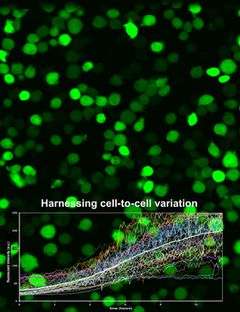
Researchers at the University of California, San Diego and Oak Ridge National Laboratory have discovered how a genetic circuit in HIV controls whether the virus turns on or stays dormant, and have succeeded in forcing the virus towards dormancy, a finding that shows promise as an avenue for HIV therapy. Their findings are published in the March 16 issue of the journal Nature Genetics.
Leor S. Weinberger, professor of chemistry and biochemistry at UC San Diego, with Michael L. Simpson of Oak Ridge National Laboratory and Roy D. Dar of the University of Tennessee, Knoxville, say that their study shows how a developmental decision between HIV’s two “replication fates” is made. The authors were able to measure the level of “noise” or randomness in HIV gene expression and use this noise to probe how HIV decides to replicate or remain dormant.
This method is somewhat like finding a radio station by honing in on regions with the most static. It provides a new tool for probing cellular, as well as viral, regulation, and for understanding how other biological decisions are made, notably how stem cells choose between different developmental fates.
“It’s significant for two reasons,” said Weinberger. “First, many researchers are interested in determining which cellular processes generate biological noise. We, instead, asked if the cellular noise could tell us anything about HIV and the cell – and it did. What it told us is how a developmental decision is made by HIV.
“We still don’t understand how developmental decisions are made at the single-cell level -- for example, how a particular stem cell differentiates into many different cell types -- and whether noise can drive this decision. Surprisingly, viruses appear to be good models for understanding this type of cellular decision-making.”
The authors explored the genetic master circuit of HIV, the Tat circuit, and built upon previous work by Weinberger which showed that it did not function like a standard on-off switch (a light switch, for example).
Weinberger’s previous work found that the HIV circuit is driven by cellular noise, or random events, which activate the circuit for a limited amount of time before it turns off. In the current study, Weinberger and colleagues were able to exploit this noise in the HIV Tat circuit to measure how long HIV remained activated in the cell, and deduce that the time spent in the active state drove HIV’s decision to destroy the cell or not.
Then the researchers increased the levels of the native cellular gene SirT1 (a gene implicated in aging) to reduce the lifespan of the HIV virus and force HIV-infected cells to go dormant. Further studies are now under way in Weinberger’s lab on the feasibility of using this approach for anti-HIV therapy.
Source: University of California - San Diego


