Fake diamonds help jet engines take the heat
March 17, 2008
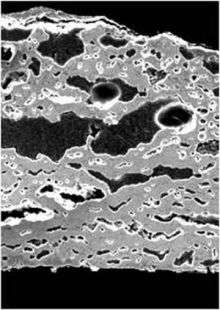
Conventional ceramic coating destroyed by molten glass. The field of view is about half a millimeter. Image by Aysegul Aygun and Nitin Padture, courtesy of Ohio State University
Ohio State University engineers are developing a technology to coat jet engine turbine blades with zirconium dioxide -- commonly called zirconia, the stuff of synthetic diamonds -- to combat high-temperature corrosion.
The zirconia chemically converts sand and other corrosive particles that build up on the blade into a new, protective outer coating. In effect, the surface of the engine blade constantly renews itself.
Ultimately, the technology could enable manufacturers to use new kinds of heat-resistant materials in engine blades, so that engines will be able to run hotter and more efficiently.
Nitin Padture, professor of materials science and engineering at Ohio State, said that he had military aircraft in mind when he began the project. He was then a professor at the University of Connecticut.
“In the desert, sand is sucked into the engines during takeoffs and landings, and then you have dust storms,” he said. “But even commercial aircraft and power turbines encounter small bits of sand or other particles, and those particles damage turbine blades.”
Jet engines operate at thousands of degrees Fahrenheit, and blades in the most advanced engines are coated with a thin layer of temperature-resistant, thermally-insulating ceramic to protect the metal blades. The coating -- referred to as a thermal-barrier coating -- is designed like an accordion to expand and contract with the metal.
The problem: When sand hits the hot engine blade it melts -- and becomes glass.
“Molten glass is one of the nastiest substances around. It will dissolve anything,” Padture said.
The hot glass chews into the ceramic coating. But the real damage happens after the engine cools, and the glass solidifies into an inflexible glaze on top of the ceramic. When the engine heats up again and the metal blades expand, the ceramic coating can’t expand, because the glaze has locked it in place. The ceramic breaks off, shortening the life of the engine blades.
In a recent issue of the journal Acta Materialia, Padture and his colleagues described how the new coating forces the glass to absorb chemicals that will convert it into a harmless -- and even helpful -- ceramic.
The key, Padture said, is that the coating contains aluminum and titanium atoms hidden inside zirconia crystals. When the glass consumes the zirconia, it also consumes the aluminum and titanium. Once the glass accumulates enough of these elements, it changes from a molten material into a stable crystal, and it stops eating the ceramic.
“The glass literally becomes a new ceramic coating on top of the old one. Then, when new glass comes in, the same thing will happen again. It’s like it’s constantly renewing the coating on the surface of the turbine,” Padture said.
Padture’s former university has applied for a patent on the technique that he devised for embedding the aluminum and titanium into the zirconia. He’s partnering with Inframat Corp., a nanotechnology company in Connecticut, to further develop the technology.
Padture stressed that the technology is in its infancy. He has yet to apply the coatings to complex shapes, and cost is a barrier as well: the process is energy-consuming.
But if that cost eventually came down and the technology matured, the payoff could be hotter engines that burn fuel more efficiently and create less pollution. Manufacturers would be able to use more sophisticated ceramics that boost the heat-resistance of engines. Eventually, technology could go beyond aircraft and power-generator turbines and extend to automobiles as well, Padture said.
Source: Ohio State University
-
Ceramic coatings may protect jet engines from volcanic ash
Apr 13, 2011 |
4.7 / 5 (3) |
0
-
Mt. Redoubt Gives Alaskans a Taste of the Moon
Apr 06, 2009 |
5 / 5 (2) |
1
-
Photovoltaic panels made from plant material could become a cheap alternative to traditional solar cells
Feb 03, 2012 |
4.8 / 5 (9) |
0
-
New sensation: Phones that let you feel the world
Jan 12, 2012 |
5 / 5 (3) |
2
-
Demonstration of ultra-high speed piezoelectric thin film with nanodomain structure
Dec 22, 2011 |
not rated yet |
0
-
Engineers build first sub-10-nm carbon nanotube transistor
Feb 01, 2012 |
4.9 / 5 (30) |
30
-
Something old, something new: Evolution and the structural divergence of duplicate genes
Jan 31, 2012 |
4.6 / 5 (7) |
1
-
The hidden nanoworld of ice crystals: Revealing the dynamic behavior of quasi-liquid layers
Jan 30, 2012 |
5 / 5 (3) |
1
-
Stock market network reveals investor clustering
Jan 27, 2012 |
3.9 / 5 (23) |
8
-
Of microchemistry and molecules: Electronic microfluidic device synthesizes biocompatible probes
Jan 26, 2012 |
5 / 5 (1) |
0
-
excited U-236 decay time in the U235 fission chain
19 hours ago
-
Polar catastrophe?
22 hours ago
-
Large scale field sonication
Feb 09, 2012
-
states and energy of paired electrons in BCS
Feb 08, 2012
-
difference between longitudinal and transverse refractive indices
Feb 08, 2012
-
Monte Carlo simulation
Feb 07, 2012
- More from Physics Forums - Atomic, Solid State, Comp. Physics
More news stories
Hovering not hard if you're top-heavy, researchers find
Top-heavy structures are more likely to maintain their balance while hovering in the air than are those that bear a lower center of gravity, researchers at New York University's Courant Institute of Mathematical Sciences ...
just added |
not rated yet |
0
|
SLAC, Stanford team focuses on high-energy electrons to treat cancer
Accelerator physicists at SLAC and cancer specialists from Stanford are working on a new technology that could dramatically reduce the time needed for cancer radiation treatments. The team ran an initial experiment ...
3 hours ago |
not rated yet |
0
Measurements from high-energy collisions lead to better understanding of why meson particles disappear
For several years, physicists at the Relativistic Heavy Ion Collider (RHIC) at Brookhaven National Laboratory (BNL), USA, have studied an unusual state of matter called the quarkgluon plasma, which they ...
3 hours ago |
not rated yet |
0
Quantum physicist explains $100K offer for proof scaled-up quantum computing is impossible
(PhysOrg.com) -- MIT researcher Scott Aaronson has certainly riled the physics community with his offer this past Friday, of $100,000 to anyone who can prove that scaled-up quantum computing is impossible. ...
Explained: Sigma
It's a question that arises with virtually every major new finding in science or medicine: What makes a result reliable enough to be taken seriously? The answer has to do with statistical significance -- but ...
Feb 09, 2012 |
5 / 5 (14) |
26
New understanding of DNA repair could eventually lead to cancer therapy
A research group in the Faculty of Medicine & Dentistry at the University of Alberta is hoping its latest discovery could one day be used to develop new therapies that target certain types of cancers.
Zuckerberg's focus drives Facebook's ascent
When Mark Zuckerberg showed up to rent Judy Fusco's Los Altos, Calif., house in the fall of 2004, soon after he'd arrived in Silicon Valley, the landlord was immediately struck by his confidence.
Both maternal and paternal age linked to autism
Older maternal and paternal age are jointly associated with having a child with autism, according to a recently published study led by researchers at The University of Texas Health Science Center at Houston (UTHealth).
Night, weekend delivery OK for babies with birth defects
Weekday delivery is no better than night or weekend delivery for infants with birth defects, according to a new study presented today at The Pregnancy Meeting, the Society for Maternal-Fetal Medicine's annual conference. ...
Sonic Cradle lands spot in TED exhibition
A Simon Fraser University graduate student project that melds music, meditation and modern technology has landed a rare spot as an exhibit at TEDActive 2012 in Palm Springs, California this month.
Drug halts organ damage in inflammatory genetic disorder
A new study shows that Kineret (anakinra), a medication approved for the treatment of rheumatoid arthritis, is effective in stopping the progression of organ damage in people with neonatal-onset multisystem inflammatory disease ...
Mar 17, 2008
Rank: 5 / 5 (1)
Mar 18, 2008
Rank: not rated yet