Gecko's 'Active' Tail Key to Preventing Falls and Aerial Maneuvers
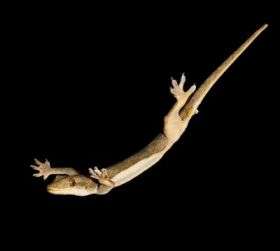
How useful is an animal's tail? For the gecko, unlike most animals, it could be a matter of life or death, according to new research from the University of California, Berkeley.
In a paper appearing this week in the online early edition of the journal Proceedings of the National Academy of Sciences, UC Berkeley biologists report that geckos rely on their tails to keep from falling off vertical surfaces and, if they do fall, to right themselves in midair and maneuver like a skydiver gliding to a safe landing.
The discovery is already helping engineers design better climbing robots and may aid in the design of unmanned gliding vehicles or spacecraft. Perhaps, the researchers say, an "active" tail could help astronauts maneuver in space.
According to senior author Robert J. Full, professor of integrative biology at UC Berkeley, previous experiments on geckos have focused on their unique toes as the key to running up a wall and hanging onto ceilings. Full discovered six years ago that, while claws help geckos climb rough surfaces, millions of microscopic toe hairs make it possible for them to climb smooth ones.
Only when engineers began building gecko-like robots, such as Boston Dynamics Inc.'s RiSE (Robot in Scansorial Environment), the University of Pennsylvania's DynaClimber and Stanford University robots Spinybot and Stickybot - all inspired by Full's findings - did they discover that a tail might be necessary to prevent the robot from pitching backward and falling when it slips on a vertical surface.
When Full and UC Berkeley graduate student Ardian Jusufi went back to the lab to look at how geckos, specifically the flat-tailed house gecko, Cosymbotus platyurus, of Southeast Asia, use their tails, they discovered that the tail is critical for dealing with slippery surfaces.
"When we ran all of our geckos on perfect surfaces, they never slipped, and they didn't use their tails," Full said. "But when we put in a slippery patch, we found that they have an active tail that functions like a fifth leg to keep them from tipping backward. This is an undiscovered function for tails that tells us a lot about how active tails could affect the performance of vertebrates."
With the help of high-speed video, the researchers discovered that when a gecko loses traction with one leg, it taps its tail on the surface to prevent pitch-back until the toes can grab hold again. This all happens in milliseconds, since geckos can run up a wall at speeds of 3 feet per second, stepping and peeling off their toes 30 times per second.
If a gecko loses traction with more than one foot, the researchers found, it will often flatten its tail to the surface to prevent a fall in a move that has the effect, says Full, of a bicycle kickstand. Using either the tail-tapping or tail-flattening technique, nearly all geckos were able to navigate across slippery patches on a vertical wall.
"We were really surprised to see that they could pitch back up to 60 degrees, return to the vertical surface and still traverse the slippery patches," Jusufi said.
The engineers with whom Full collaborates are now devising active tails for their robots to replicate these moves, which in a gecko are probably reflexive, Full said.
The researchers acknowledged the usefulness of tails in other animals: kangaroos lean on theirs; chameleons, lemurs and New World monkeys grasp with theirs; and dinosaurs may have used theirs for balance while running and walking. Unlike these more static uses, however, the gecko's tail actively helps in high-speed vertical climbing and gliding.
During the slippery wall experiments, Jusufi and Full noticed something else about the geckos when they fell. They nearly always made a four-point landing after using their tails to reorient themselves in mid-air. Using high-speed video to record geckos falling upside down from a fake leaf, they found that the geckos rotated their tails so that their bodies counter-rotated to face downward, then spread their legs and toes to parachute. This mid-air maneuver was possible because of the gecko's typically large tail, which can be filled with fat.
While this parachuting had been noticed before by other researchers, the role of the tail was first recognized by Full and Jusufi.
"Air righting in mammals is characterized by a bending and twisting of the spine," Jusufi said. Cats, whose mid-air twists have been particularly well studied since 1894, are able to land on four paws with or without a tail. In contrast, he said, "the gecko is keeping its limbs and spine absolutely immobile in nearly 70 percent of all trials, and only rotates its tail until it turns around."
Moreover, after turning face down, the geckos in the study often used their tails to maneuver in mid-air like a skydiver steering toward a targeted drop zone. In wind tunnel tests, geckos could actually hover in the air stream and, using their tails, steer toward a solid perch.
"Why go into this Superman posture?" Full asked. "We found that it allowed them to use their tails to turn or control yaw and pitch. In the wild, this might allow a gecko escaping a predator to just go off the end of a branch and maneuver to another place."
Pitch refers to a head-down versus tail-down position, while yaw is a rotation to the left or right around a vertical axis.
Jusufi is now observing geckos in the wild to determine how these aerobatic skills serve them in the forest.
"We believe these animals are using their tails instead of their bodies to simplify control," he said. "Geckos reorient mainly around one axis, whereas air-righting maneuvers in mammals involve several axes and appear to require far more coordination."
"This discovery is another example of how basic research leads to unexpected applications - new climbing and gliding robots, highly maneuverable unmanned aerial vehicles and even energy-efficient control in space vehicles," said Full, who directs UC Berkeley's new Center for Interdisciplinary Bio-inspiration in Education and Research (CiBER). CiBER's goal is to discover principles that will inspire engineers from academia and industry to develop new materials and design novel robots, but also to seek feedback from engineering successes and failures to suggest new biological hypotheses.
Jusufi and Full are continuing their study of how the gecko uses its tail, and they plan to look at other lizards to determine how widespread this behavior is.
Source: University of California - Berkeley


