Scientists report first 3-D view of anti-cancer agent
March 18, 2008
Scientists report first 3-D view of anti-cancer agent

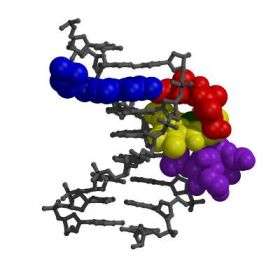
The image shows bleomycin represented in a space-filling rendering bound to DNA, in a gray ball-and-stick rendering. The color scheme highlights the different moieties that make up bleomycin: blue, bithiazole; red, linker; yellow, metal-binding domain; purple, dissacharide; and green, Co (III). Credit: Kristie Goodwin, Ph.D., Indiana University School of Medicine

Researchers from the Indiana University School of Medicine and the Purdue School of Science at Indiana University-Purdue University Indianapolis have created the first three-dimensional image of how a well-established chemotherapy agent targets and binds to DNA. The study, which publishes online the week of March 17 in the Early Edition of the Proceedings of the National Academy of Sciences, may help scientists develop better chemotherapy drugs to treat a wide range of cancers.

Using X-ray crystallography, the scientists produced the first 3-D molecular level images of bleomycin bound to DNA. X-ray crystallography is a widely used analytical technique in which X-rays are directed through crystals and results are deduced from the pattern of diffraction of the X-rays.

“Although bleomycin has been studied for 40 years and much is known about the mechanism of action of bleomycin, without an accurate 3-D picture you can’t fully understand how the drug targets and sits on the DNA. If you want to improve on the properties of the drug, to make it a better chemo agent, you need to understand in great detail how it works,” said Millie M. Georgiadis, Ph.D., associate professor of biochemistry and molecular biology at the IU School of Medicine and at the Purdue School of Science. She and Eric C. Long, Ph.D., professor of chemistry & chemical biology at the Purdue School of Science, are senior authors of the study.

A combination chemotherapy regimen including bleomycin was successfully pioneered at the IU School of Medicine by oncologist Lawrence H. Einhorn, M.D., distinguished professor of medicine. This multi-agent therapy, which mutes the toxicity of bleomycin, is now the standard of care for testicular cancer. Because it causes lung damage, bleomycin is not typically used to treat other cancers.

“Our 3-D picture of the structure of bleomycin gives us a much better understanding of exactly how the drug interacts with the DNA so we can begin thinking about engineering a better drug, with less toxicity. Since it’s a DNA targeting agent, there’s no limit to what type of cancers we could target with bleomycin if we can decrease the toxicity,” said Dr. Georgiadis, a structural biologist.

Many successful chemotherapeutics are DNA targeting agents.

Source: Indiana University


Rank not rated yet
Tags

Relevant PhysicsForums posts
  • Is Everyday Technology Killing Us?
    createdFeb 08, 2012
  • Exercise and weight loss
    createdFeb 08, 2012
  • Why do we have head aches? Our brains can't feel anything.
    createdFeb 07, 2012
  • "The end of diseases" by David Agus, interview from Daily Show with Jon Stewart
    createdFeb 04, 2012
  • Oncolytic adenovirus
    createdFeb 04, 2012
  • Nutrition label stuffs and diets
    createdFeb 02, 2012
  • More from Physics Forums - Medical Sciences

More news stories

Starve a virus, feed a cure? Findings show how some cells protect themselves against HIV

A protein that protects some of our immune cells from the most common and virulent form of HIV works by starving the virus of the molecular building blocks that it needs to replicate, according to research published online ...

Medicine & Health / Research

created 11 hours ago | popularity 5 / 5 (2) | comments 0 | with audio podcast

Overeating may double risk of memory loss

New research suggests that consuming between 2,100 and 6,000 calories per day may double the risk of memory loss, or mild cognitive impairment (MCI), among people age 70 and older. The study was released today and will be ...

Medicine & Health / Neuroscience

created 8 hours ago | popularity 5 / 5 (2) | comments 0 | with audio podcast

Declining health-care productivity in England: Who says so?

Reports that the National Health Service in England has been declining in productivity in the last decade appear to have been accepted as fact. However, a Viewpoint published Online First by The Lancet disputes this. The Vi ...

Medicine & Health / Health

created 6 hours ago | popularity 1 / 5 (1) | comments 0

Injured boomers beware: Know when to see doctor

(AP) -- It happened to nurse Jane Byron years after an in-line skating fall, business owner Haralee Weintraub while doing "men's" push-ups, and avid cyclist Gene Wilberg while lifting a heavy box.

Medicine & Health / Health

created 13 hours ago | popularity 5 / 5 (1) | comments 0

FDA-approved drug rapidly clears amyloid from the brain, reverses Alzheimer's symptoms in mice

Neuroscientists at Case Western Reserve University School of Medicine have made a dramatic breakthrough in their efforts to find a cure for Alzheimer's disease. The researchers' findings, published in the journal Science, show t ...

Medicine & Health / Neuroscience

created Feb 09, 2012 | popularity 4.9 / 5 (58) | comments 17 | with audio podcast


Scientists discover molecular secrets of 2,000-year-old Chinese herbal remedy

For roughly two thousand years, Chinese herbalists have treated Malaria using a root extract, commonly known as Chang Shan, from a type of hydrangea that grows in Tibet and Nepal. More recent studies suggest that halofuginone, ...

New method to examine batteries -- MRI from the inside

There is an ever-increasing need for advanced batteries for portable electronics, such as phones, cameras, and music players, but also to power electric vehicles and to facilitate the distribution and storage of energy derived ...

A mitosis mystery solved: How chromosomes align perfectly in a dividing cell

Although the process of mitotic cell division has been studied intensely for more than 50 years, Whitehead Institute researchers have only now solved the mystery of how cells correctly align their chromosomes during symmetric ...

Google might launch Drive for cloud storage soon

(PhysOrg.com) -- Google's next big move, according to the Wall Street Journal, is a cloud storage service called Drive. Hardly first to the plate, Google is simply catching up to introducing its cloud reposi ...

Lab study raises questions over nano-particle impact

Tests involving chickens have raised questions about the impact on health from engineered nano-particles, the ultra-fine grains commonly used in drugs and processed foods, scientists said on Sunday.

Researchers find extensive RNA editing in human transcriptome

In a new study published online in Nature Biotechnology, researchers from BGI, the world's largest genomics organization, reported the evidence of extensive RNA editing in a human cell line by analysis of RNA-seq data, demons ...