The Vanishing Rings of Saturn
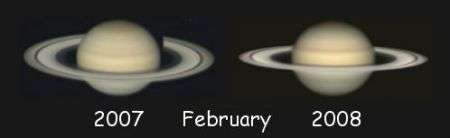
Saturn: jewel of the solar system, taker of breaths, ringed beauty. Even veteran astronomers can't help but gasp when they see her through a small telescope. Red Alert: Saturn's rings are vanishing.
Around the world, amateur astronomers have noticed the change; Saturn's wide open rings are rapidly narrowing into a thin line. Efrain Morales Rivera sends these pictures taken through a backyard telescope in Aguadilla, Puerto Rico (see above).
"The rings have narrowed considerably in the last year," he reports. "The Cassini division (a dark gap in the rings) is getting hard to see."
Four hundred years ago, the same phenomenon puzzled Galileo. Peering through a primitive spy glass, he discovered Saturn's rings in 1610 and immediately wrote to his Medici patrons: "I found another very strange wonder, which I should like to make known to their Highnesses…." He was dumbfounded, however, when the rings winked out little more than a year later.
What happened?
The same thing that's happening now: we're experiencing a "ring plane crossing." As Saturn goes around the sun, it periodically turns its rings edge-on to Earth—once every 14-to-15 years. Because the rings are so thin, they can actually disappear when viewed through a small telescope.
In the months ahead, Saturn's rings will become thinner and thinner until, on Sept. 4, 2009, they vanish. When this happened to Galileo in 1612, he briefly abandoned his study of the planet. Big mistake: ring plane crossings are good times to discover new Saturnian moons and faint outer rings.
It's also a good time to behold Saturn's curiously blue north pole. In 2005 the Cassini spacecraft flew over Saturn's northern hemisphere and found the skies there as azure as Earth itself. Saturn is a planet of golden clouds, but for some reason clouds at high northern latitudes have cleared, revealing a dome of surprising blue.
For years, only Cassini has enjoyed this view because from Earth, the blue top of Saturn was hidden behind the rings. No more: "Now that Saturn's rings are only open 8 degrees, we can finally view its northern hemisphere's beautiful teal blue colored belts and zones, which really did look blue through my 10-inch telescope," reports Dan Petersen of Racine, Wisconsin, who took this picture on Feb. 24, 2008.
Galileo never understood the true nature of Saturn's rings. He didn't know that they were a disk-shaped swarm of orbiting moonlets ranging in size from microscopic dust to tumbling houses. (Scientists still aren't sure, but they may be debris from a shattered moon.) He didn't even know the rings were rings. Through his 17th-century telescope, they looked more like ears or planetary lobes of some kind.
Yet, somehow, his intuition guided him to make a correct prediction: "they'll be back," or Italian words to that effect. And he was right. Saturn's rings opened up again and scientists resumed their study. In 1659, Christaan Huygens correctly explained the periodic disappearances as ring plane crossings. In 1660, Jean Chapelain argued that Saturn's rings were not solid, but made instead of many small particles independently orbiting Saturn. His correct suggestion was not widely accepted for nearly two hundred years.
Almost 27 ring plane crossings later, we still marvel at Saturn. Even with rings diminished, she is still a breathtaking sight through the meanest of telescopes. Indeed, this is a good week to look. On Tuesday, March 18th, and Wednesday, March 19th, the nearly-full Moon and Saturn will be lined up in the same part of the evening sky. That makes Saturn unusually easy to find: Go outside after sunset and look around for the Moon; Saturn is the bright golden "star" nearby.
Point your telescope and, well, just try not to gasp.
Looking Ahead : If you miss the March 18-19 encounter, try again on April 14-15. The Moon and Saturn will be close together and the rings even narrower. Mark your calendar!
Source: by Dr. Tony Phillips, Science@NASA


