UCSD Scientists Develop Sensor for Homemade Bombs
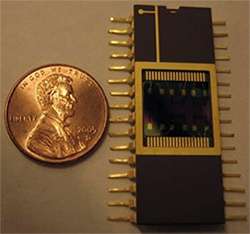
A team of chemists and physicists at the University of California, San Diego has developed a tiny, inexpensive sensor chip capable of detecting trace amounts of hydrogen peroxide, a chemical used in the most common form of homemade explosives.
The invention and operation of this penny-sized electronic sensor, capable of sniffing out hydrogen peroxide vapor in the parts-per-billion range from peroxide-based explosives, such as those used in the 2005 bombing of the London transit system, is detailed in a paper in this week’s issue of the Journal of the American Chemical Society.
In addition to detecting explosives, UC San Diego scientists say the sensor could have widespread applications in improving the health of industrial workers by providing a new tool to inexpensively monitor the toxic hydrogen peroxide vapors from bleached pulp and other products to which factory workers are exposed.
“The detection capability of this tiny electronic sensor is comparable to current instruments, which are large, bulky and cost thousands of dollars each,” said William Trogler, a professor of chemistry and biochemistry at UCSD and one of its inventors. “If this device were mass produced, it’s not inconceivable that it could be made for less than a dollar.”
The device was invented by a team led by Trogler; Andrew Kummel, a professor of chemistry and biochemistry; and Ivan Schuller, a professor of physics. Much of the work was done by UCSD chemistry and physics graduate students Forest Bohrer, Corneliu Colesniuc and Jeongwon Park.
The sensor works by monitoring the variability of electrical conductivity through thin films of “metal phthalocyanines.” When exposed to most oxidizing agents, such as chlorine, these metal films show an increase in electrical current, while reducing agents have the opposite effect—a decrease of electrical current.
But when exposed to hydrogen peroxide, an oxidant, the metal phthalocyanine films behave differently depending on the type of metal used. Films made of cobalt phthalocyanine show decreases in current, while those made from copper or nickel show increases in current.
The UCSD team used this unusual trait to build their sensor. It is composed of thin films of both cobalt phthalocyanine and copper phthalocyanine to display a unique signature whenever tiny amounts of hydrogen peroxide are present.
Bombs constructed with hydrogen peroxide killed more than 50 people and injured 700 more on two London subway trains and a transit bus during rush hour on July 7, 2005. More than 1,500 pounds of a hydrogen peroxide-based mixture was discovered after an alleged bomb plot in Germany that resulted in the widely publicized arrest last September of three people.
Trogler said that because the team’s sensor is so little affected by water vapor, it can be used in industrial and other “real-life applications.” The university has applied for a patent on the invention, which has not yet been licensed.
A copy of the paper can be obtained at: http://pubs.acs.org/cgi-bin/abstract.cgi/jacsat/asap/abs/ja710324f.html
Source: University of California - San Diego


