Need New Look? Online Makeover is fan-taaz-tic
March 18, 2008
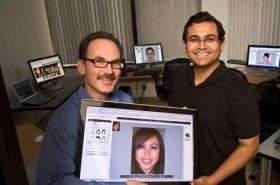
Thanks to a Jacobs School startup company whose site, Taaz.com went live today, the cosmetics counter isn't the only place to try out the latest makeup trends. The new way is easier, faster, and much more private. Anyone with a digital photograph can now apply more than 4,000 makeup products with the click of a mouse. It's all at www.taaz.com - the creation of two Jacobs School computer scientists turned entrepreneurs.
The computer scientists invented an algorithm for separating gloss from non-gloss in digital images - a technical feat crucial for taaz.com's patented approach to applying photorealistic makeup to images. It is also useful for more traditional computer vision applications like face recognition.
Taaz.com is easy and free. Simply upload a portrait-style photograph and a computer vision system automatically identifies your eyes, nose, lips and cheeks. From here, you can apply thousands of makeup products from a wide range of brands to your digital portrait and experiment with new hairstyles and colored contacts. After trying a taaz.com prototype, one user went home and bought a new pair of colored contacts, says David Kriegman, a UCSD computer science professor and taaz.com co-founder.
Once you create a new look, you can share it with friends, post the picture in taaz.com's public gallery or upload it to social networking sites. To make shopping easier, you can print a list of what you tried on at taaz.com.
"With taaz.com, we take something very complicated -- giving digital portraits a photorealistic makeover -- and make it very easy," says Satya Mallick, a taaz.com co-founder with a fresh Ph.D. in electrical engineering from UCSD.
Mallick's dissertation focused on the gloss removal algorithm that led to taaz.com.
Kriegman, Mallick and third co-founder Kevin Barnes secured venture funding from iSherpa Capital in August 2007. They hired three recent UCSD grads. Kriegman credits the Jacobs School's von Liebig Center, UCSD's Technology Transfer and Intellectual Property Services, and CONNECT's Springboard program for helping the team develop and spin out their business, license the core technology, and secure venture capital.
Watch a two-minute demo of Taaz.com here: http://www.youtube … =wGE2zGQypbA
Source: University of California, San Diego
-
Engineers build first sub-10-nm carbon nanotube transistor
Feb 01, 2012 |
4.9 / 5 (33) |
30
-
Something old, something new: Evolution and the structural divergence of duplicate genes
Jan 31, 2012 |
4.6 / 5 (7) |
1
-
The hidden nanoworld of ice crystals: Revealing the dynamic behavior of quasi-liquid layers
Jan 30, 2012 |
5 / 5 (5) |
1
-
Stock market network reveals investor clustering
Jan 27, 2012 |
3.9 / 5 (23) |
8
-
Of microchemistry and molecules: Electronic microfluidic device synthesizes biocompatible probes
Jan 26, 2012 |
5 / 5 (2) |
0
-
Quantum computer faster than regular computer?
1 hour ago
-
Flushing RAM in Mathematica
6 hours ago
-
Synergistic relations between computer science and technology.
Feb 06, 2012
-
how do iphone gloves work?
Feb 05, 2012
-
iPhone battery over time
Jan 30, 2012
-
Best alternate Tablet to an iPad for writing math or physics equations?
Jan 26, 2012
- More from Physics Forums - Computing & Technology
More news stories
The joy of cheques
An electronic cheque which eliminates the need for costly processing by banks but preserves the simplicity and ease of a traditional cheque book has been designed by a team of academics in the UK.
58 minutes ago |
not rated yet |
0
Research shows promise in converting camelina oil into jet fuel
(PhysOrg.com) -- Researchers at Montana State University-Northern have developed a process to convert camelina oil to jet fuel and other high-value chemicals. MSU has applied for a U.S. patent and research is ongoing.
Technology / Energy & Green Tech
55 minutes ago |
not rated yet |
0
Thomas Edison inspires the oscar awards you don't see
Thomas Edison's invention of the first motion picture camera in 1891 inspired scientific and technological advances that he never could have imagined.
Technology / Hi Tech & Innovation
9 minutes ago |
not rated yet |
0
Cutting our carbon footprint
Roofing materials that double as solar panels and can also moderate the temperature of buildings are among the next-generation building products being developed at UNSW.
Technology / Energy & Green Tech
44 minutes ago |
not rated yet |
0
The art of shutting down a nuclear plant
Gaëtan Girardin, researcher in nuclear engineering, gives us the key to understanding nuclear reactor safety. While the disaster at Fukushima is at the center of our conversation, the recent and minor ...
Technology / Energy & Green Tech
36 minutes ago |
not rated yet |
0
With climate change, today's '100-year floods' may happen every three to 20 years: research
Last August, Hurricane Irene spun through the Caribbean and parts of the eastern United States, leaving widespread wreckage in its wake. The Category 3 storm whipped up water levels, generating storm surges ...
Researchers make better heat sensor based on butterfly wings
(PhysOrg.com) -- Scientists have long known that butterfly wings produce their iridescent colors by bouncing light around and between tiny ridges in structures made of chitin. More recently they’ve discovered ...
Manipulating genes with hidden TALENs
(PhysOrg.com) -- A better understanding of gene function in model plant and animal systems could be used to develop useful traits in livestock and crop plants, and might someday lead to developments in stem ...
Couples in the same place emotionally stay together, study says
(Medical Xpress) -- Despite lifes ups and downs, couples whose feelings are in sync consistently over time are more likely to stay together, says a University of California, Davis, study.
Researchers make breakthrough in stem cell research
(Medical Xpress) -- University of Queensland scientists have developed a world-first method for producing adult stem cells that will substantially impact patients who have a range of serious diseases.
Georgia Tech develops software for the rapid analysis of foodborne pathogens
2011 brought two of the deadliest bacterial outbreaks the world has seen during the last 25 years. The two epidemics accounted for more than 4,200 cases of infectious disease and 80 deaths. Software developed at Georgia Tech ...