Natural Selection and the Human Skull

March 18, 2008

New research led by UC Davis anthropologist Tim Weaver adds to the evidence that chance, rather than natural selection, best explains why the skulls of modern humans and ancient Neanderthals evolved differently. The findings may alter how anthropologists think about human evolution.

Weaver's study appears in the March 17 issue of the Proceedings of the National Academy of Sciences.

It builds on findings from a study he and his colleagues published last year in the Journal of Human Evolution, in which the team compared cranial measurements of 2,524 modern human skulls and 20 Neanderthal specimens.
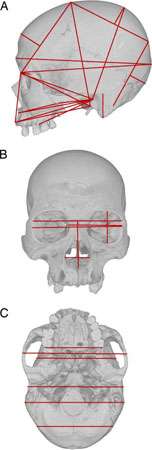
Natural Selection and the Human Skull

The approximate locations of the cranial measurements used in the analyses are superimposed as red lines on lateral (A), anterior (B), and inferior (C) views of a human cranium. (National Academy of Sciences, PNAS (Copyright 2008))

The researchers concluded that random genetic change, or genetic drift, most likely account for the cranial differences.

In their new study, Weaver and his colleagues crunched their fossil data using sophisticated mathematical models -- and calculated that Neanderthals and modern humans split about 370,000 years ago. The estimate is very close to estimates derived by other researchers who have dated the split based on clues from ancient Neanderthal and modern-day human DNA sequences.

The close correlation of the two estimates -- one based on studying bones, one based on studying genes -- demonstrates that the fossil record and analyses of DNA sequences give a consistent picture of human evolution during this time period.

"A take-home message may be that we should reconsider the idea that all morphological (physical) changes are due to natural selection, and instead consider that some of them may be due to genetic drift," Weaver said. "This may have interesting implications for our understanding of human evolution."

Weaver conducted the research with Charles Roseman, an anthropologist at the University of Illinois at Urbana-Champaign, and Chris Stringer, a paleontologist at the Natural History Museum in London.

Source: UC Davis


Rate this story - 4.4 /5 (30 votes)

Rank Filter

Move the slider to adjust rank threshold, so that you can hide some of the comments.


Display comments: newest first

  • AJW - Mar 19, 2008
    • Rank: 1 / 5 (1)
    Natural selection does produce "all"
    change. The "genetic drift" defines
    natual selection precision or said
    another way, 'It is the measure of
    environmental tolerance.'

March 18, 2008 all stories

Comments: 1

4.4 /5 (30 votes)

  • hide
  • Related Stories

  • 38 percent of world's surface in danger of desertification
    created 13 hours ago | popularity not rated yet | comments 0
  • Understanding past and future climate
    created Feb 05, 2010 | popularity not rated yet | comments 0
  • Mining destruction for data to help others
    created Feb 04, 2010 | popularity not rated yet | comments 0
  • Soft intelligence for hard decisions
    created Feb 04, 2010 | popularity not rated yet | comments 0
  • 3-D scaffold provides clean, biodegradable structure for stem cell growth
    created Feb 02, 2010 | popularity not rated yet | comments 0


Other News

bee

Are bees also addicted to caffeine and nicotine?

Biology / Plants & Animals

created 53 minutes ago | popularity 5 / 5 (2) | comments 2 | with audio podcast

A study carried out at the University of Haifa has found that bees prefer nectar with a small concentration of caffeine and nicotine over nectar that does not comprise these substances at all. "This could ...


giant oarfish

Bizarre giant oarfish filmed (w/ Video)

Biology / Plants & Animals

created 4 hours ago | popularity 4.4 / 5 (5) | comments 0 | with audio podcast report

(PhysOrg.com) -- A rare giant oarfish, probably the largest bony fish in the ocean, has been filmed off the Gulf of Mexico. This is possibly the first time the fish has been observed in its natural environment.


Scientists crash test DNA's replication machinery

Biology / Cell & Microbiology

created 3 hours ago | popularity 5 / 5 (2) | comments 0 | with audio podcast

(PhysOrg.com) -- Important molecular machines routinely crash into one another while plying their trades on DNA. New research shows that the enzymes that copy DNA before cell division, called replisomes, are the kings of ...


Great tits: birds with character

Great tits: birds with character

Biology / Plants & Animals

created 17 hours ago | popularity 5 / 5 (3) | comments 3 | with audio podcast

(PhysOrg.com) -- In humans and animals alike, individuals differ in sets of traits that we usually refer to as personality. An important part of the individual difference in personality is due to variation ...


Study carried out into biological risks of eating reptiles

Study carried out into biological risks of eating reptiles

Biology / Cell & Microbiology

created 19 hours ago | popularity 3 / 5 (2) | comments 4

Reptiles are bred in captivity primarily for their skins, but some restaurants and population groups also want them for their meat. A study shows that eating these animals can have side effects that call into ...